
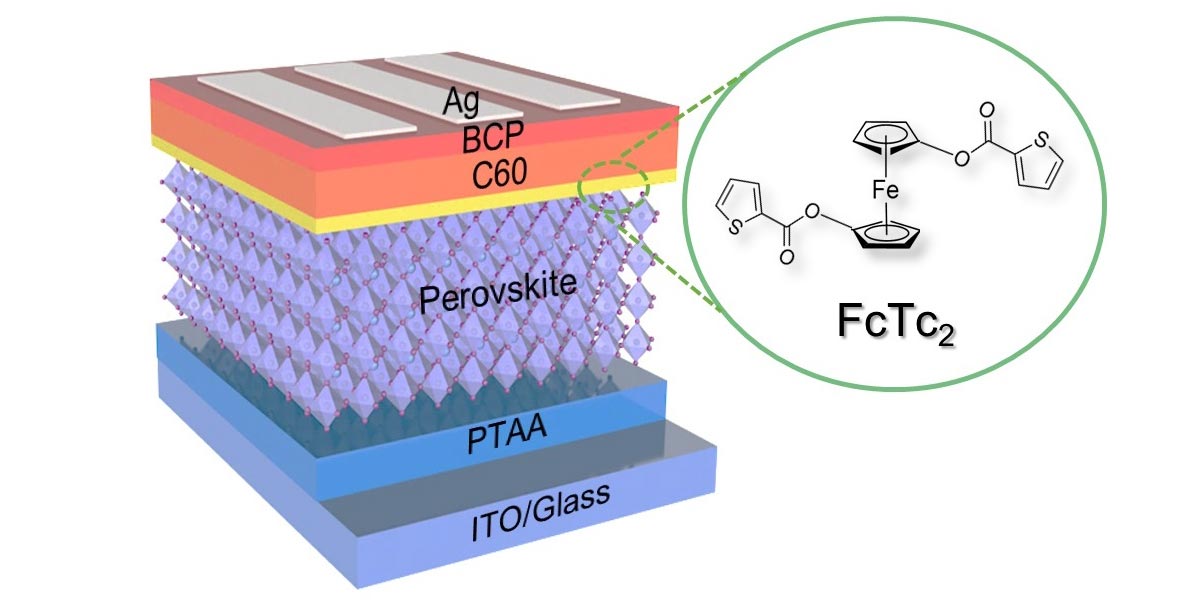
New solar cell devices that are cheaper and easier to make could soon make their way to market thanks to materials made at Imperial College London.
Traditional solar cells are made of silicon, which has high efficiency and stability but is very expensive to produce and can only be manufactured in rigid panels.
Perovskite solar cells offer an intriguing alternative; they can be printed from inks, making them low-cost, thin, lightweight, high efficiency, and flexible. They have, however, lagged behind silicon solar cells in terms of efficiency and, more crucially, stability, breaking down under normal environmental circumstances.
New metal-containing materials called ferrocenes may be able to help solve these problems. Researchers from City University of Hong Kong (CityU) have added Imperial-made ferrocenes into perovskite solar cells, vastly improving their efficiency and stability. The results are published today (April 21, 2022) in the journal Science.
Co-lead author Professor Nicholas Long, from the Department of Chemistry at Imperial, said: “Silicon cells are efficient but expensive, and we urgently need new solar energy devices to accelerate the transition to renewable energy. Stable and efficient perovskite cells could ultimately allow solar energy to be used in more applications – from powering the developing world to charging a new generation of wearable devices.
“Our collaboration with colleagues in Hong Kong was beautifully serendipitous, arising after I gave a talk about new ferrocene compounds and met Dr. Zonglong Zhu from CityU, who asked me to send over some samples. Within a few months, the CityU team told us the results were exciting, and asked us to send more samples, beginning a research program that has resulted in perovskite devices that are both more efficient and more stable.”
The Power of Ferrocenes
Perovskite forms the ‘light-harvesting’ layer of solar cell devices. However, these devices have been less efficient at converting solar energy into electricity than silicon-based solar cells, primarily because the electrons are less ‘mobile’ – they are less able to move from the harvesting layer to the electricity conversion layers.
Ferrocenes are compounds with iron at their center, surrounded by sandwiching rings of carbon. The unique structure of ferrocene was first recognized by Imperial’s own Nobel Prize-winner Professor Geoffrey Wilkinson in 1952, and ferrocenes are still being researched around the world today for their unique properties.
One property their structure gives them is excellent electron richness, which in this case allows electrons to move more easily from the perovskite layer to subsequent layers, improving the efficiency of converting solar energy to electricity.
Tests performed by the team CityU and in commercial labs show that the efficiency of perovskite devices with an added ferrocene layer can reach 25%, approaching the efficiency of traditional silicon cells.
Two Birds With One Stone
But this isn’t the only problem the ferrocene-based materials solved. The team at Imperial has been experimenting with attaching different chemical groups to the carbon rings of ferrocene, and after sending the Hong Kong team several versions of these, made by PhD student Stephanie Sheppard, the collaborators discovered a version that significantly improves the attachment of the perovskite layers to the rest of the device.
This added attachment power improved the stability of the devices, meaning they maintained more than 98% of their initial efficiency after continuously operating at maximum power for 1,500 hours. The efficiency and stability gained thanks to the addition of a ferrocene layer bring these perovskite devices close to current international standards for traditional silicon cells.
Lead researcher Dr. Zonglong Zhu from CityU said: “We are the first team to successfully boost the inverted perovskite solar cell to a record-high efficiency of 25% and pass the stability test set by the International Electrotechnical Commission.”
The team has patented their design and hopes to license it, eventually bringing their perovskite devices to the market. In the meantime, they are experimenting with different ferrocene designs to further improve the performance and stability of the devices.
Reference: “Organometallic-functionalized interfaces for highly efficient inverted perovskite solar cells” by Zhen Li, Bo Li, Xin Wu, Stephanie A. Sheppard, Shoufeng Zhang, Danpeng Gao, Nicholas J. Long and Zonglong Zhu 21 April 2022, Science.
DOI: 10.1126/science.abm8566
Never miss a breakthrough: Join the SciTechDaily newsletter.
Follow us on Google and Google News.