
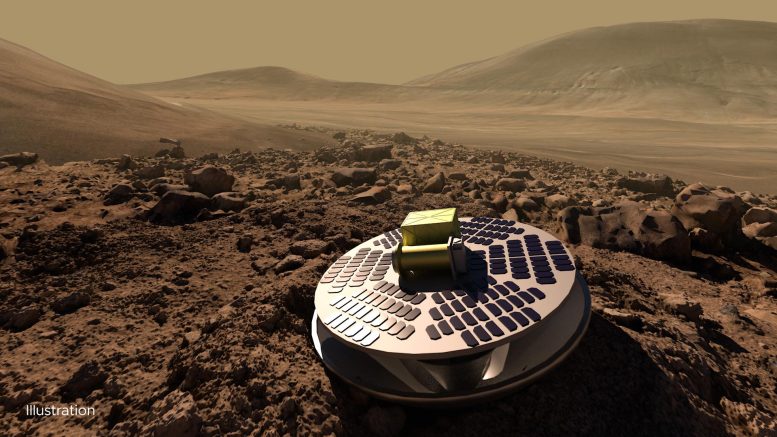
The experimental SHIELD lander is designed to absorb a hard impact like a car’s crumple zone.
NASA has successfully landed spacecraft on Mars nine times, using cutting-edge parachutes, massive airbags, and jetpacks to safely touch down on the surface. Now engineers are investigating whether or not crashing is the easiest way to get to the Martian surface.
Rather than slow a spacecraft’s high-speed descent before touching down, an experimental lander design called SHIELD (Simplified High Impact Energy Landing Device) would use an accordion-like, collapsible base that acts like the crumple zone of a car and absorbs the energy of a hard impact.
By simplifying the harrowing entry, descent, and landing process, the new design could drastically reduce the cost of landing on Mars. It could also expand options for possible landing sites.
SHIELD is a Mars lander concept that could allow lower-cost missions to visit the Martian surface by using an impact-absorbing, collapsible base to safely crash land. Credit: NASA/JPL-Caltech
“We think we could go to more treacherous areas, where we wouldn’t want to risk trying to place a billion-dollar rover with our current landing systems,” said SHIELD’s project manager, Lou Giersch of NASA’s Jet Propulsion Laboratory in Southern California. “Maybe we could even land several of these at different difficult-to-access locations to build a network.”
Car Crashes, Mars Landings
Much of SHIELD’s design is heavily influenced by work done for NASA’s Mars Sample Return campaign. The first step in that campaign involves the Perseverance rover collecting rock samples in airtight metal tubes. In the future, a spacecraft will carry those Martian samples back to Earth in a small capsule and safely crash land in a deserted location.
Studying approaches for that process led engineers to wonder if the general idea was reversible, said Velibor Cormarkovic, SHIELD team member at JPL.
“If you want to land something hard on Earth, why can’t you do it the other way around for Mars?” he said. “And if we can do a hard landing on Mars, we know SHIELD could work on planets or moons with denser atmospheres.”
To test whether the theory could actually work in practice, engineers needed to prove SHIELD can protect sensitive electronics during landing. The team used a drop tower standing nearly 90 feet (27 meters) at JPL to test how Perseverance’s sample tubes would hold up in a hard Earth landing. It features a giant sling – called a bow launch system – that can hurl an object into the surface at the same speeds reached during a Mars landing.
Cormarkovic previously worked for the auto industry, testing cars that carried crash dummies. In some of those tests, the cars ride on sleds that are accelerated to high speeds and crashed into a wall or deformable barrier. There are a number of ways to accelerate the sleds, including using a sling akin to the bow launch system.
“The tests we’ve done for SHIELD are kind of like a vertical version of the sled tests,” Cormarkovic said. “But instead of a wall, the sudden stop is due to an impact into the ground.”
Smashing Success
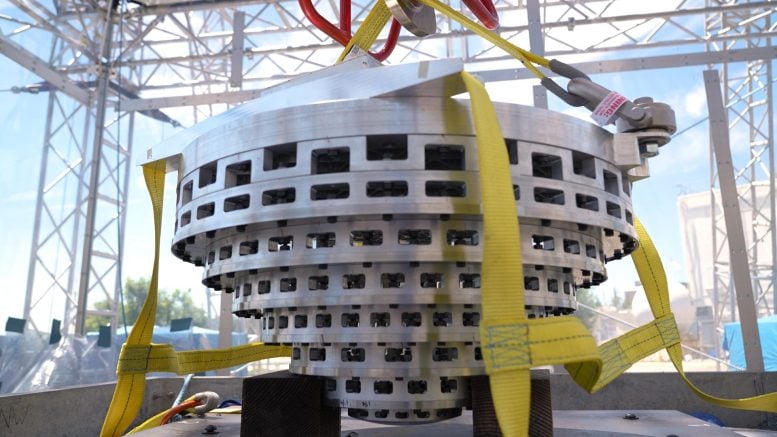
On August 12, the team gathered at the drop tower with a full-size prototype of SHIELD’s collapsible attenuator – an inverted pyramid of metal rings that absorb impact. They hung the attenuator on a grapple and inserted a smartphone, a radio, and an accelerometer to simulate the electronics a spacecraft would carry.
Sweating in the summer heat, they watched SHIELD slowly rise to the top of the tower.
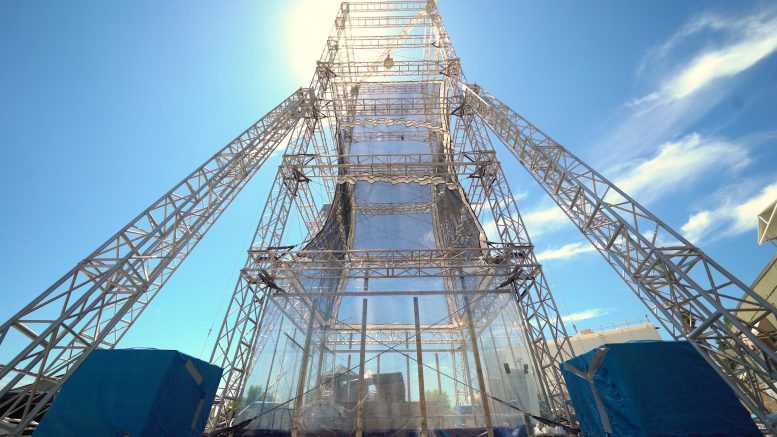
“Hearing the countdown gave me goosebumps,” said Nathan Barba, another SHIELD project member at JPL. “The whole team was excited to see if the objects inside the prototype would survive the impact.”
In just two seconds, the wait was over: The bow launcher slammed SHIELD into the ground at roughly 110 miles per hour (177 kilometers per hour). That’s the speed a Mars lander reaches near the surface after being slowed by atmospheric drag from its initial speed of 14,500 miles per hour (23,335 kilometers per hour) when it enters the Mars atmosphere.
Previous SHIELD tests used a dirt “landing zone,” but for this test, the team laid a steel plate 2 inches (5 centimeters) thick on the ground to create a landing harder than a spacecraft would experience on Mars. The onboard accelerometer later revealed SHIELD impacted with a force of about 1 million newtons – comparable to 112 tons smashing against it.
High-speed camera footage of the test shows that SHIELD impacted at a slight angle, then bounced about 3.5 feet (1 meter) into the air before flipping over. The team suspects the steel plate caused the bounce, since no bounce occurred in the earlier tests.
Upon opening the prototype and retrieving the simulated electronic payload, the team found the onboard devices – even the smartphone – survived.
“The only hardware that was damaged were some plastic components we weren’t worried about,” Giersch said. “Overall, this test was a success!”
The next step? Designing the rest of a lander in 2023 and seeing just how far their concept can go.
Never miss a breakthrough: Join the SciTechDaily newsletter.
Follow us on Google and Google News.
2 Comments
The impact force of 1million newtons does not describe conditions experienced by the electronics. The impact acceleration (in Gs) is more useful to disclose.
When engineers decide it’s just too hard, they’re going to crash anyways, lets just put some bumpers on it. Defund Nasa.