
Close Menu
    Facebook X (Twitter) Instagram
    SciTechDaily
    • Biology
    • Chemistry
    • Earth
    • Health
    • Physics
    • Science
    • Space
    • Technology
    Facebook X (Twitter) Pinterest YouTube RSS
    SciTechDaily
    Home»Space»Shocks in a Distant Gamma-Ray Burst Help Reveal Two General Types of GRBs
    Space

    Shocks in a Distant Gamma-Ray Burst Help Reveal Two General Types of GRBs

    By Harvard-Smithsonian Center for AstrophysicsSeptember 14, 2015No Comments3 Mins Read
    Facebook Twitter Pinterest Telegram LinkedIn WhatsApp Email Reddit
    Share
    Facebook Twitter LinkedIn Pinterest Telegram Email Reddit
    Detection of Shock-Breakout Emission from a Cosmological γ-Ray Burst
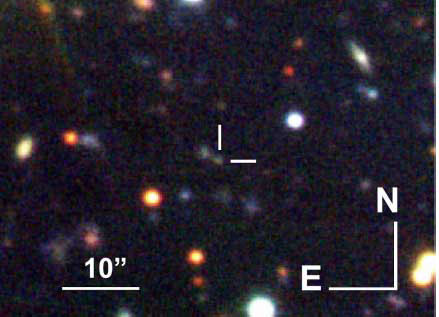
    An optical image of the sky at the location of a faint galaxy (marked with the cross-hairs) where a gamma-ray burst (GRB) was seen last year. Followup studies of the burst and its afterglow find that it originated in a supernova – the death of a massive star – yet also shows signs of shocks more typically originating in GRBs from merging binary stars.

    New research form the Harvard-Smithsonian Center for Astrophysics shows that shocks in a distant gamma-ray burst originated in a supernova.

    Gamma-ray bursts (GRBs)–flashes of high-energy light occur about once a day, randomly, from around the sky–are the brightest events in the known universe. While a burst is underway, it is many millions of times brighter than an entire galaxy. Astronomers are anxious to decipher their nature not only because of their dramatic energetics, but also because their tremendous brightness enables them to be seen across cosmological distances and times, providing windows into the young universe.

    There appear to be two general types of GRBs: those associated with the deaths of massive stars, and ones believed to originate from the coalescence of two extreme objects (neutron stars or black holes) that had been orbiting each other in a binary system. In general, the two types can be distinguished by the lengths of their bursts, the former lasting longer than a few seconds, while the latter is briefer. Astronomers think that, despite the differences, both kinds of GRBs have hot discs accreting material leading to the production of bipolar jets of charged particles moving at relativistic speeds. In the standard model, shocks internal to the fireball produce the gamma rays in the first (longer duration) case, while shocks from the jets’ interactions with the external medium produce the initial burst of gamma rays in the second case. Many details are similar in both scenarios, however, while some others vary according to the type, and astronomers have been trying to constrain these various parameters so that they can trace the origin of each GRB more precisely.

    CfA astronomer Raffaella Margutti and her colleagues used several ground-based telescopes to follow up on a GRB event that went off in June of 2014, examining the afterglow from about three days after the detection to about one hundred and twenty days later. They conclude that the burst is associated with a massive star’s death (a supernova), but find that some of its emission apparently results from shocks external to the fireball as are seen in the less luminous class of GRBs. The results are consistent with the predictions of supernova modeling, but the fact that this object spans both classes highlights the complexity of the sometimes overlapping physical processes at work and the importance of observations at multiple wavelengths.

    Reference: “GRB 140606B/iPTF14bfu: Detection of Shock-Breakout Emission from a Cosmological γ-Ray Burst” by Zach Cano, A. de Ugarte Postigo, D. Perley, T. Kruhler, R. Margutti, M. Friis, D. Malesani, P. Jakobsson, J. P. U. Fynbo, J. Gorosabel, J. Hjorth, R. Sanchez-Ramırez, S. Schulze, N. R. Tanvir, C. C. Thone and D. Xu, 15 July 2015, MNRAS.
    DOI: 10.1093/mnras/stv1327

    Never miss a breakthrough: Join the SciTechDaily newsletter.
    Follow us on Google and Google News.

    Astronomy Astrophysics Black Hole Gamma Ray Harvard-Smithsonian Center for Astrophysics
    Share. Facebook Twitter Pinterest LinkedIn Email Reddit

    Related Articles

    Researchers Study Mysterious Gamma Ray Source with No Known Counterpart

    Astronomers Discover a Gamma-Ray Burst without a Radio Afterglow

    New Research Shows Fast Radio Bursts Might Come From Nearby Stars

    Astronomers Confirm a Reverse Shock in Gamma Ray Burst 130427A

    A Link Between Black Hole Accretion Rate and Star Formation Rate

    Astronomers Measure a Black Hole’s “Point of No Return”

    Cloud of Hydrogen and Helium Plunging Toward the Galactic Center

    Study Challenges Prevailing Ideas About How Supermassive Black Holes Grow

    Gamma-Ray Beams Suggest Milky Way’s Central Black Hole Had Active Past

    Leave A Reply Cancel Reply

    • Facebook
    • Twitter
    • Pinterest
    • YouTube

    Don't Miss a Discovery

    Subscribe for the Latest in Science & Tech!

    Trending News

    Why Popular Diabetes Drugs Like Ozempic Don’t Work for Everyone: The “Genetic Glitch”

    Scientists Stunned After Finding Plant Thought Extinct for 60 Years

    Scientists Discover Tiny New Spider That Hunts Prey 6x Its Size

    Natural Component From Licorice Shows Promise for Treating Inflammatory Bowel Disease

    Scientists Warn: Popular Sweetener Linked to Dangerous Metabolic Effects

    Monster Storms on Jupiter Unleash Lightning Beyond Anything on Earth

    Scientists Create “Liquid Gears” That Spin Without Touching

    The Simple Habit That Could Help Prevent Cancer

    Follow SciTechDaily
    • Facebook
    • Twitter
    • YouTube
    • Pinterest
    • Newsletter
    • RSS
    SciTech News
    • Biology News
    • Chemistry News
    • Earth News
    • Health News
    • Physics News
    • Science News
    • Space News
    • Technology News
    Recent Posts
    • Ancient Bacteria Turned a DNA System Into a Cell Skeleton
    • Researchers Finally Solve 50-Year-Old Blood Group Mystery
    • Scientists Discover “Molecular Switch” That Fuels Alzheimer’s Brain Inflammation
    • Hidden Ocean Currents Revealed in Stunning Detail by AI
    • Trees Emit Tiny Lightning Flashes During Storms and Scientists Finally Prove It
    Copyright © 1998 - 2026 SciTechDaily. All Rights Reserved.
    • Science News
    • About
    • Contact
    • Editorial Board
    • Privacy Policy
    • Terms of Use

    Type above and press Enter to search. Press Esc to cancel.