
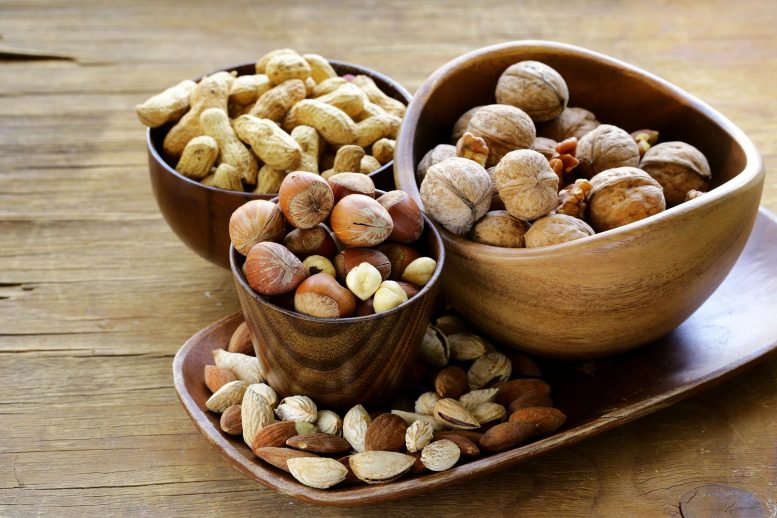
Boosting daily nut consumption linked to less weight gain and lower obesity risk. Substituting half a daily serving of unhealthy foods with nuts may help stave off gradual weight gain, say researchers.
Increasing nut consumption by just half a serving (14 g or ½ oz) a day is linked to less weight gain and a lower risk of obesity, suggests a large, long-term observational study, published in the online journal BMJ Nutrition, Prevention & Health.
Substituting unhealthy foods, such as processed meats, French fries, and crisps (potato chips) with half a serving of nuts may be a simple strategy to ward off the gradual weight gain that often accompanies the aging process, suggest the researchers.
On average, US adults pile on 1lb or nearly half a kilo every year. Gaining 2.5-10 kilos in weight is linked to a significantly greater risk of heart disease/stroke and diabetes.
Nuts are rich in healthy unsaturated fats, vitamins, minerals, and fiber, but they are calorie-dense, so often not thought of as good for weight control. But emerging evidence suggests that the quality of what’s eaten may be as important as the quantity.
Amid modest increases in average nut consumption in the US over the past two decades, the researchers wanted to find out if these changes might affect weight control.
They analyzed information on weight, diet, and physical activity in three groups of people: 51,529 male health professionals, aged 40 to 75 when enrolled in the Health Professionals Follow-Up Study; 121,700 nurses, aged 35 to 55 when recruited to the Nurses Health Study (NHS); and 116,686 nurses, aged 24 to 44 when enrolled in the Nurses Health Study II (NHS II).
Over more than 20 years of monitoring, participants were asked every 4 years to state their weight, and how often, over the preceding year they had eaten a serving (28 g or 1 oz) of nuts, including peanuts and peanut butter.
Average weekly exercise– walking, jogging, cycling, swimming, racquet sports, and gardening–was assessed every two years by questionnaire. It was measured in metabolic equivalent of task (MET) hours, which express how much energy (calories) is expended per hour of physical activity.
The average annual weight gain across all three groups was 0.32 kg (0.71 lb). Between 1986 and 2010, total nut consumption rose from a quarter to just under half a serving/day in men; and from 0.15 to 0.31 servings/day among the women in the NHS study. Between 1991 and 2011 total daily nut consumption rose from 0.07 to 0.31 servings among women in the NHS II study.
Increasing consumption of any type of nut was associated with less long-term weight gain and a lower risk of becoming obese (BMI of 30 or more kg/m²), overall.
Increasing nut consumption by half a serving a day was associated with a lower risk of putting on 2 or more kilos over any 4 year period. And a daily half-serving increase in walnut consumption was associated with a 15% lower risk of obesity.
Substituting processed meats, refined grains, or desserts, including chocolates, pastries, pies, and donuts, for half a serving of nuts was associated with staving off weight gain of between 0.41 and 0.70 kg (0.9 and 1.5 lbs) in any 4-year period.
Within any 4-year period, upping daily nut consumption from none to at least half a serving was associated with staving off 0.74 kg in weight, a lower risk of moderate weight gain, and a 16% lower risk of obesity, compared with not eating any nuts.
And a consistently higher nut intake of at least half a serving a day was associated with a 23% lower risk of putting on 5 or more kilos and of becoming obese over the same timeframe.
No such associations were observed for increases in peanut butter intake.
The findings held true after taking into account changes in diet and lifestyle, such as exercise and alcohol intake.
This is an observational study, and as such, can’t establish cause. And the data relied on the personal report, which may have affected accuracy, while only white, relatively affluent health professionals were included, so the findings may not be more widely applicable.
But the findings echo those of previous observational studies, note the researchers, who attempt to explain the associations they found.
Chewing nuts takes some effort, leaving less energy for eating other things, they suggest, while the high fiber content of nuts can delay stomach emptying so making a person feel sated and full for longer.
Nut fiber also binds well to fats in the gut, meaning that more calories are excreted. And there is some evidence that the high unsaturated fat content of nuts increases resting energy expenditure, which may also help to stave off weight gain.
Snacking on a handful of nuts rather than biscuits or crisps may help to ward off the weight gain that often accompanies aging and is a relatively manageable way of helping to curb the onset of obesity, they suggest.
And a nut habit is likely to be good for the planet, they add. “In addition to the impact on human health, using environmentally friendly plant-based protein, such as nuts and seeds to replace animal sources of protein may contribute to the promotion of a global sustainable food system,” they write.
Reference: “Changes in nut consumption influence long-term weight change in US men and women” by Xiaoran Liu, Yanping Li, Marta Guasch-Ferré, Walter C Willett, Jean-Philippe Drouin-Chartier, Shilpa N Bhupathiraju and Deirdre K Tobias, 23 September 2019, BMJ Nutrition, Prevention & Health.
DOI: 10.1136/bmjnph-2019-000034
Never miss a breakthrough: Join the SciTechDaily newsletter.
Follow us on Google and Google News.