
Close Menu
    Facebook X (Twitter) Instagram
    SciTechDaily
    • Biology
    • Chemistry
    • Earth
    • Health
    • Physics
    • Science
    • Space
    • Technology
    Facebook X (Twitter) Pinterest YouTube RSS
    SciTechDaily
    Home»Health»Simply Eating Walnuts May Slow Cognitive Decline In At-Risk Elderly
    Health

    Simply Eating Walnuts May Slow Cognitive Decline In At-Risk Elderly

    By Loma Linda University Adventist Health Sciences CenterJanuary 28, 2020No Comments3 Mins Read
    Facebook Twitter Pinterest Telegram LinkedIn WhatsApp Email Reddit
    Share
    Facebook Twitter LinkedIn Pinterest Telegram Email Reddit

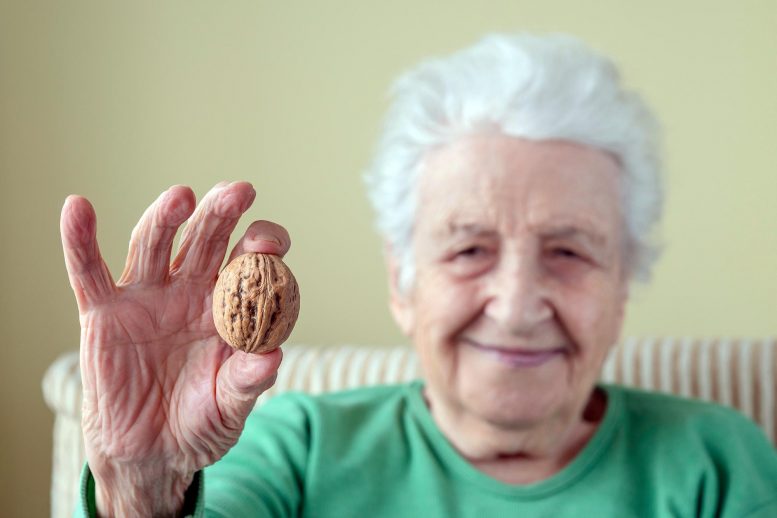
    Senior Woman Holding Walnut

    Two-year study examined walnut consumption among study groups in California and Spain.

    Eating walnuts may help slow cognitive decline in at-risk groups of the elderly population, according to a study conducted by researchers in California and Spain.

    The Walnuts and Healthy Aging Study, published this month in The American Journal of Clinical Nutrition, found that walnut consumption by healthy, elderly adults had little effect on cognitive function over two years, but it had greater effect on elderly adults who had smoked more and had a lower baseline neuropsychological test scores.

    The study examined nearly 640 free-living elders in Loma Linda, California, USA, and in Barcelona, Catalonia, Spain. For two years, the test group included walnuts in their daily diet, and the control group abstained from walnuts.

    Walnuts contain omega-3 fatty acids and polyphenols, which have previously been found to counteract oxidative stress and inflammation, both of which are drivers of cognitive decline.

    Joan Sabaté, MD, DrPH, professor of nutrition and epidemiology at Loma Linda University School of Public Health and the study’s principal investigator, said this was the largest and most well-controlled trial ever conducted on the effects of nuts on cognition.

    “While this was a minor result, it could lead to better outcomes when conducted over longer periods of time,” Sabaté said. “Further investigation is definitely warranted based on our findings, especially for disadvantaged populations, who may have the most to gain from incorporating walnuts and other nuts into their diet.”

    Sabaté and his research team at Loma Linda University were the first to discover the cholesterol-lowering effect of nut consumption — specifically walnuts — with lowering blood cholesterol. Findings were first published in the New England Journal of Medicine in 1993.

    Subsequently, findings from Loma Linda University researchers have linked nut consumption to lower risk of cardiovascular diseases.

    Reference: “Effect of a 2-year diet intervention with walnuts on cognitive decline. The Walnuts And Healthy Aging (WAHA) study: a randomized controlled trial” by Aleix Sala-Vila, Cinta Valls-Pedret, Sujatha Rajaram, Nina Coll-Padrós, Montserrat Cofán, Mercè Serra-Mir, Ana M Pérez-Heras, Irene Roth, Tania M Freitas-Simoes, Mónica Doménech, Carlos Calvo, Anna López-Illamola, Edward Bitok, Natalie K Buxton, Lynnley Huey, Adam Arechiga, Keiji Oda, Grace J Lee, Dolores Corella, Lídia Vaqué-Alcázar, Roser Sala-Llonch, David Bartrés-Faz, Joan Sabaté and Emilio Ros, 7 January 2020, The American Journal of Clinical Nutrition.
    DOI: 10.1093/ajcn/nqz328

    The Walnuts and Healthy Aging Study was funded by a grant from the California Walnut Commission, which had no input in the study design, data collection, analyses, or writing and submission of the manuscript.

    Never miss a breakthrough: Join the SciTechDaily newsletter.
    Follow us on Google and Google News.

    Alzheimer's Disease Food Science Neuroscience Nutrition
    Share. Facebook Twitter Pinterest LinkedIn Email Reddit

    Related Articles

    Scientists Warn That Fructose Could Drive Alzheimer’s Disease

    A High-Fiber Diet May Reduce the Risk of Dementia

    Higher Antioxidant Levels Linked to Lower Alzheimer’s Disease, Dementia Risk

    Essential Amino Acid Supplements Could Prevent Dementia

    Natural Compound in Basil May Protect Against Alzheimer’s Disease

    Eating Just One Serving of Processed Meat a Day Could Increase Dementia Risk by 44%

    The Combination of Foods You Eat Together May Raise Dementia Risk

    Common Nutrient Supplement May Prevent Alzheimer’s Disease

    New Study Shows Fructose Alters Brain Genes, Which Can Lead to Disease

    Leave A Reply Cancel Reply

    • Facebook
    • Twitter
    • Pinterest
    • YouTube

    Don't Miss a Discovery

    Subscribe for the Latest in Science & Tech!

    Trending News

    The Universe Is Expanding Too Fast and Scientists Can’t Explain Why

    “Like Liquid Metal”: Scientists Create Strange Shape-Shifting Material

    Early Warning Signals of Esophageal Cancer May Be Hiding in Plain Sight

    Common Blood Pressure Drug Shows Surprising Power Against Deadly Antibiotic-Resistant Superbug

    Scientists Uncover Dangerous Connection Between Serotonin and Heart Valve Disease

    Scientists Discover a “Protector” Protein That Could Help Reverse Hair Loss

    Bone-Strengthening Discovery Could Reverse Osteoporosis

    Scientists Uncover Hidden Trigger Behind Stem Cell Aging

    Follow SciTechDaily
    • Facebook
    • Twitter
    • YouTube
    • Pinterest
    • Newsletter
    • RSS
    SciTech News
    • Biology News
    • Chemistry News
    • Earth News
    • Health News
    • Physics News
    • Science News
    • Space News
    • Technology News
    Recent Posts
    • Scientists Overcome Major Quantum Bottleneck, Potentially Transforming Teleportation and Computing
    • Quantum Physics’ Strangest Problem May Hold the Key to Time Itself
    • Scientists Create “Liquid Gears” That Spin Without Touching
    • The Simple Habit That Could Help Prevent Cancer
    • Forgotten Medicinal Plant Shows Promise in Fighting Dangerous Superbugs
    Copyright © 1998 - 2026 SciTechDaily. All Rights Reserved.
    • Science News
    • About
    • Contact
    • Editorial Board
    • Privacy Policy
    • Terms of Use

    Type above and press Enter to search. Press Esc to cancel.