
Close Menu
    Facebook X (Twitter) Instagram
    SciTechDaily
    • Biology
    • Chemistry
    • Earth
    • Health
    • Physics
    • Science
    • Space
    • Technology
    Facebook X (Twitter) Pinterest YouTube RSS
    SciTechDaily
    Home»Space»Simulating Supernova Remnants and Star Formation With a High-Power Laser in Earthbound Lab
    Space

    Simulating Supernova Remnants and Star Formation With a High-Power Laser in Earthbound Lab

    By American Institute of PhysicsApril 22, 2022No Comments3 Mins Read
    Facebook Twitter Pinterest Telegram LinkedIn WhatsApp Email Reddit
    Share
    Facebook Twitter LinkedIn Pinterest Telegram Email Reddit
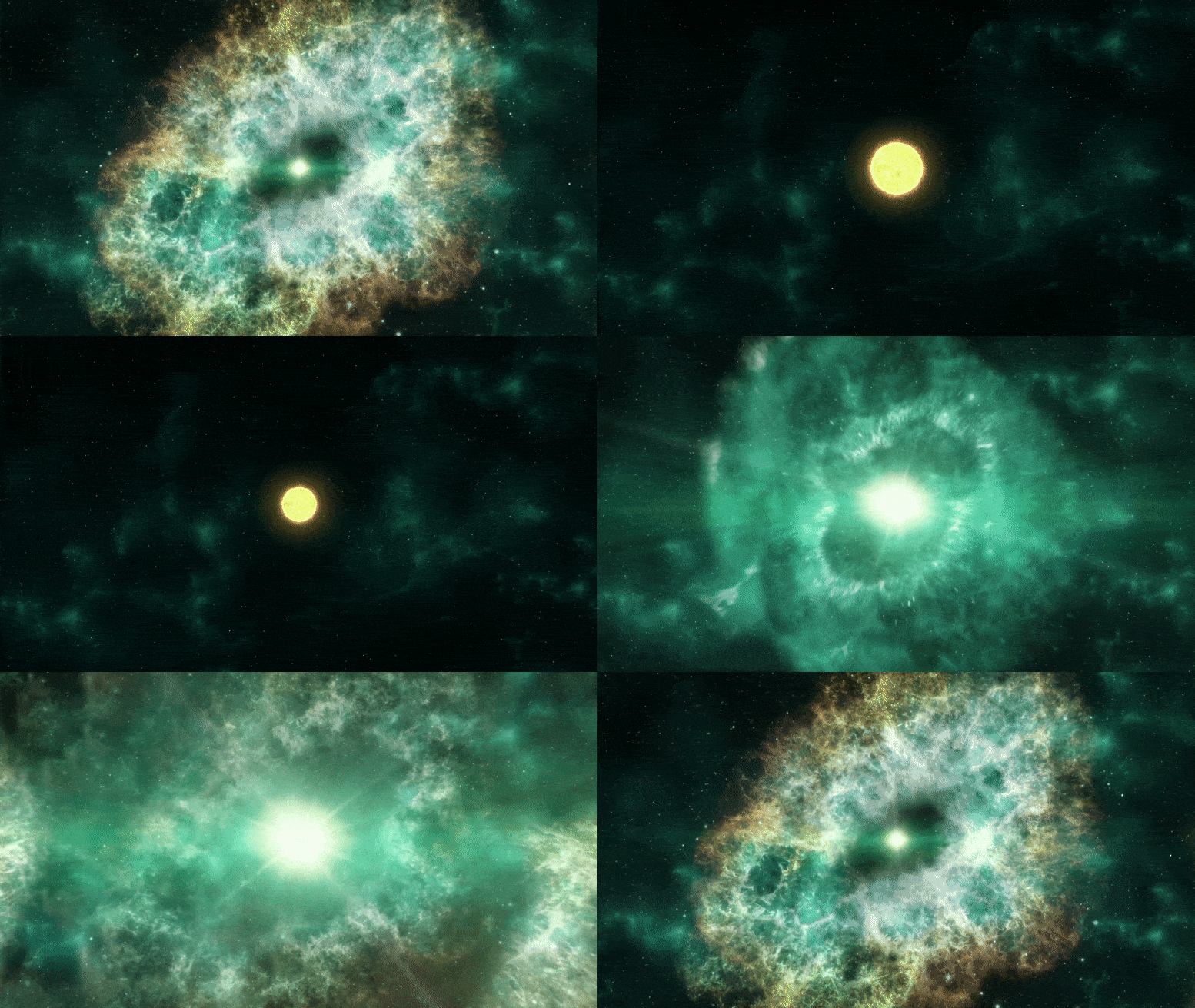
    Supernova Explosion Nebula
    Animation showing the formation of a supernova remnant.

    High-power laser and foam ball show how blast waves from supernova remnant might trigger star formation in a molecular cloud.

    Molecular clouds are collections of gas and dust in space. When left alone, the clouds remain in their state of peaceful equilibrium.

    But when triggered by some external agent, like supernova remnants, shockwaves can propagate through the gas and dust to create pockets of dense material. At a certain limit, that dense gas and dust collapses and begins to form new stars.

    Astronomical observations lack the spatial resolution required to observe these processes, and numerical simulations are incapable of handling the complexities of the interaction between clouds and supernova remnants. As a result, the triggering and formation of new stars in this manner remains mostly shrouded in mystery.

    Using High-Power Lasers to Model Cloud and Supernova Interactions

    In an article that was recently published the journal Matter and Radiation at Extremes, by AIP Publishing in partnership with China Academy of Engineering Physics, researchers modeled the interaction between supernova remnants and molecular clouds using a high-power laser and a foam ball. The study was conducted by scientists from the Polytechnic Institute of Paris, the Free University of Berlin, the Joint Institute for High Temperatures of the Russian Academy of Sciences, the Moscow Engineering Physics Institute, the French Alternative Energies and Atomic Energy Commission, the University of Oxford, and Osaka University.

    The foam ball represents a dense area within a molecular cloud. The high-power laser creates a blast wave that propagates through a surrounding chamber of gas and into the ball, where the team observed the compression using X-ray images.
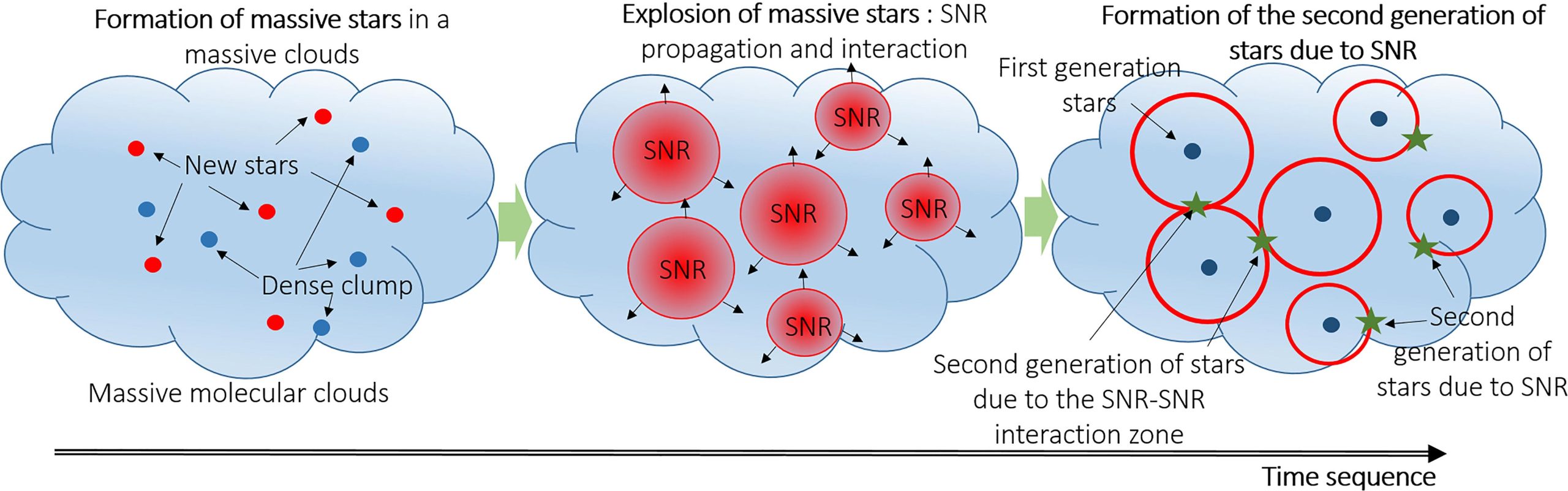
    Evolution of Massive Cloud
    Illustration of the evolution of a massive cloud which indicates the importance of SNR propagation in forming new stars. Credit: Albertazzi et al.

    “We are really looking at the beginning of the interaction,” said author Bruno Albertazzi. “In this way, you can see if the average density of the foam increases and if you will begin to form stars more easily.”

    Insights into Star Formation Triggering Mechanisms

    The mechanisms for triggering star formation are interesting on a number of scales. They can impact the star formation rate and evolution of a galaxy, help explain the formation of the most massive stars, and have consequences in our own solar system.

    “Our primitive molecular cloud, where the sun was formed, was probably triggered by supernova remnants,” said author Albertazzi. “This experiment opens a new and promising path for laboratory astrophysics to understand all these major points.”

    While some of the foam compressed, some of it also stretched out. This changed the average density of the material, so in the future, the authors will need to account for the stretched mass to truly measure the compressed material and the shockwave’s impact on star formation. They plan to explore the influence of radiation, magnetic field, and turbulence.

    “This first paper was really to demonstrate the possibilities of this new platform opening a new topic that could be investigated using high-power lasers,” said Albertazzi.

    Reference: “Triggering star formation: Experimental compression of a foam ball induced by Taylor–Sedov blast waves” by B. Albertazzi, P. Mabey, Th. Michel, G. Rigon, J. R. Marquès, S. Pikuz, S. Ryazantsev, E. Falize, L. Van Box Som, J. Meinecke, N. Ozaki, G. Gregori and M. Koenig, 12 April 2022, Matter and Radiation at Extremes.
    DOI: 10.1063/5.0068689

    Never miss a breakthrough: Join the SciTechDaily newsletter.
    Follow us on Google and Google News.

    American Institute of Physics Astrophysics Stars
    Share. Facebook Twitter Pinterest LinkedIn Email Reddit

    Related Articles

    Astronomers Discover Star Orbiting the Black Hole at Center of the Milky Way

    Ultramassive Stars of Cluster R136 Were Created from the Merger of Lighter Stars

    Examining the Accuracy of the Spectral Energy Distribution Models

    NASA Data Reveals Significant Changes in Exoplanet’s Atmosphere

    Astrophysicists Zero In on How the Universe Responds to Gravity

    Astronomers Discover Radio Emissions From a Brown Dwarf

    Rogue Planets Captured by Stars

    Astronomers Combine Hundreds of Images of Carina Nebula to Reveal Thousands of Stars in Stellar Nursery

    Hubble Observes Rare Blue Stars in Andromeda’s Core

    Leave A Reply Cancel Reply

    • Facebook
    • Twitter
    • Pinterest
    • YouTube

    Don't Miss a Discovery

    Subscribe for the Latest in Science & Tech!

    Trending News

    AI Could Detect Early Signs of Alzheimer’s in Under a Minute – Far Before Traditional Tests

    What if Dark Matter Has Two Forms? Bold New Hypothesis Could Explain a Cosmic Mystery

    This Metal Melts in Your Hand – and Scientists Just Discovered Something Strange

    Beef vs. Chicken: Surprising Results From New Prediabetes Study

    Alzheimer’s Breakthrough: Scientists Discover Key Protein May Prevent Toxic Protein Clumps in the Brain

    Quantum Reality Gets Stranger: Physicists Put a Lump of Metal in Two Places at Once

    Scientists May Have Found the Key to Jupiter and Saturn’s Moon Mystery

    Scientists Uncover Brain Changes That Link Pain to Depression

    Follow SciTechDaily
    • Facebook
    • Twitter
    • YouTube
    • Pinterest
    • Newsletter
    • RSS
    SciTech News
    • Biology News
    • Chemistry News
    • Earth News
    • Health News
    • Physics News
    • Science News
    • Space News
    • Technology News
    Recent Posts
    • What if Your Memories Never Happened? Physicists Take a New Look at the Boltzmann Brain Paradox
    • Students Found an Ancient Star That Shouldn’t Be in the Milky Way
    • Astronomers Solve 50-Year Mystery and Reveal Hidden Culprit Behind Strange X-Ray Emissions
    • One of the Universe’s Largest Stars May Be Getting Ready To Explode
    • Scientists Discover Enzyme That Could Supercharge Ozempic-Like Weight Loss Drugs
    Copyright © 1998 - 2026 SciTechDaily. All Rights Reserved.
    • Science News
    • About
    • Contact
    • Editorial Board
    • Privacy Policy
    • Terms of Use

    Type above and press Enter to search. Press Esc to cancel.