
Close Menu
    Facebook X (Twitter) Instagram
    SciTechDaily
    • Biology
    • Chemistry
    • Earth
    • Health
    • Physics
    • Science
    • Space
    • Technology
    Facebook X (Twitter) Pinterest YouTube RSS
    SciTechDaily
    Home»Space»Six New Infrared Images of Saturn’s Moon Titan Are the Clearest Views To Date
    Space

    Six New Infrared Images of Saturn’s Moon Titan Are the Clearest Views To Date

    By Tony Greicius, NASAJuly 19, 2018No Comments4 Mins Read
    Facebook Twitter Pinterest Telegram LinkedIn WhatsApp Email Reddit
    Share
    Facebook Twitter LinkedIn Pinterest Telegram Email Reddit
    Seeing Titan with Infrared Eyes
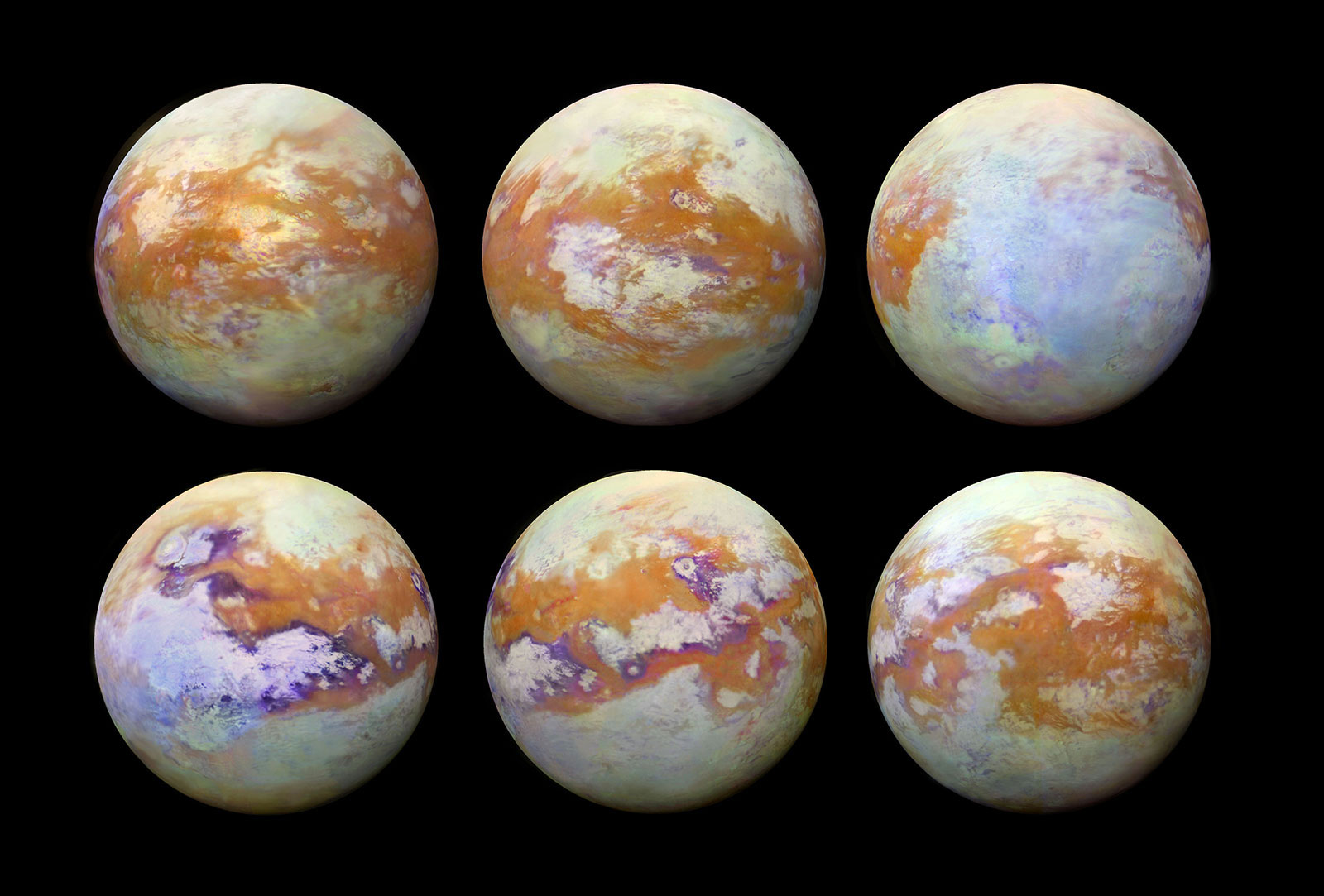
    These six infrared images of Saturn’s moon Titan were created by combining data from a range of Visual and Infrared Mapping Spectrometer (VIMS) observations collected during 13 years of Cassini’s mission. This new collection of images is by far the best representation of how Titan might appear to the casual observer if it weren’t for the moon’s hazy atmosphere. Credit: NASA/JPL-Caltech/Stéphane Le Mouélic, University of Nantes, Virginia Pasek, University of Arizona

    These six infrared images of Saturn’s moon Titan represent some of the clearest, most seamless-looking global views of the icy moon’s surface produced so far. The views were created using 13 years of data acquired by the Visual and Infrared Mapping Spectrometer (VIMS) instrument on board NASA’s Cassini spacecraft. The images are the result of a focused effort to smoothly combine data from the multitude of different observations VIMS made under a wide variety of lighting and viewing conditions over the course of Cassini’s mission.

    Previous VIMS maps of Titan (for example, PIA02145) display great variation in imaging resolution and lighting conditions, resulting in obvious seams between different areas of the surface. With the seams now gone, this new collection of images is by far the best representation of how the globe of Titan might appear to the casual observer if it weren’t for the moon’s hazy atmosphere, and it likely will not be superseded for some time to come.

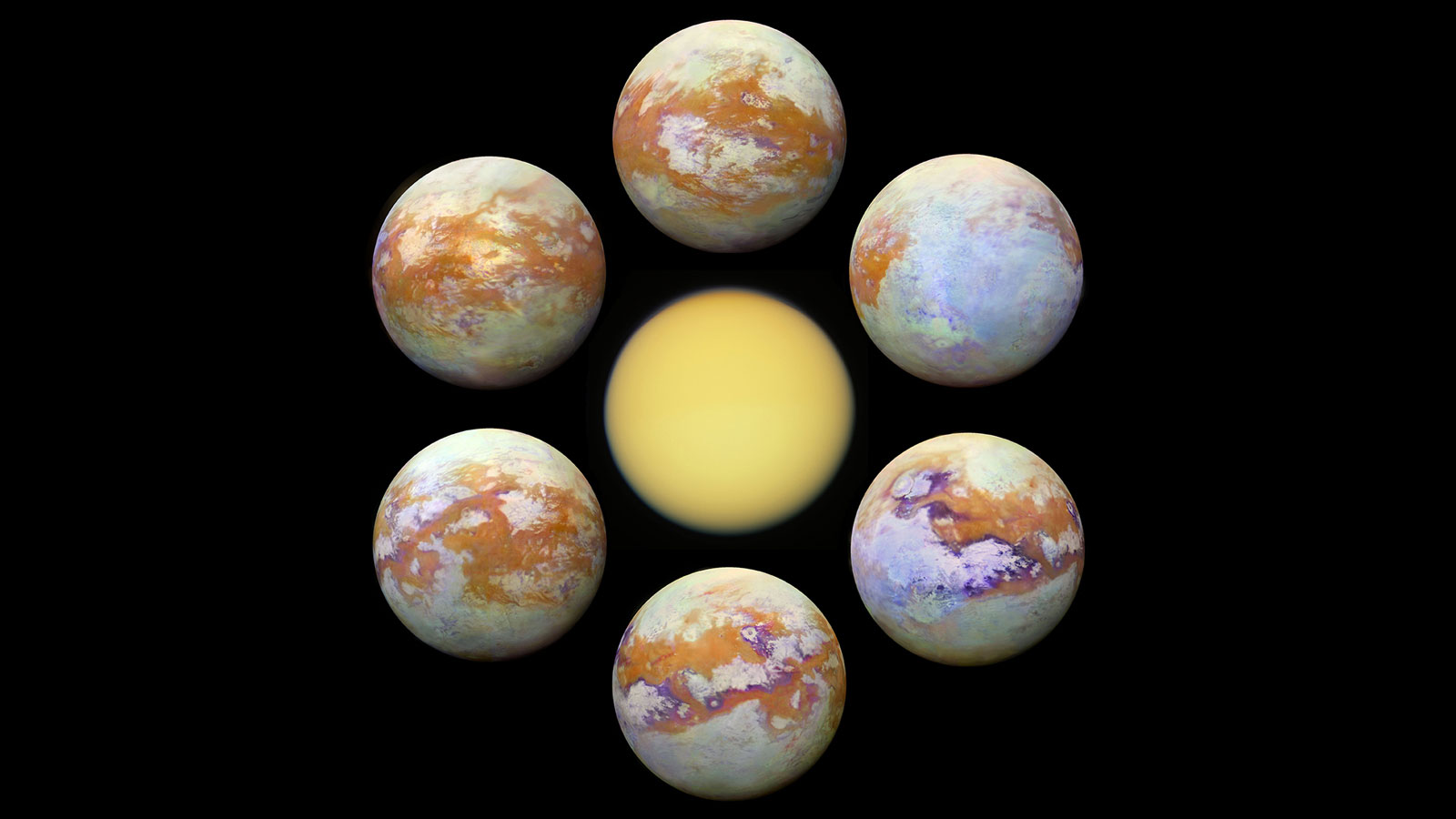
    Observing the surface of Titan in the visible region of the spectrum is difficult, due to the globe-enshrouding haze around the moon. This is primarily because small particles called aerosols in Titan’s upper atmosphere strongly scatter visible light. But Titan’s surface can be more readily imaged in a few infrared “windows” — infrared wavelengths where scattering and absorption of light is much weaker. This is where the VIMS instrument excelled, parting the haze to obtain clear images of Titan’s surface. (For comparison, Figure B shows Titan as it appears in visible light, as does PIA11603.)
    New Infrared Images of Saturn's Moon Titan
    Titan has a complex surface, with numerous geologic features and compositional units, as evidenced by this rare group of photos. Credit: NASA/JPL-Caltech/Stéphane Le Mouélic, University of Nantes, Virginia Pasek, University of Arizona

    Making mosaics of VIMS images of Titan has always been a challenge because the data were obtained over many different flybys with different observing geometries and atmospheric conditions. One result is that very prominent seams appear in the mosaics that are quite difficult for imaging scientists to remove. But, through laborious and detailed analyses of the data, along with time consuming hand processing of the mosaics, the seams have been mostly removed. This is an update to the work previously discussed in PIA20022.

    Any full color image is comprised of three color channels: red, green, and blue. Each of the three color channels combined to create these views was produced using a ratio between the brightness of Titan’s surface at two different wavelengths (1.59/1.27 microns [red], 2.03/1.27 microns [green] and 1.27/1.08 microns [blue]). This technique (called a “band-ratio” technique) reduces the prominence of seams, as well as emphasizing subtle spectral variations in the materials on Titan’s surface. For example, the moon’s equatorial dune fields appear a consistent brown color here. There are also bluish and purplish areas that may have different compositions from the other bright areas, and may be enriched in water ice.

    For a map of Titan with latitudes, longitudes, and labeled surface features, see PIA20713.

    It is quite clear from this unique set of images that Titan has a complex surface, sporting myriad geologic features and compositional units. The VIMS instrument has paved the way for future infrared instruments that could image Titan at much higher resolution, revealing features that were not detectable by any of Cassini’s instruments.

    The Cassini-Huygens mission is a cooperative project of NASA, the European Space Agency, and the Italian Space Agency. NASA’S Jet Propulsion Laboratory, a division of Caltech in Pasadena, manages the mission for NASA’s Science Mission Directorate, Washington. The VIMS team is based at the University of Arizona in Tucson.

    Never miss a breakthrough: Join the SciTechDaily newsletter.
    Follow us on Google and Google News.

    Astronomy Cassini-Huygens Mission Planetary Science Titan
    Share. Facebook Twitter Pinterest LinkedIn Email Reddit

    Related Articles

    Cassini Reveals Clues about Saturn’s Moon Titan

    New Cassini Images of Titan’s Hydrocarbon Seas and Lakes

    NASA’s Cassini Detects Propylene on Titan for the First Time

    Cassini Reveals a Rigid and Weathered Ice Shell on Titan

    Cassini Helps Explain the Mystery of the Missing Waves on Titan

    Cassini Data Confirms PAHs Play Major Role in Production of Lower Haze on Titan

    Scientists Use Cassini Data to Create First Global Topographic Map of Titan

    Titan’s Methane May Run Out

    Cassini Spots a Nile Like River Valley on Titan

    Leave A Reply Cancel Reply

    • Facebook
    • Twitter
    • Pinterest
    • YouTube

    Don't Miss a Discovery

    Subscribe for the Latest in Science & Tech!

    Trending News

    Tea or Coffee? Your Daily Choice Could Affect Osteoporosis Risk

    Vitamin C May Fight Cancer in a Surprising Way

    Hidden Earthquake Threat: Oregon’s Fault May Be Closer to the Surface Than Scientists Thought

    Scientists Discover Hidden Sleep Switch That Boosts Brainpower, Builds Muscle, and Burns Fat

    Ancient Mega-Floods Once Ripped Across Mars and Left This Giant Scar

    Scientists Discover Cheap, Natural Remedy for High Blood Pressure

    Earth’s Upper Atmosphere Is Cooling Fast and Scientists Finally Know Why

    32,000 Olympic Pools of Magma Nearly Erupted Beneath Atlantic Island

    Follow SciTechDaily
    • Facebook
    • Twitter
    • YouTube
    • Pinterest
    • Newsletter
    • RSS
    SciTech News
    • Biology News
    • Chemistry News
    • Earth News
    • Health News
    • Physics News
    • Science News
    • Space News
    • Technology News
    Recent Posts
    • 146,000-Year-Old Discovery Rewrites the Story of Human Creativity
    • The Type of Alcohol You Drink Could Affect How Long You Live
    • 19-Year Study Reveals the Surprising Truth About Sitting and Dementia
    • This Common Vitamin May Help Stop Prediabetes From Turning Into Diabetes
    • Canada’s Billion-Year-Old Rocks Could Hold the Future of Clean Energy
    Copyright © 1998 - 2026 SciTechDaily. All Rights Reserved.
    • Science News
    • About
    • Contact
    • Editorial Board
    • Privacy Policy
    • Terms of Use

    Type above and press Enter to search. Press Esc to cancel.