
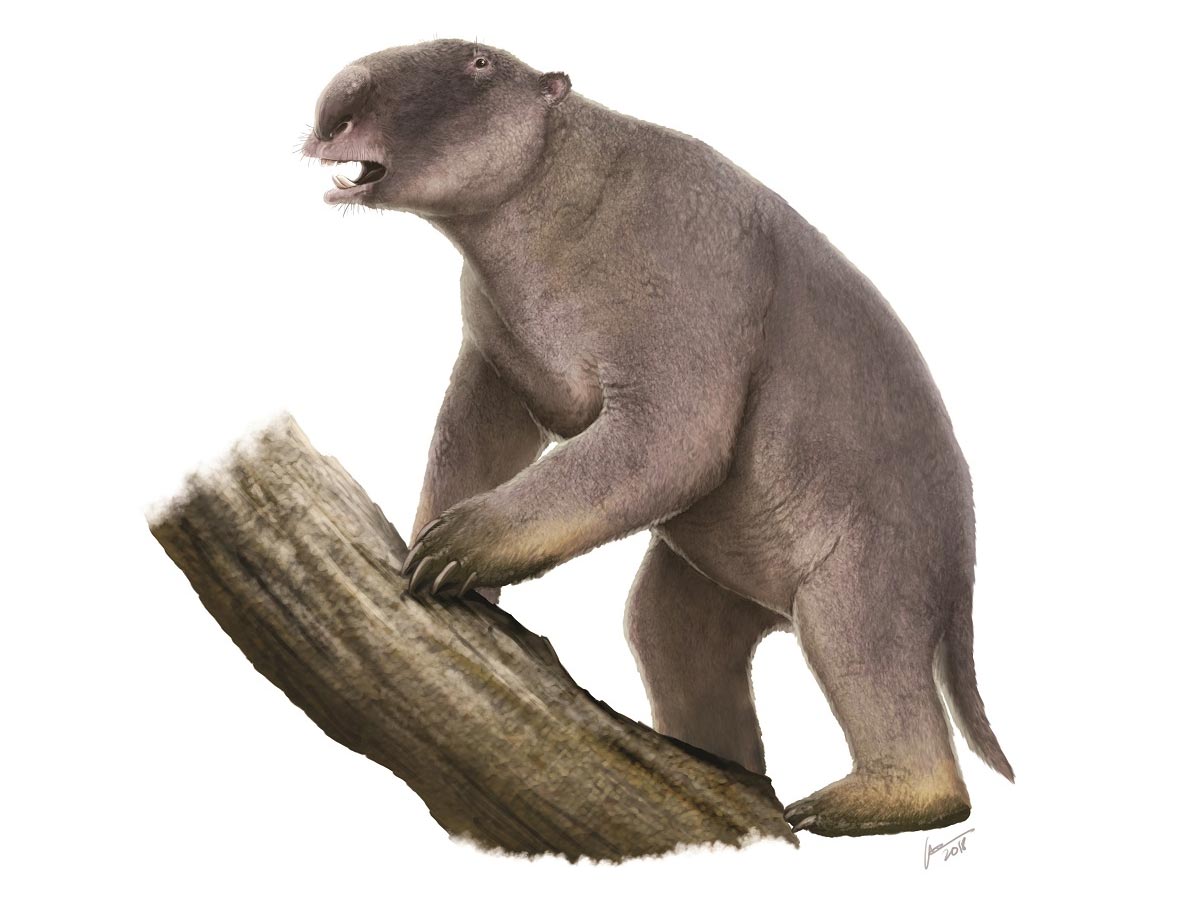
Using simulation models, researchers found that the biological traits of extinct Australian megafauna don’t clearly explain their extinction timing. Local factors, including climate, human hunting, and behavior like burrowing or speed, likely played bigger roles.
Ancient clues, in the shape of fossils and archaeological evidence of varying quality scattered across Australia, have formed the basis of several hypotheses about the fate of megafauna that vanished about 42,000 years ago from the ancient continent of Sahul, comprising mainland Australia, Tasmania, New Guinea, and neighboring islands.
There is a growing consensus that multiple factors were at play, including climate change, the impact of people on the environment, and access to freshwater sources.
Modeling Extinction Risk Through Species Traits
Now, research led by Professor Corey Bradshaw of Flinders University and the Australian Research Council Centre of Excellence of Australian Biodiversity and Heritage (CABAH) has used sophisticated mathematical modeling to assess how susceptible different species were to extinction — and what it means for the survival of creatures today.
Using various characteristics such as body size, weight, lifespan, survival rate, and fertility, they created population simulation models to predict the likelihood of these species surviving under different types of environmental disturbance.
Simulations included everything from increasing droughts to increasing hunting pressure to see which species of 13 extinct megafauna, as well as 8 comparative species still alive today, had the highest chances of surviving.
Published in the journal eLife, Bradshaw and his team compared the results to what we know about the timing of extinction for different megafauna species derived from dated fossil records. They expected to confirm that the most extinction-prone species were the first species to go extinct — but that wasn’t necessarily the case.
While they did find that slower-growing species with lower fertility, like the rhino-sized wombat relative Diprotodon, were generally more susceptible to extinction than more-fecund species like the marsupial ‘tiger’ thylacine, the relative susceptibility rank across species did not match the timing of their extinctions recorded in the fossil record.
“We found no clear relationship between a species’ inherent vulnerability to extinction — such as being slower and heavier and/or slower to reproduce — and the timing of its extinction in the fossil record,” explained Professor Bradshaw.
“In fact, we found that most of the living species used for comparison — such as short-beaked echidnas, emus, brush turkeys, and common wombats — were more susceptible on average than their now-extinct counterparts.”
Localized Pressures Shaped Extinction Patterns
The researchers concluded that the true extinction cascade was likely the result of complex, localized scenarios, including impacts of regional climate variation, and different pressures from people across regions.
Associate Professor Vera Weisbecker of Flinders University and co-author of the study said: “The relative speed of different species to escape hunters, as well as whether or not a species dug protective burrows, also likely contributed to the mismatch between extinction susceptibility and timing.
“For example, fast-hopping red kangaroos still alive today might have had an escape advantage over some of the slower-striding short-faced kangaroos that went extinct. Small wombats that dug burrows might also have been more difficult for people to hunt than the bigger, non-burrowing megafauna.”
Co-author Dr Frédérik Saltré of Flinders University added: “We determined that the kangaroo species were the least-susceptible to extinction based on their biology, followed by the monotremes (echidnas), and the giant ‘wombat’ species. Interestingly, the large, flightless birds, like emu and the giant mihirung ‘thunderbird’ Genyornis, had the highest susceptibilities.
“Our results support the notion that extinction risk can be high across all body sizes depending on a species’ particular ecology, meaning that predicting future extinctions from climate change and human impacts aren’t always straightforward based on the first principles of biology,” concluded Professor Bradshaw.
Reference: “Relative demographic susceptibility does not explain the extinction chronology of Sahul’s megafauna” by Corey JA Bradshaw, Christopher N Johnson, John Llewelyn, Vera Weisbecker, Giovanni Strona and Frédérik Saltré, 30 March 2021, eLife.
DOI: 10.7554/eLife.63870
Never miss a breakthrough: Join the SciTechDaily newsletter.
Follow us on Google and Google News.