
Close Menu
    Facebook X (Twitter) Instagram
    SciTechDaily
    • Biology
    • Chemistry
    • Earth
    • Health
    • Physics
    • Science
    • Space
    • Technology
    Facebook X (Twitter) Pinterest YouTube RSS
    SciTechDaily
    Home»Space»SOHO Views Large Coronal Hole Near the Sun’s North Pole
    Space

    SOHO Views Large Coronal Hole Near the Sun’s North Pole

    By Karen C. Fox, NASA's Goddard Space Flight Center; NASAJuly 22, 2013No Comments2 Mins Read
    Facebook Twitter Pinterest Telegram LinkedIn WhatsApp Email Reddit
    Share
    Facebook Twitter LinkedIn Pinterest Telegram Email Reddit
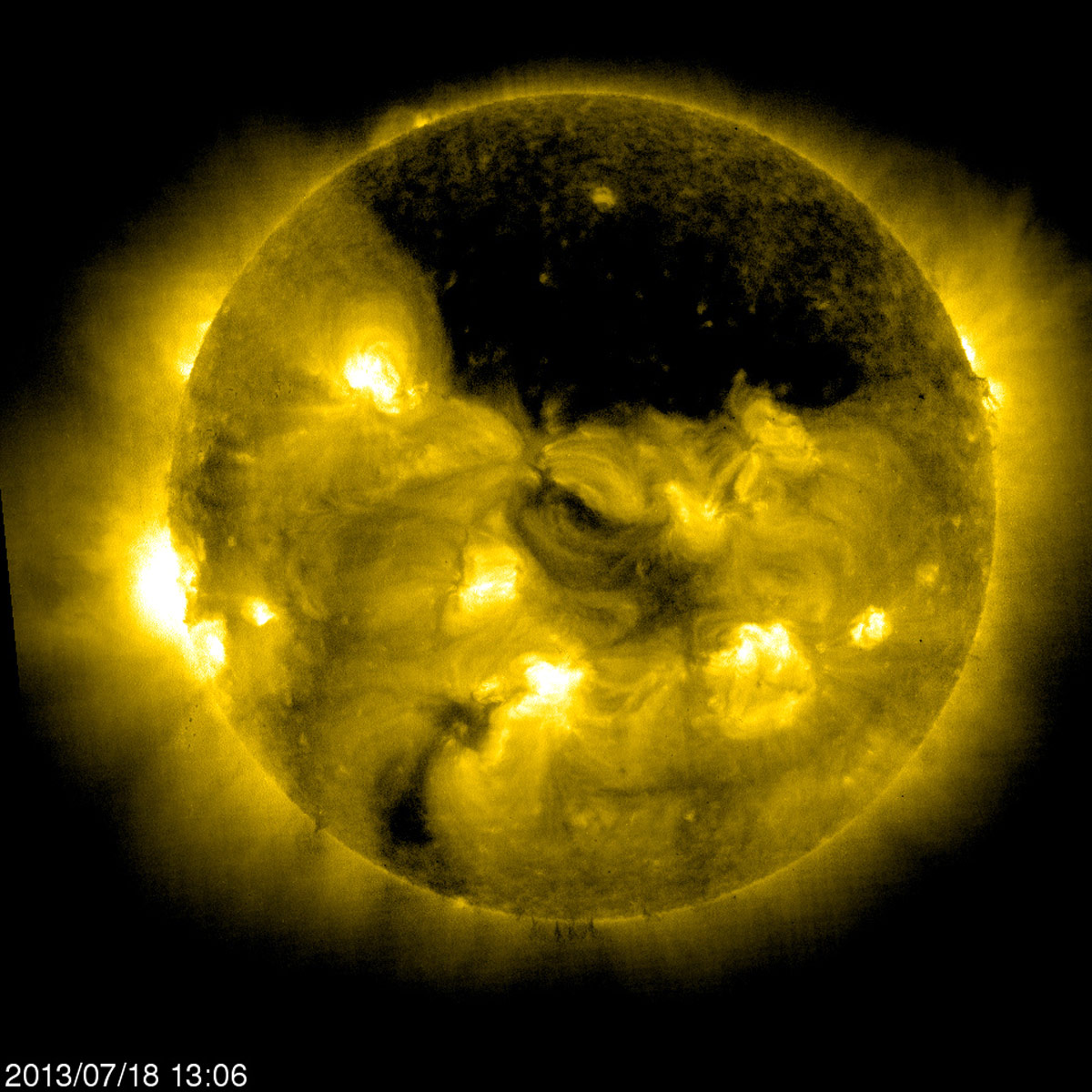
    A Gigantic Coronal Hole Hovering Over the Suns North Pole
    The European Space Agency/NASA Solar and Heliospheric Observatory, or SOHO, captured this image of a gigantic coronal hole hovering over the sun’s north pole on July 18, 2013, at 9:06 a.m. EDT. Credit: ESA&NASA/SOHO

    The Solar and Heliospheric Observatory captured an image of a coronal hole hovering over the sun’s north pole.

    The European Space Agency/NASA Solar and Heliospheric Observatory, or SOHO, captured this image of a gigantic coronal hole hovering over the sun’s north pole on July 18, 2013, at 9:06 a.m. EDT. Coronal holes are dark, low-density regions of the sun’s outermost atmosphere, the corona. They contain little solar material, have lower temperatures, and therefore, appear much darker than their surroundings.

    Coronal holes are a typical feature on the sun, though they appear at different places and with more frequency at different times of the sun’s activity cycle. The activity cycle is currently ramping up toward what is known as solar maximum, currently predicted for late 2013. During this portion of the cycle, the number of coronal holes decreases. During solar max, the magnetic fields on the sun reverse and new coronal holes appear near the poles with the opposite magnetic alignment. The coronal holes then increase in size and number, extending further from the poles as the sun moves toward solar minimum again. At such times, coronal holes have appeared that are even larger than this one.

    The holes are important to our understanding of space weather, as they are the source of a high-speed wind of solar particles that streams off the sun some three times faster than the slower wind elsewhere. While it’s unclear what causes coronal holes, they correlate to areas on the sun where magnetic fields soar up and away, failing to loop back down to the surface, as they do elsewhere.

    Never miss a breakthrough: Join the SciTechDaily newsletter.
    Follow us on Google and Google News.

    Astronomy European Space Agency NASA SOHO Sun
    Share. Facebook Twitter Pinterest LinkedIn Email Reddit

    Related Articles

    Incredible New Views of the Sun – As You’ve Never Seen It Before

    Massive Solar Eruption Captured by Solar Orbiter Spacecraft

    Unusual “Rosetta Stone” Solar Eruption Could Help Explain Mysterious Powerful Explosions on the Sun

    Mars-Directed Coronal Mass Ejection Erupts From the Sun

    A Small, Bright Surprise: Two Views of a Sungrazing Comet

    ESA/NASA Solar and Heliospheric Observatory Celebrates a Quarter-Century in Space

    Solar and Heliospheric Observatory Captures the Sounds of the Sun

    SOHO Reveals Evidence of Seismic G-Mode Waves in Our Sun

    NASA’s Solar and Heliospheric Observatory Celebrates 20 Years of Science

    Leave A Reply Cancel Reply

    • Facebook
    • Twitter
    • Pinterest
    • YouTube

    Don't Miss a Discovery

    Subscribe for the Latest in Science & Tech!

    Trending News

    Largest-Ever Study Finds Medicinal Cannabis Ineffective for Anxiety, Depression, PTSD

    250-Million-Year-Old Egg Solves One of Evolution’s Biggest Mysteries

    Living With Roommates Might Be Changing Your Gut Microbiome Without You Knowing

    Century-Old Cleaning Chemical Linked to 500% Increased Risk of Parkinson’s Disease

    What if Your Memories Never Happened? Physicists Take a New Look at the Boltzmann Brain Paradox

    One of the Universe’s Largest Stars May Be Getting Ready To Explode

    Scientists Discover Enzyme That Could Supercharge Ozempic-Like Weight Loss Drugs

    Popular Sweetener Linked to DNA Damage – “It’s Something You Should Not Be Eating”

    Follow SciTechDaily
    • Facebook
    • Twitter
    • YouTube
    • Pinterest
    • Newsletter
    • RSS
    SciTech News
    • Biology News
    • Chemistry News
    • Earth News
    • Health News
    • Physics News
    • Science News
    • Space News
    • Technology News
    Recent Posts
    • The Surprising Diet Rule That Makes “Good” Parasites Work
    • This Simple Blood Test Could Outperform “Bad Cholesterol” in Preventing Heart Disease
    • Scientists Uncover Potential Brain Risks of Popular Fish Oil Supplements
    • Scientists Prove There Are Just Six Degrees of Separation in a Social Network
    • Bee Bacteria Could Fix a Major Flaw in Plant-Based Milk
    Copyright © 1998 - 2026 SciTechDaily. All Rights Reserved.
    • Science News
    • About
    • Contact
    • Editorial Board
    • Privacy Policy
    • Terms of Use

    Type above and press Enter to search. Press Esc to cancel.