

Close Menu
    Facebook X (Twitter) Instagram
    SciTechDaily
    • Biology
    • Chemistry
    • Earth
    • Health
    • Physics
    • Science
    • Space
    • Technology
    Facebook X (Twitter) Pinterest YouTube RSS
    SciTechDaily
    Home»Technology»Solar Cell Breakthrough: Korean Researchers Set New Perovskite Efficiency Records
    Technology

    Solar Cell Breakthrough: Korean Researchers Set New Perovskite Efficiency Records

    By Ulsan National Institute of Science and TechnologyJanuary 25, 20242 Comments3 Mins Read
    Facebook Twitter Pinterest Telegram LinkedIn WhatsApp Email Reddit
    Share
    Facebook Twitter LinkedIn Pinterest Telegram Email Reddit
    Solar Cell Research Concept
    Researchers at UNIST, in collaboration with Korea University, have significantly improved the stability and efficiency of perovskite solar cells, offering advancements in both solar energy and green hydrogen production. By developing a novel cathode interlayer, they achieved exceptional performance in photovoltaic and photoelectrochemical devices, marking a step forward in sustainable energy technology.

    A team of researchers from the School of Energy and Chemical Engineering at UNIST, jointly led by Professors Sung-Yeon Jang, Jungki Ryu, and Ji-Wook Jang, in collaboration with Professor Sang Kyu Kwak from Korea University, has made significant strides in enhancing the stability and efficiency of perovskite solar cells. Their pioneering research not only advances the potential for commercializing perovskite solar cells (PSCs) but also shows promising implications for green hydrogen production technology, guaranteeing efficient and long-lasting operation.

    Perovskite solar cells (PSCs) have garnered attention due to their reduced toxicity and broad light absorption capabilities, making them highly promising for photovoltaic applications. However, the presence of inherent ionic vacancies in tin-lead halide perovskites (TLHPs) has posed challenges, leading to accelerated device degradation through inward metal diffusion.
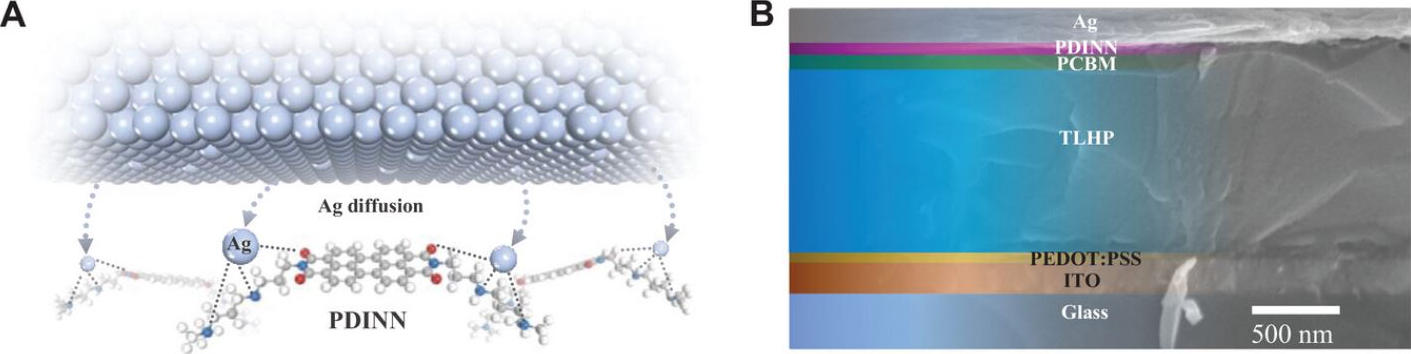
    Illustration of the Chemical Interaction Between PDINN and Metal Atoms
    a) Illustration of the chemical interaction between PDINN and metal atoms. b) Cross-sectional SEM image of a PV device. Credit: UNIST

    To address this challenge, the research team developed a chemically protective cathode interlayer using amine-functionalized perylene diimide (PDINN). By leveraging its nucleophilic sites to form tridentate metal complexes, PDINN effectively extracts electrons and suppresses inward metal diffusion. The novel solution-processed PDINN cathode interlayer has showcased remarkable performance in stabilizing TLHP-based photovoltaic (PV) and photoelectrochemical (PEC) devices.

    Remarkable Achievements in Efficiency and Stability

    The PV device achieved an impressive efficiency of 23.21%, with over 81% retention after 750 hours of operation at 60 °C, and more than 90% retention after 3100 hours at 23 ± 4 °C. Additionally, the TLHP-based PEC devices, coupled with biomass oxidation, exhibited a record-high bias-free solar hydrogen production rate of 33.0 mA cm−2, approximately 1.7-fold higher than the target set by the U.S. Department of Energy for one-sun hydrogen production.

    Sung Yeon Jang and Team
    From top left are Professor Jungki Ryu, Professor Ji-Wook Jang, and Professor Sung-Yeon Jang. From bottom left are Yuri Choi, Muhibullah Al Mubarok, and Rashmi Mehrotra. Credit: UNIST

    Their innovative design of the cathode interlayer has successfully demonstrated the immense potential of TLHPs for efficient and stable photoconversion.

    “We have dramatically increased the long-term stability of tin-lead PSCs,” explained Professor Jang. “Our goal is not only to convert light energy into electrical energy but also to develop eco-friendly methods for producing basic chemicals, such as hydrogen, which form the foundation of various industries.”
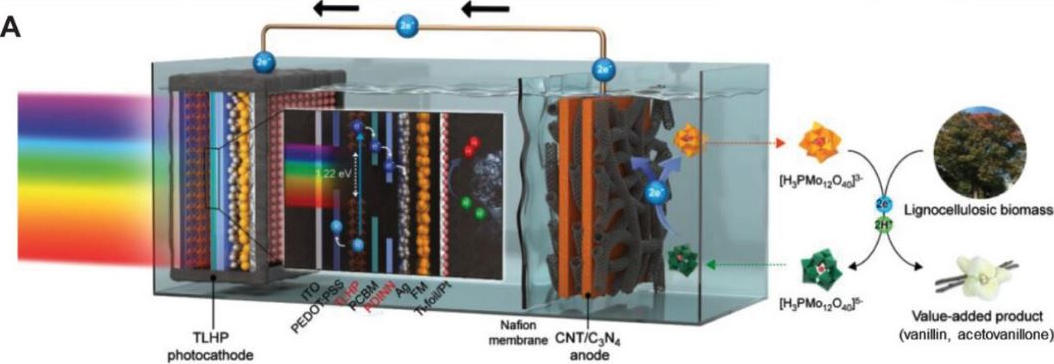
    Schematic Illustration of PEC Device
    a) Schematic illustration of PEC device using TLHP/PDINN photocathode and CNT/C3N4 anode. Credit: UNIST

    Reference: “Efficient and Stable Tin–Lead Perovskite Photoconversion Devices Using Dual-Functional Cathode Interlayer” by Muhibullah Al Mubarok, Yuri Choi, Rashmi Mehrotra, Yu Jin Kim, Rama Krishna Boddu, Inhui Lee, Jiyeong Kim, Sang Kyu Kwak, Ji-Wook Jang, Jungki Ryu and Sung-Yeon Jang, 30 November 2023, Advanced Energy Materials.
    DOI: 10.1002/aenm.202302555

    The study received support from the National Research Foundation of Korea (NRF) under the Ministry of Science and ICT (MSIT).

    Never miss a breakthrough: Join the SciTechDaily newsletter.
    Follow us on Google and Google News.

    Perovskite Solar Cell Photovoltaics Solar Cells Solar Energy Ulsan National Institute of Science and Technology
    Share. Facebook Twitter Pinterest LinkedIn Email Reddit

    Related Articles

    Durable and Transparent: Researchers Develop High-Efficiency Bifacial Perovskite Solar Cells

    Innovative Technology Offers Big Performance Boost to Perovskite–Silicon Tandem Solar Cells

    New Materials Enable Cheaper Solar Cells That Are Easier To Make

    Researchers Set New World Record for Solar Cell Efficiency

    Predicting Semiconductor Solar Cell Performance From Terahertz and Microwave Spectroscopy

    Templating Approach Stabilizes “Ideal” Perovskite Material for Cheap, Efficient Solar Cells

    Nanoscientists Improve the Stability of Perovskite Solar Cells

    New “Tandem” Solar Cell to Harnesses More Sunlight

    Aluminum Studs Improve Solar Panel Efficiency

    2 Comments

    1. Clyde Spencer on January 25, 2024 10:36 am

      “Perovskite [like] solar cells (PSCs) have garnered attention due to their reduced toxicity …”
      Reduced compared to what? Since when are lead compounds NOT toxic?

      Reply
    2. Chuwang Pam Zang on January 27, 2024 10:23 am

      The best source of electrical energy is Renewable Energy, it’s less cheap in maintenance

      Reply
    Leave A Reply Cancel Reply

    • Facebook
    • Twitter
    • Pinterest
    • YouTube

    Don't Miss a Discovery

    Subscribe for the Latest in Science & Tech!

    Trending News

    Scientists Warn That This Common Pet Fish Can Wreck Entire Ecosystems

    Scientists Make Breakthrough in Turning Plastic Trash Into Clean Fuel Using Sunlight

    This Popular Supplement May Interfere With Cancer Treatment, Scientists Warn

    Scientists Finally Solved One of Water’s Biggest Mysteries

    Could This New Weight-Loss Pill Disrupt the Entire Market? Here’s What You Should Know About Orforglipron

    Earth’s Crust Is Tearing Open in Africa, and It Could Form a New Ocean

    Breakthrough Bowel Cancer Trial Leaves Patients Cancer-Free for Nearly 3 Years

    Natural Compound Shows Powerful Potential Against Rheumatoid Arthritis

    Follow SciTechDaily
    • Facebook
    • Twitter
    • YouTube
    • Pinterest
    • Newsletter
    • RSS
    SciTech News
    • Biology News
    • Chemistry News
    • Earth News
    • Health News
    • Physics News
    • Science News
    • Space News
    • Technology News
    Recent Posts
    • Enormous Prehistoric Insects Puzzle Scientists
    • College Student Identifies Bizarre New Carnivorous Dinosaur Three Times Older Than T. rex
    • The Most Effective Knee Arthritis Treatments Aren’t What You Expect
    • Scientists Develop Bioengineered Chewing Gum That Could Help Fight Oral Cancer
    • Popular Weight-Loss Drugs Found To Cut Heart Attack and Stroke Risk
    Copyright © 1998 - 2026 SciTechDaily. All Rights Reserved.
    • Science News
    • About
    • Contact
    • Editorial Board
    • Privacy Policy
    • Terms of Use

    Type above and press Enter to search. Press Esc to cancel.