
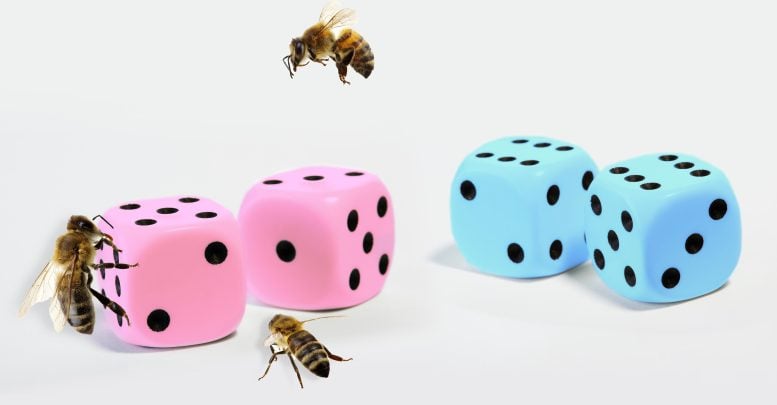
To date it has been unclear exactly how the sex of a bee is determined. A research team from Heinrich Heine University Düsseldorf (HHU) comprising biologists and chemists has now identified a key gene and the molecular mechanism linked with it. In the current issue of the scientific journal Science Advances, they describe how this process is similar to a game involving two dice.
The sex of a living creature has significant consequences for its form, function, and behavior. The biological sex of an organism is usually determined at the start of its life. In humans, for example, the presence of the sex-determining “Y chromosome” decides whether a man will be born.
The Silesian priest Johann Dzierzon already examined the sex-determining mechanisms of honeybees (Apis mellifera) back in 1845. Among other things, he discovered the asexual reproduction of male bees – the “drones.”
Sex Determination in Bees
Unlike humans, bees do not have just one sex-determining chromosome. A research team headed by Professor Dr. Martin Beye from the Institute of Evolutionary Genetics at HHU has now established that sex is determined by a single gene, referred to as “Csd” (Complementary sex determiner) via a special mechanism.
This gene can have more than 100 variations, so-called alleles. In other cases, e.g. in flowers, the various alleles of a gene can determine petal color.
In the case of sexual fertilization, the simple chromosome sets from the egg and sperm cells come together to create a double – diploid – chromosome set. Accordingly, two Csd gene variants are now present in each sexually fertilized bee.
The next finding of the bee researchers in Düsseldorf: Where the two alleles of the Csd gene are different, a female bee develops. By contrast, if the alleles of the gene are the same on both chromosomes, a male bee develops. However, as the bees want to prevent this to avoid inbreeding, the worker bees do not raise these eggs.
Molecular Mechanism of Sex Determination
The question remained as to how this sex determination occurs at molecular level. Lead author Dr. Marianne Otte: “It is necessary to know here that each different allele of the Csd gene produces a different variant of the associated Csd protein, all of which differ slightly. We were able to demonstrate that only different Csd proteins can bind with each other and thus activate a molecular switch that determines ‘female bee’. By contrast, if the proteins are the same, they bind differently and the switch is not activated. In this case, a male bee would develop, but it is not raised.”
Professor Beye, last author of the study in Science Advances: “It is similar to a molecular game involving two dice: However, in this case, the throw that produces a double is not the winner. Instead, the throw must produce two different numbers to enable a new bee – a female – to be raised.”
By contrast, the drones develop from unfertilized eggs. Accordingly, these male bees only have a simple chromosome set with identical Csd proteins. The queen bee decides not to add sperm to the egg during the laying process.
Conclusion and Future Directions
Dr. Otte: “We have been able to solve a genetic mystery that has existed for more than 100 years by tracing it back to the switch function of the Csd protein.” Professor Beye comments on further research questions: “The mechanism the worker bees use to identify whether the fertilized egg contains two different Csd proteins and is thus switched to ‘female’ is still unknown. As it is dark inside the hive, there must be an olfactory clue.”
The results will be used to advance bee breeding measures.
Reference: “Recognition of polymorphic Csd proteins determines sex in the honeybee” by Marianne Otte, Oksana Netschitailo, Stefanie Weidtkamp-Peters, Claus A. M. Seidel and Martin Beye, 4 October 2023, Science Advances.
DOI: 10.1126/sciadv.adg4239
Never miss a breakthrough: Join the SciTechDaily newsletter.
Follow us on Google and Google News.