
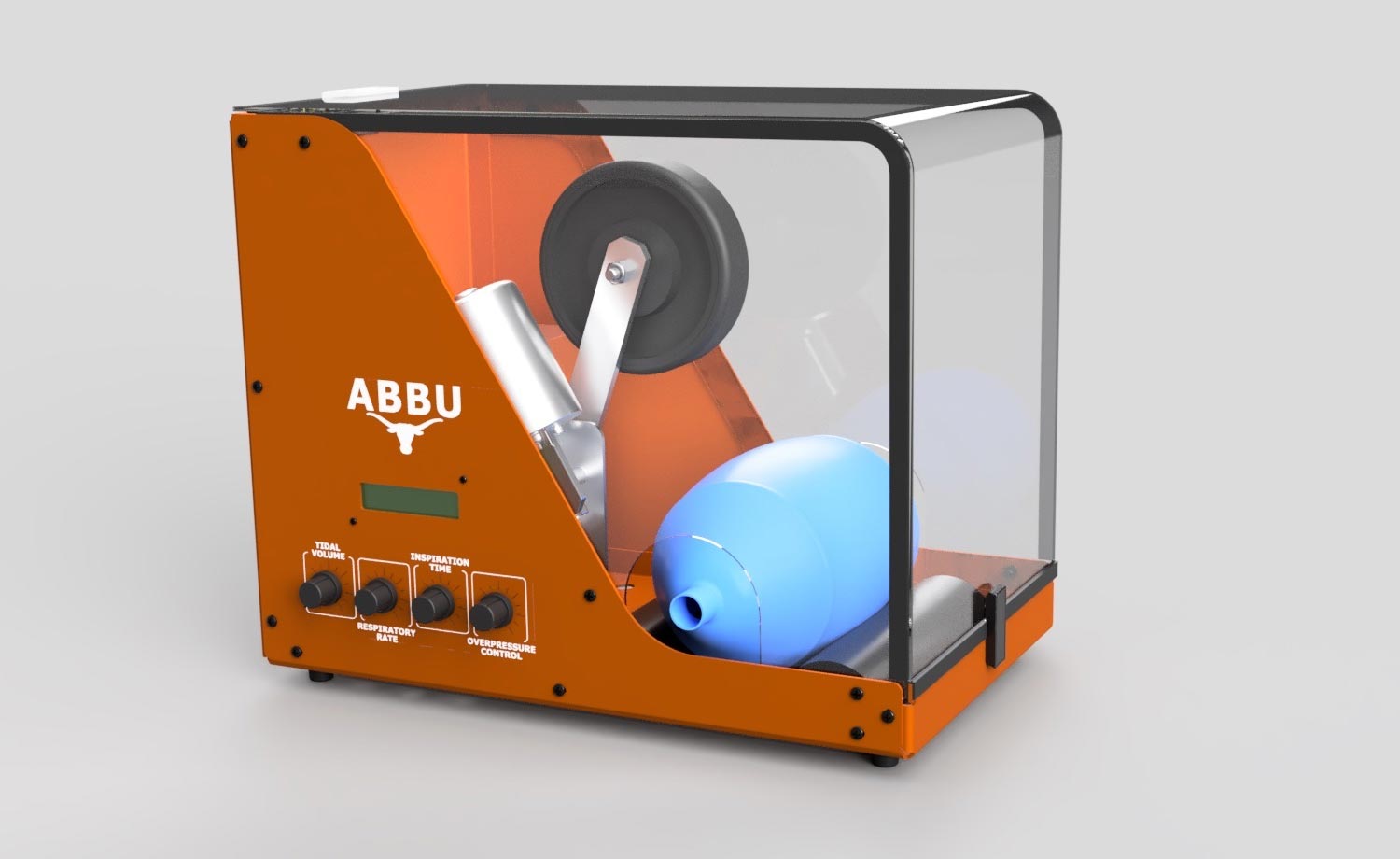
Researchers at The University of Texas at Austin are building a new type of ventilator made of cheap, widely available materials to help fill the demand created by the spread of COVID-19 for these critical devices that help patients breathe.
Ventilators become necessary when patients can’t breathe on their own, physically pumping oxygen into their lungs. They are in short supply. That’s why the researchers are building a “bridge ventilator” that can be replicated and mass-produced by others.
“The problem is that when ICUs fill up, there are no more ventilators,” said Thomas Milner, a professor in the Department of Biomedical Engineering in the Cockrell School of Engineering, who is leading the project. “And you can’t bring in new ICU beds because you don’t have the ventilators.”
Hospitals across Texas had an estimated 3,730 ventilators in 2009 during the H1N1 pandemic, according to research published in 2017. That supply is enough to handle patient needs during mild to moderate pandemic scenarios. However, during a more severe scenario, statewide projected demand would top 10,000 ventilators, the research found, far exceeding 2009 resources.
The device is called the Assisted Bag Breathing Unit, and it uses a manual resuscitator, a common tool called an AMBU (artificial medical breathing unit) bag. The AMBU is a handheld device approved by the U.S. Food and Drug Administration that includes a bag that fills up with oxygen and a mask that patients wear to receive ventilation. However, the unit requires a person to compress the bag frequently to help patients breathe, a challenging task at a time when medical personnel across the country are stretched thin due to the coronavirus. The team needed a way to automatically compress the bag to get oxygen to patients.
A windshield wiper motor pulled from a Toyota Camry powers a small caster wheel that pushes down on the bag to control oxygen flow. Four potentiometers control the respiration rate, the volume of oxygen given to patients, the time to inhale and the maximum pressure.
“Essentially, we are replacing the human hand that would normally depress against the bag to inject oxygen into the patient’s lungs,” Milner said.
Milner said a colleague came up with the idea to use a windshield wiper motor during a brainstorming session. These motors are available, reliable and inexpensive. They go through extensive testing as part of the automobile production process. It took a little while for the team to figure out the motor, but they worked with a local mechanic to learn the ins and outs.
The team is testing the device on a manikin from UT’s Dell Medical School and test lungs provided by UT Health San Antonio.
Once the team vets its prototype, the plan is to provide an open license to the design so that anyone can make their own low-cost, reliable ventilator. The researchers and a team from Dell Medical School are in discussion with numerous manufacturing partners, with a goal of quickly producing at least 2,000 ventilators. Austin’s Unorthodox Ventures has committed to producing five prototype units for the team to stress test.
Because the components of the device are regulated individually, Milner is hoping for approval in a matter of weeks rather than months. Just recently, the FDA issued an Emergency Use Authorization protocol to speed up production of ventilators and other respiratory devices.
“Really, all we are doing is making what we would argue is a simple modification of how you push on the bag,” Milner said.
His team from UT includes Arnold Estrada, Scott Jenny, Nitesh Katta, Aydin Zahedivash, Tim Phillips and Austin McElroy. Numerous medical doctors are also contributing to the project, including Dr. Paul Harford from Dell Medical School, and Drs. Stephen Derdak and Marc Feldman and respiratory therapist Richard Wettstein, all from UT Health San Antonio. This project received seed funding from the Dell Medical School’s Texas Health Catalyst program, and Ruben Rathnasingham, Dell Med’s assistant dean for health product innovation, has been leading efforts to help translate the idea to the clinic through accelerated regulatory approval, external funding and manufacturing partnerships.
The UT group is part of a Bridge Ventilator Consortium, headed by Dr. Brian Wong, assistant chair of the Department of Otolaryngology in the School of Medicine at the University of California, Irvine, that aims to produce alternative ventilators amid a nationwide shortage.
Milner noted the impressive efforts of universities across the country, including The University of Texas at Austin, to quickly pivot to COVID-19 projects after most research was shut down by the pandemic. Another recent example of that effort came out of the University of Minnesota last week, when a cardiac anesthesiologist went “full-on MacGyver,” building a ventilator prototype out of $150 worth of spare parts found in a medical device lab.
Help Put the Assisted Bag Breathing Unit Into Action
The ABBU team is currently raising funds to complete testing of the device, obtain FDA approval, begin production with a manufacturer and provide the system to medical facilities treating COVID-19 patients.
Learn more about how you can support the project team
Never miss a breakthrough: Join the SciTechDaily newsletter.
Follow us on Google and Google News.