
Close Menu
    Facebook X (Twitter) Instagram
    SciTechDaily
    • Biology
    • Chemistry
    • Earth
    • Health
    • Physics
    • Science
    • Space
    • Technology
    Facebook X (Twitter) Pinterest YouTube RSS
    SciTechDaily
    Home»Space»Spitzer Discovers a Young Stellar System That “Blinks” Every 93 Days
    Space

    Spitzer Discovers a Young Stellar System That “Blinks” Every 93 Days

    By Adam Hadhazy, Jet Propulsion Laboratory; NASAAugust 1, 20131 Comment4 Mins Read
    Facebook Twitter Pinterest Telegram LinkedIn WhatsApp Email Reddit
    Share
    Facebook Twitter LinkedIn Pinterest Telegram Email Reddit
    Astronomers Spot a Young Stellar System That Blinks Every 93 Days
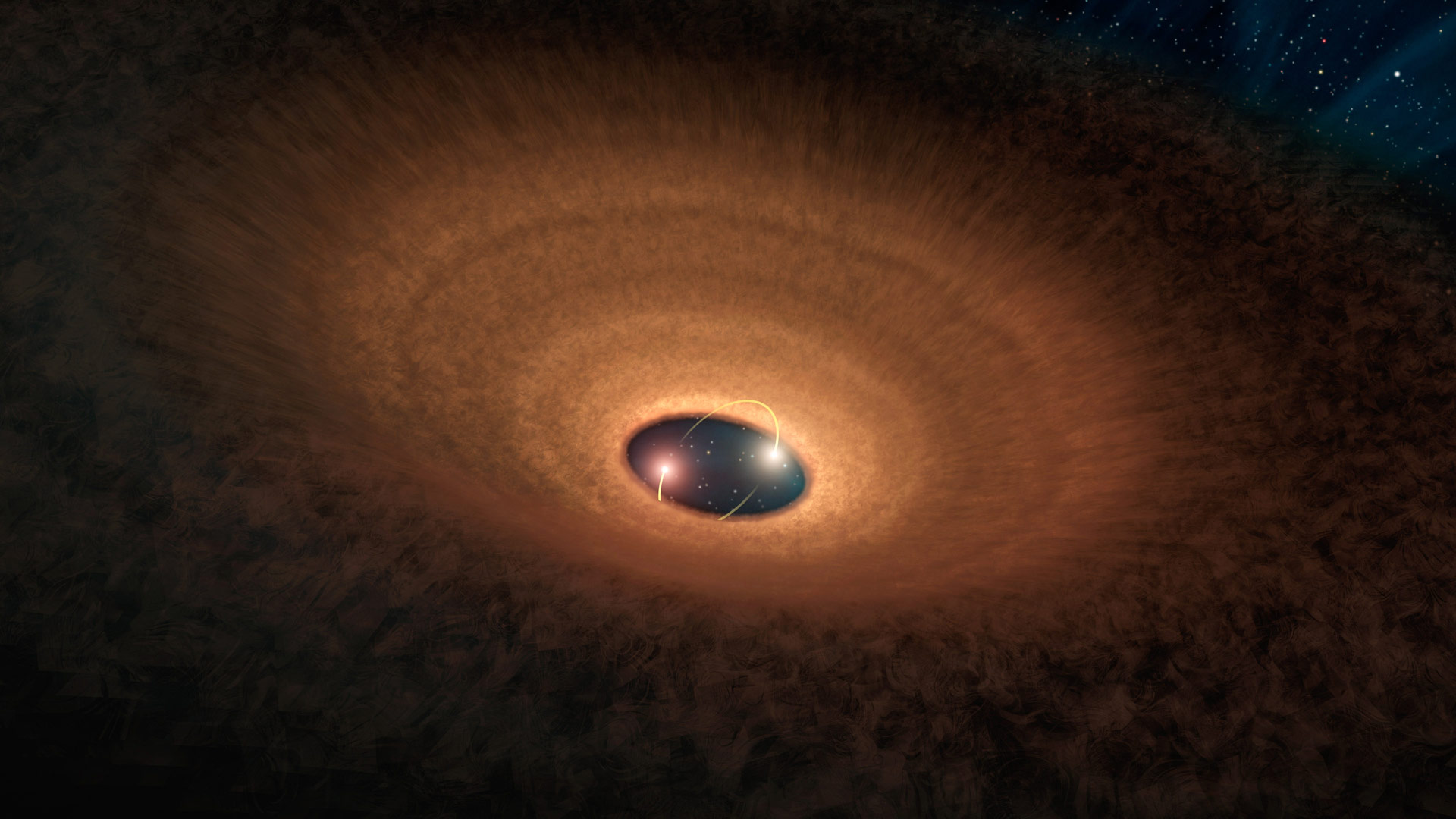
    In this artist’s impression, a disk of dusty material leftover from star formation girds two young stars like a hula hoop. As the two stars whirl around each other, they periodically peek out from the disk, making the system appear to “blink” every 93 days. The dusty hula hoop itself is misaligned from the central star pair, thanks to the disrupting gravitational presence of a third star orbiting at the periphery of the system. The light yellow arcs near the two central stars indicate their movement relative to each other and the disk. It is believed that this disk will go on to spawn planets and the other celestial bodies that make up a solar system. NASA’s Spitzer Space Telescope observed this system, called YLW 16A, in the infrared light emitted by the disk’s warmed gas and dust. Credit: NASA/JPL-Caltech

    Using data from NASA’s Spitzer Space Telescope, scientists have discovered a young stellar system that “blinks” every 93 days. This is the fourth example of a star system known to blink in such a manner, suggesting that these systems might be more common than previously thought.

    Astronomers using NASA’s Spitzer Space Telescope have spotted a young stellar system that “blinks” every 93 days. Called YLW 16A, the system likely consists of three developing stars, two of which are surrounded by a disk of material left over from the star-formation process.

    As the two inner stars whirl around each other, they periodically peek out from the disk that girds them like a hula hoop. The hoop itself appears to be misaligned from the central star pair, probably due to the disrupting gravitational presence of the third star orbiting at the periphery of the system. The whole system cycles through bright and faint phases, with the central stars playing a sort of cosmic peek-a-boo as the tilted disk twirls around them. It is believed that this disk should go on to spawn planets and the other celestial bodies that make up a solar system.

    Spitzer observed infrared light from YLW 16A, emitted by the warmed gas and dust in the disk that still swathes the young stars. Other observations came from the ground-based 2MASS survey, as well as from the NACO instrument at the European Southern Observatory’s Very Large Telescope in Chile.

    YLW 16A is the fourth example of a star system known to blink in such a manner, and the second in the same star-forming region Rho Ophiuchus. The finding suggests that these systems might be more common than once thought. Blinking star systems with warped disks offer scientists a way to study how planets form in these environments. The planets can orbit one or both of the stars in the binary star system. The famous science fictional planet Tatooine in “Star Wars” orbits two stars, hence its double sunsets. Such worlds are referred to as circumbinary planets. Astronomers can record how light is absorbed by planet-forming disks during the bright and faint phases of blinking stellar systems, which in turn reveals information about the materials that comprise the disk.

    “These blinking systems offer natural probes of the binary and circumbinary planet formation process,” said Peter Plavchan, a scientist at the NASA Exoplanet Science Institute and Infrared Processing and Analysis Center at the California Institute of Technology, Pasadena, California, and lead author of a new paper published in Astronomy & Astrophysics.

    NASA’s Jet Propulsion Laboratory, Pasadena, California, manages the Spitzer Space Telescope mission for NASA’s Science Mission Directorate, Washington. Science operations are conducted at the Spitzer Science Center at Caltech. Data are archived at the Infrared Science Archive housed at the Infrared Processing and Analysis Center. Caltech manages JPL for NASA. For more information about Spitzer, visit http://spitzer.caltech.edu and http://www.nasa.gov/spitzer .

    Reference: “The identification of 93 day periodic photometric variability for YSO YLW 16A” by P. Plavchan, T. Güth, N. Laohakunakorn and J. R. Parks, 12 June 2013, Astronomy & Astrophysics.
    DOI: 10.1051/0004-6361/201220747
    arXiv:1304.2398

    Never miss a breakthrough: Join the SciTechDaily newsletter.
    Follow us on Google and Google News.

    Astronomy Astrophysics NASA Planetary Science Popular Spitzer Space Telescope
    Share. Facebook Twitter Pinterest LinkedIn Email Reddit

    Related Articles

    Astronomers Create First Cloud Map of a Planet Beyond Our Solar System

    SEEDS Project Discovers “Second Jupiter” – Lowest-Mass Exoplanet Around a Sun-Like Star

    Magnetic Winds From a Young Star in the Orion Nebula

    NASA Data Suggests Black Holes Abundant Among the Earliest Stars

    New Astronomical Tool Traces the Evolution of Cosmic Carbon

    Kepler Mission Discovers Tiny Planet Slightly Larger Than Our Moon

    New Study Revives Doubted Exoplanet Fomalhaut b

    Measuring the Expansion of Universe – A Newly Refined Value for the Hubble Constant

    NASA’s Kepler Mission Discovers Multiple Transiting Planets Orbiting Two Suns

    1 Comment

    1. Samsun Rock on July 12, 2019 10:30 pm

      Thank’s to the provide this information.

      Reply
    Leave A Reply Cancel Reply

    • Facebook
    • Twitter
    • Pinterest
    • YouTube

    Don't Miss a Discovery

    Subscribe for the Latest in Science & Tech!

    Trending News

    Scientists Uncover Potential Brain Risks of Popular Fish Oil Supplements

    Scientists Discover a Surprising Way To Make Bread Healthier and More Nutritious

    After 60 Years, Scientists Uncover Unexpected Brain Effects of Popular Diabetes Drug Metformin

    New Research Uncovers Hidden Side Effects of Popular Weight-Loss Drugs

    Scientists Rethink Extreme Warming After Surprising Ocean Discovery

    Landmark Study Links Never Marrying to Significantly Higher Cancer Risk

    Researchers Discover Unknown Beetle Species Just Steps From Their Lab

    Largest-Ever Study Finds Medicinal Cannabis Ineffective for Anxiety, Depression, PTSD

    Follow SciTechDaily
    • Facebook
    • Twitter
    • YouTube
    • Pinterest
    • Newsletter
    • RSS
    SciTech News
    • Biology News
    • Chemistry News
    • Earth News
    • Health News
    • Physics News
    • Science News
    • Space News
    • Technology News
    Recent Posts
    • Early Warning Signals of Esophageal Cancer May Be Hiding in Plain Sight
    • Researchers Have Discovered a THC-Free Cannabis Compound That May Replace Opioids
    • Common Blood Pressure Drug Shows Surprising Power Against Deadly Antibiotic-Resistant Superbug
    • Students Build Dark Matter Detector and Set New Experimental Limits
    • Scientists Discover Caffeine Can Repair Key Memory Circuits After Sleep Loss
    Copyright © 1998 - 2026 SciTechDaily. All Rights Reserved.
    • Science News
    • About
    • Contact
    • Editorial Board
    • Privacy Policy
    • Terms of Use

    Type above and press Enter to search. Press Esc to cancel.