
Close Menu
    Facebook X (Twitter) Instagram
    SciTechDaily
    • Biology
    • Chemistry
    • Earth
    • Health
    • Physics
    • Science
    • Space
    • Technology
    Facebook X (Twitter) Pinterest YouTube RSS
    SciTechDaily
    Home»Space»Spitzer Telescope Views ‘Enterprise’ Nebulae
    Space

    Spitzer Telescope Views ‘Enterprise’ Nebulae

    By Elizabeth Landau, Jet Propulsion LaboratorySeptember 8, 20161 Comment2 Mins Read
    Facebook Twitter Pinterest Telegram LinkedIn WhatsApp Email Reddit
    Share
    Facebook Twitter LinkedIn Pinterest Telegram Email Reddit
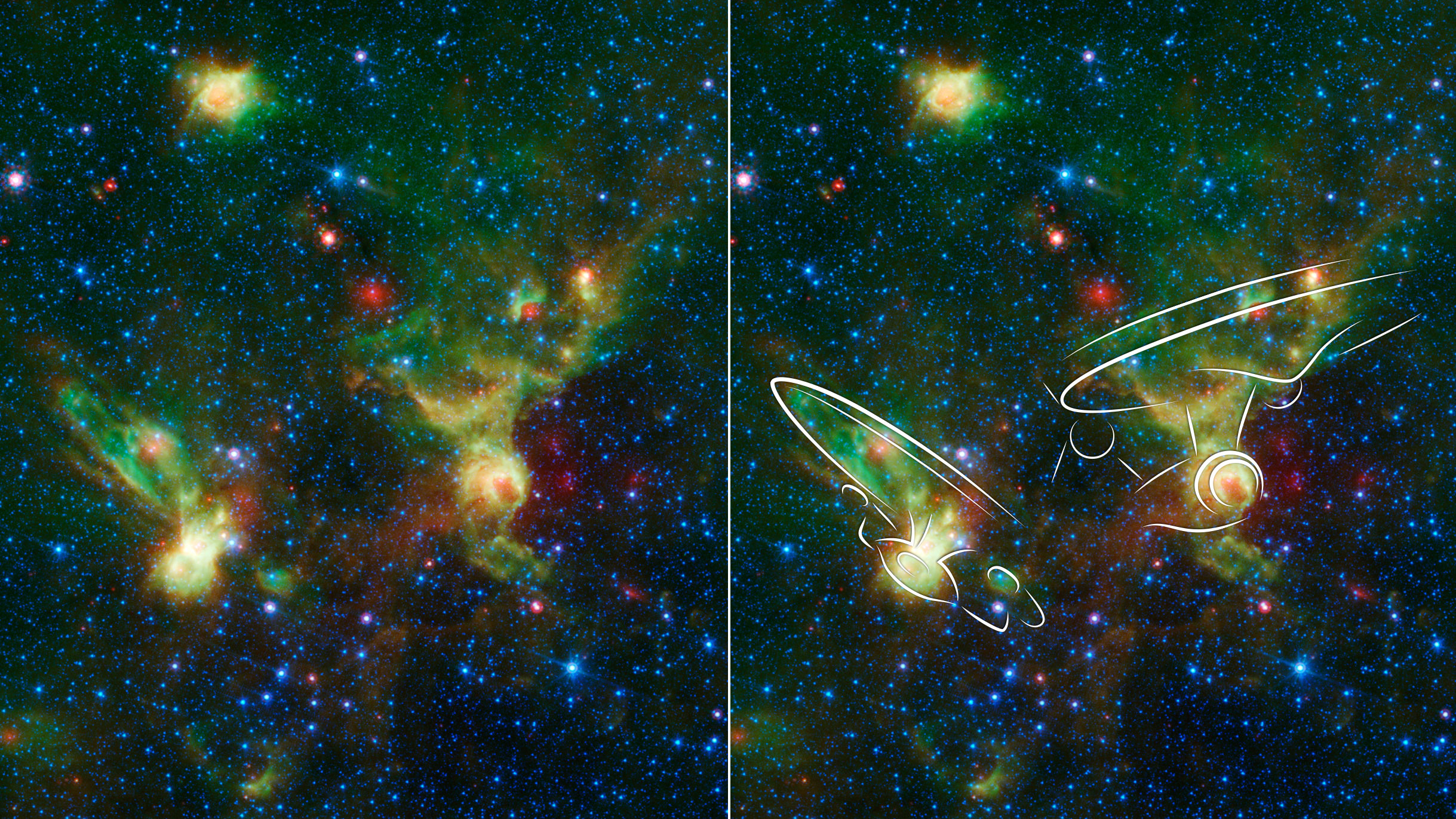
    New Image of the Enterprise Nebulae
    These nebulae seen by NASA’s Spitzer Space Telescope, at left, may resemble two versions of the starship Enterprise from “Star Trek,” overlaid at right.

    A new infrared image from NASA’s Spitzer Space Telescope may remind fans of Star Trek.

    Since ancient times, people have imagined familiar objects when gazing at the heavens. There are many examples of this phenomenon, known as pareidolia, including the constellations and the well-known nebulae named Ant, Stingray and Hourglass.

    On the right of the image, with a little scrutiny, you may see hints of the saucer and hull of the original USS Enterprise, captained by James T. Kirk, as if it were emerging from a dark nebula. To the left, its “Next Generation” successor, Jean-Luc Picard’s Enterprise-D, flies off in the opposite direction.

    Astronomically speaking, the region pictured in the image falls within the disk of our Milky Way galaxy and displays two regions of star formation hidden behind a haze of dust when viewed in visible light. Spitzer’s ability to peer deeper into dust clouds has revealed a myriad of stellar birthplaces like these, which are officially known only by their catalog numbers, IRAS 19340+2016 and IRAS19343+2026.

    Trekkies, however, may prefer using the more familiar designations NCC-1701 and NCC-1701-D. Fifty years after its inception, Star Trek still inspires fans and astronomers alike to boldly explore where no one has gone before.

    This image was assembled using data from Spitzer’s biggest surveys of the Milky Way, called GLIMPSE and MIPSGAL. Light with a wavelength of 3.5 microns is shown in blue, 8.0 microns in green, and 24 microns in red. The green colors highlight organic molecules in the dust clouds, illuminated by starlight. Red colors are related to thermal radiation emitted from the very hottest areas of dust.

    Never miss a breakthrough: Join the SciTechDaily newsletter.
    Follow us on Google and Google News.

    Astronomy Cosmology Spitzer Space Telescope
    Share. Facebook Twitter Pinterest LinkedIn Email Reddit

    Related Articles

    Scientists Discover Colossal ‘Super Spiral’ Galaxies

    Spitzer and WISE Reveal Dozens of Runaway Stars

    Magnified Image Reveals the Faintest Known Galaxy from the Early Universe

    Study Reveals Strange Star KIC 8462852 is Likely Swarmed by Comets

    Astronomers Study the Star Formation Rates of Galaxies

    VISTA Survey Telescope Discovers Massive Galaxies in the Early Universe

    NASA Spots Giant Gathering of Galaxies Located 8.5 billion Light-Years Away

    Young Star Systems May Reveal How Our Own Solar System Came To Be

    NASA Data Suggests Black Holes Abundant Among the Earliest Stars

    1 Comment

    1. Valeriy on September 9, 2016 1:30 pm

      Outflows are ubiquitous in astrophysics. Despite different sizes, velocity and amount of transported energy, luminosity and degree of collimation, they have obvious morphological similarities. However, what is important for us, there is the picture of the outflows from everywhere and none of inflows into somewhere. That is an obvious asymmetry.

      Reply
    Leave A Reply Cancel Reply

    • Facebook
    • Twitter
    • Pinterest
    • YouTube

    Don't Miss a Discovery

    Subscribe for the Latest in Science & Tech!

    Trending News

    Don’t Miss: August Brings Two Eclipses and the Perseid Meteor Shower

    Brain Waves Once Dismissed As Noise May Help Build Our Reality

    Perseverance Finds Organic Carbon Preserved Just Beneath the Martian Surface

    Tick Found in Austin Apartment Linked to Rare Relapsing Fever

    Ozempic Changes Your Body, but Does It Change Your Life? A New Study Suggests Not

    Ancient Super-Eruptions May Have Frozen Earth for Centuries

    A Common Sugar May Loosen Cancer Cells and Help Them Spread

    Scientists Discover a Major Brain Change That Starts Around Age 50

    Follow SciTechDaily
    • Facebook
    • Twitter
    • YouTube
    • Pinterest
    • Newsletter
    • RSS
    SciTech News
    • Biology News
    • Chemistry News
    • Earth News
    • Health News
    • Physics News
    • Science News
    • Space News
    • Technology News
    Recent Posts
    • Democracy Has a Math Problem No Country Can Fully Solve
    • Scientists Solve a Long-Standing Mystery About Bird and Dinosaur Eggs
    • Cave Discovery Suggests Neanderthals and Modern Humans May Have Shared Culture
    • Scientists Discover a Hidden Way T Cells Attack Leukemia
    • A Vegan Diet May Begin Changing Gene Activity in Just 4 Weeks
    Copyright © 1998 - 2026 SciTechDaily. All Rights Reserved.
    • Science News
    • About
    • Contact
    • Editorial Board
    • Privacy Policy
    • Terms of Use

    Type above and press Enter to search. Press Esc to cancel.