
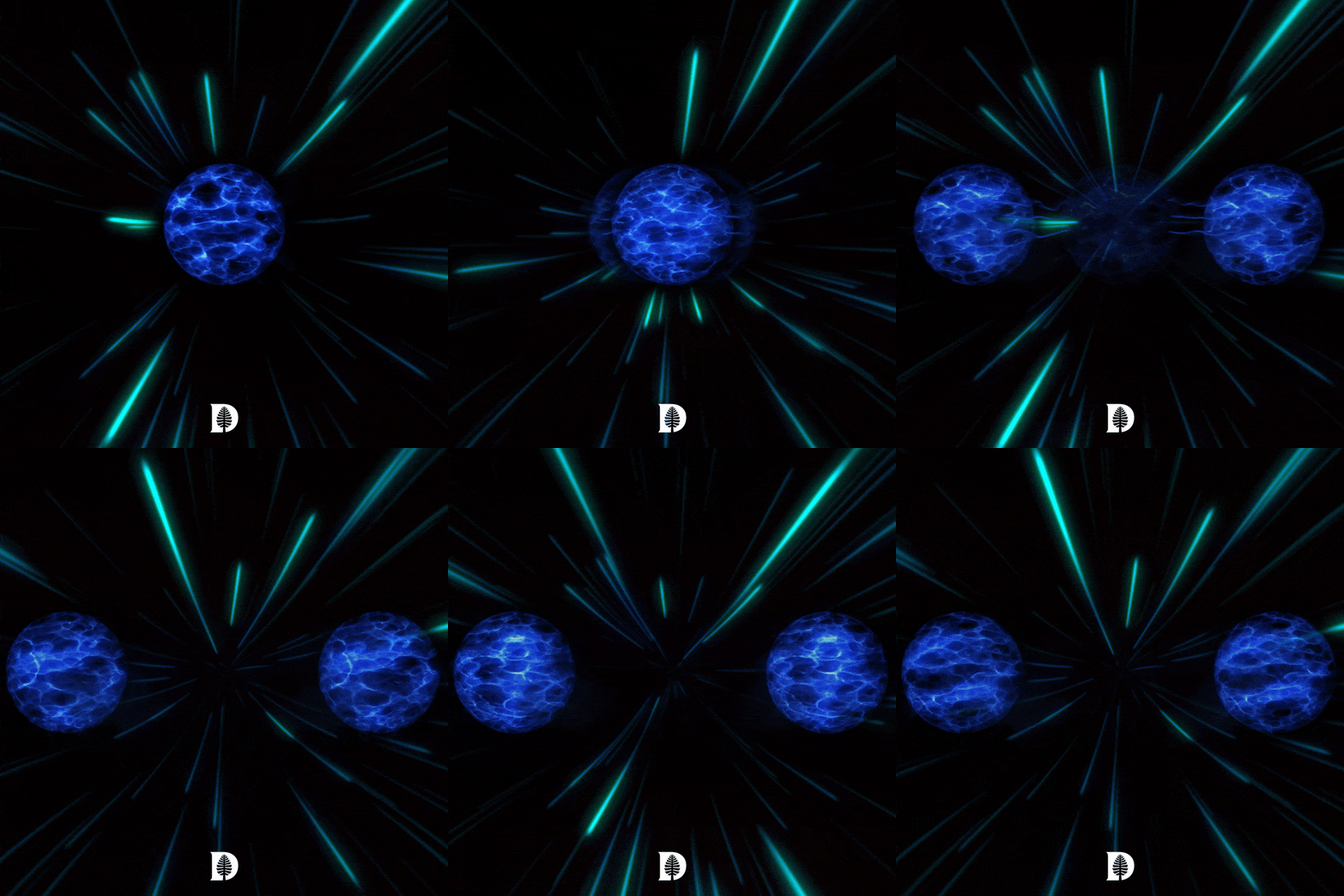
Research Predicts the Existence of a Previously-Unimaginable Particle
When Italian physicist Ettore Majorana suggested that electrons could be split into halves nearly a century ago, the revolutionary idea was largely underappreciated. It now serves as a cornerstone of physics.
Leveraging the same curiosity as Majorana, researchers from Dartmouth’s Viola Research Group are predicting that split photons may also exist.
“This is a major paradigm change of how we understand light in a way that was not believed to be possible,” says Lorenza Viola, the James Frank Family Professor of Physics. “Not only did we find a new physical entity, but it was one that nobody believed could exist.”
The theoretical discovery of the split photon – known as a “Majorana boson” – advances the fundamental understanding of light and how it behaves. Research describing the discovery was published this month in Physical Review Letters.
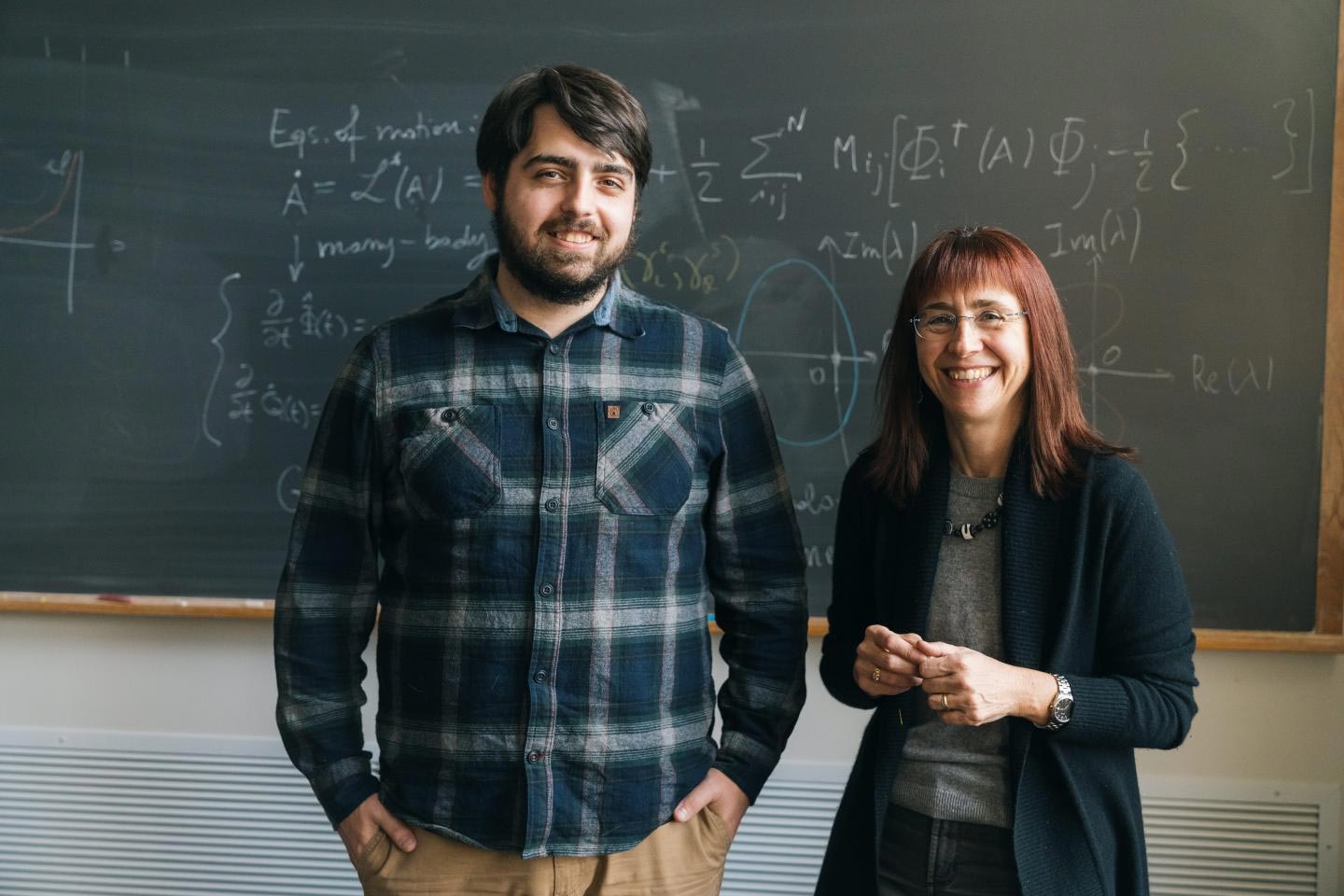
“Every photon can be thought of as the sum of two distinct halves,” says Vincent Flynn, Guarini ’22, the lead author of the paper. “We were able to identify conditions for isolating these halves from one another.”
Light Behaving Like Matter in Different Phases
Similar to how liquid water can change into ice or vapor under specific conditions, the research indicates that light can also exist in a different phase – one where photons appear as two distinct halves.
“Water is water regardless of its liquid or solid form. It just behaves differently depending on physical conditions,” said Viola. “This is how we need to approach our understanding of light—like matter, it can exist in different phases.”
“We have split something previously thought to be unsplittable, and we’ll never look at light the same way.”
Lorenza Viola, the James Frank Family Professor of Physics
Rather than pieces that can be physically pulled apart, the photon halves are similar to the two sides of a coin. The two distinct parts make up a whole, yet they can be described and function as separate units.
The theory, co-authored by Emilio Cobanera, a visiting assistant professor of physics and astronomy, was developed in Wilder Hall, the same building that housed the laboratory where landmark research in the early 1900s measured the radiation pressure of light.
“As an early career scientist, it’s incredibly rewarding to build off the ideas of giants like Majorana and to be able to do so in a department with such deep historical connection to the physics of light,” says Flynn.
The new theory relies on energy-leaking cavities filled with quantum packets of light and predicts that particle halves appear at the edges of such a synthetic platform.
A laboratory experiment is still required to confirm that photons can exist in this previously-unimaginable split form. Unlike the massive structures built to detect the renowned Higgs boson, a test to detect photon halves could be done on a tabletop using existing or near-term technology.
Potential Applications in Quantum Tech and Optics
According to the research team, the research points the way toward uncovering new, exotic phases of matter and light. It is hard to predict how the findings may be applied, but the Majorana boson could support quantum computing, optical sensors, and light amplifiers.
“In order to make this discovery we had to challenge long-held beliefs and really think outside the box,” says Viola. “We have split something previously thought to be unsplittable, and we’ll never look at light the same way.”
For more on this research, see New Research Predicts the Existence of a Previously-Unimaginable Particle.
Reference: “Topology by Dissipation: Majorana Bosons in Metastable Quadratic Markovian Dynamics” by Vincent P. Flynn, Emilio Cobanera and Lorenza Viola, 10 December 2021, Physical Review Letters.
DOI: 10.1103/PhysRevLett.127.245701
Never miss a breakthrough: Join the SciTechDaily newsletter.
Follow us on Google and Google News.
4 Comments
… and now same old thing,but is there might be three parts of an electron, couldn’t there be a …
… What now…
…I gave a big stone to a mason to create nice carved Standard model that will be sitting in a years to come on the top of my grave, but now…
why the same news twice in a week?
Has the Majorana fermion been experimentally established? I heard that the initial results been questioned quite seriously.