
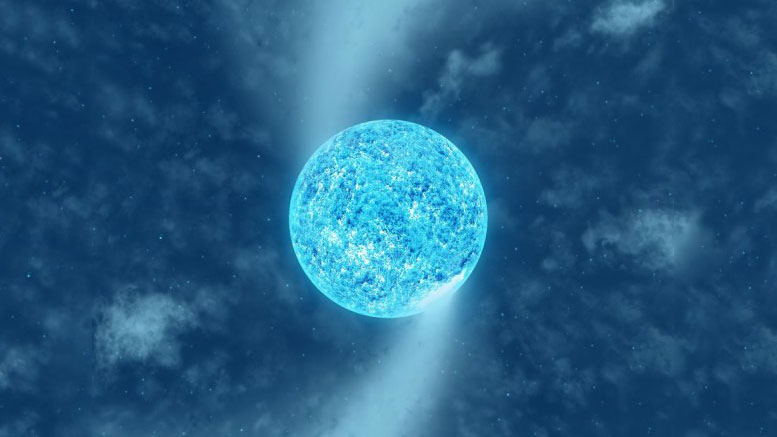
Astronomers recently discovered that spots on the surface of supergiant star Zeta Puppis are driving huge spiral structures in its stellar wind.
Massive stars are responsible for producing the heavy elements that make up all life on Earth. At the end of their lives they scatter the material into interstellar space in catastrophic explosions called supernovae — without these dramatic events, our solar system would never have formed.
Zeta Puppis is an evolved massive star known as a ‘supergiant.’ It is about sixty times more massive than our sun, and seven times hotter at the surface. Massive stars are rare, and usually found in pairs called ‘binary systems’ or small groups known as ‘multiple systems.’ Zeta Puppis is special, however, because it is a single massive star, moving through space alone, at a velocity of about 60 kilometers (37 miles) per second. “Imagine an object about sixty times the mass of the Sun, traveling about sixty times faster than a speeding bullet,” the investigators say. Dany Vanbeveren, professor at Vrije Universiteit Brussel, gives a possible explanation as to why the star is traveling so fast; “One theory is that Zeta Puppis has interacted with a binary or a multiple system in the past, and been thrown out into space at an incredible velocity.”
Using a network of ‘nanosatellites’ from the “BRIght Target Explorer” (BRITE) space mission, astronomers monitored the brightness of the surface of Zeta Puppis over a six-month period, and simultaneously monitored the behavior of its stellar wind from several ground-based professional and amateur observatories.
Tahina Ramiaramanantsoa (Ph.D. student at the Université de Montréal and member of the Centre de Recherche en Astrophysique du Québec; CRAQ) explains the authors’ results: “The observations revealed a repeated pattern every 1.78 days, both at the surface of the star and in the stellar wind. The periodic signal turns out to reflect the rotation of the star through giant ‘bright spots’ tied to its surface, which are driving large-scale spiral-like structures in the wind, dubbed ‘co-rotating interaction regions’ or ‘CIRs’.”
“By studying the light emitted at a specific wavelength by ionized helium from the star’s wind,” continued Tahina, “we clearly saw some ‘S’ patterns caused by arms of CIRs induced in the wind by the bright surface spots.” In addition to the 1.78-day periodicity, the research team also detected random changes on timescales of hours at the surface of Zeta Puppis, strongly correlated with the behavior of small regions of higher density in the wind known as “clumps” that travel outward from the star. “These results are very exciting because we also find evidence, for the first time, of a direct link between surface variations and wind clumping, both random in nature,” comments investigating team member Anthony Moffat, emeritus professor at Université de Montréal, and Principal Investigator for the Canadian contribution to the BRITE mission.
After several decades of puzzling over the potential link between the surface variability of very hot massive stars and their wind variability, these results are a significant breakthrough in massive star research, essentially owing to the BRITE nanosats and the large contribution by amateur astronomers. “It is really exciting to know that, even in the era of giant professional telescopes, dedicated amateur astronomers using off-the-shelf equipment in their backyard observatories can play a significant role at the forefront of science,” says investigating team member Paul Luckas from the International Centre for Radio Astronomy Research (ICRAR) at the University of Western Australia. Paul is one of six amateur astronomers who intensively observed Zeta Puppis from their homes during the observing campaign, as part of the ‘Southern Amateur Spectroscopy initiative.’
The physical origins of the bright surface spots and the random brightness variations discovered in Zeta Puppis remain unknown at this point, and will be the subject of further investigations, probably requiring many more observations using space observatories, large ground-based facilities, and small telescopes alike.
Reference: “BRITE-Constellation high-precision time-dependent photometry of the early-O-type supergiant ζ Puppis unveils the photospheric drivers of its small- and large-scale wind structures” by Tahina Ramiaramanantsoa, Anthony F. J. Moffat, Robert Harmon, Richard Ignace, Nicole St-Louis, Dany Vanbeveren, Tomer Shenar, Herbert Pablo, Noel D. Richardson, Ian D. Howarth, Ian R. Stevens, Caroline Piaulet, Lucas St-Jean, Thomas Eversberg, Andrzej Pigulski, Adam Popowicz, Rainer Kuschnig, Elżbieta Zocłońska, Bram Buysschaert, Gerald Handler, Werner W. Weiss, Gregg A. Wade, Slavek M. Rucinski, Konstanze Zwintz, Paul Luckas, Bernard Heathcote, Paulo Cacella, Jonathan Powles, Malcolm Locke, Terry Bohlsen, André-Nicolas Chené, Brent Miszalski, Wayne L. Waldron, Marissa M. Kotze, Enrico J. Kotze and Torsten Böhm, 13 October 2017, Monthly Notices of the Royal Astronomical Society.
DOI: 10.1093/mnras/stx2671
Never miss a breakthrough: Join the SciTechDaily newsletter.
Follow us on Google and Google News.