
Close Menu
    Facebook X (Twitter) Instagram
    SciTechDaily
    • Biology
    • Chemistry
    • Earth
    • Health
    • Physics
    • Science
    • Space
    • Technology
    Facebook X (Twitter) Pinterest YouTube RSS
    SciTechDaily
    Home»Space»Zeta Ophiuchi: Spectacular Shock Wave From Rejected Star Hurtling Through Space at 100,000 Miles per Hour
    Space

    Zeta Ophiuchi: Spectacular Shock Wave From Rejected Star Hurtling Through Space at 100,000 Miles per Hour

    By Chandra X-ray ObservatoryJuly 29, 2022No Comments4 Mins Read
    Facebook Twitter Pinterest Telegram LinkedIn WhatsApp Email Reddit
    Share
    Facebook Twitter LinkedIn Pinterest Telegram Email Reddit
    Zeta Ophiuchi
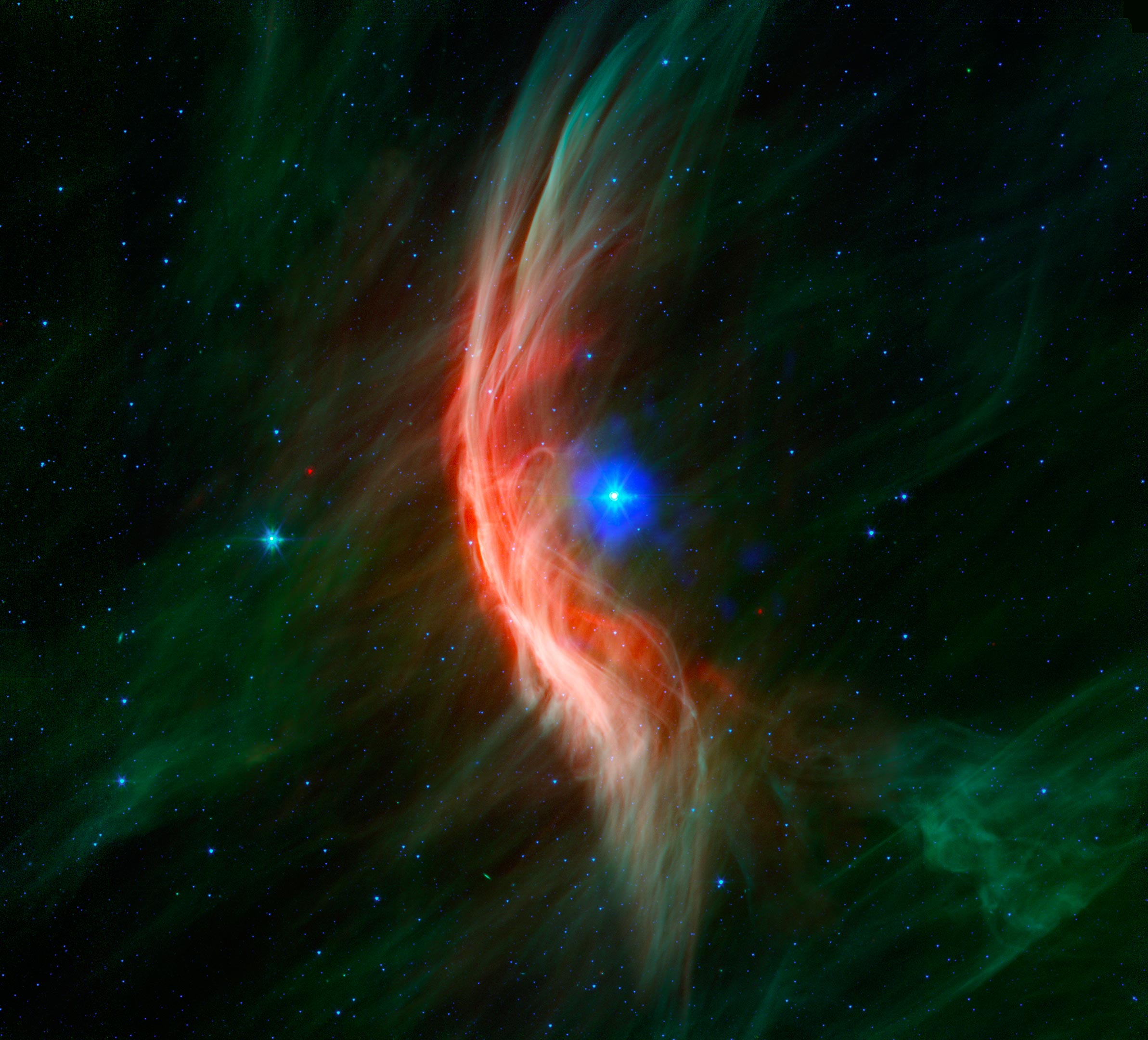
    Zeta Ophiuchi was once in close orbit with another star, before being ejected when this companion was destroyed in a supernova explosion. Infrared data from Spitzer reveal a spectacular shock wave that was formed by matter blowing away from the star’s surface and slamming into gas in its path. Data from Chandra show a bubble of X-ray emission located around the star, produced by gas that has been heated by the shock wave to tens of millions of degrees. The Chandra data help tell more of the story of this runaway star. Credit: X-ray: NASA/CXC/Univ. of Cambridge/J. Sisk-Reynés et al.; Radio: NSF/NRAO/VLA; Optical: PanSTARRS
    • Zeta Ophiuchi is a single star that likely once had a companion that was destroyed when it went supernova.
    • The supernova explosion sent Zeta Ophiuchi, seen in Spitzer (green and red) and Chandra data (blue), hurtling through space.
    • X-rays detected by Chandra originate from gas that has been heated to millions of degrees by the effects of a shock wave.
    • Scientists are working to match computational models of this object to explain data obtained at different wavelengths.

    Zeta Ophiuchi is a star with a complicated past, as it was likely ejected from its birthplace by a powerful stellar explosion. A detailed new look by NASA’s Chandra X-ray Observatory helps tell more of the history of this runaway star.

    Located approximately 440 light-years from Earth, Zeta Ophiuchi is a hot star that is about 20 times more massive than the Sun. Evidence that Zeta Ophiuchi was once in close orbit with another star, before being ejected at about 100,000 miles per hour (45,000 meters per second) when this companion was destroyed in a supernova explosion over a million years ago has been provided by previous observations.

    In fact, previously released infrared data from NASA’s now-retired Spitzer Space Telescope, seen in this new composite image, reveals a spectacular shock wave (red and green) that was formed by matter blowing away from the star’s surface and slamming into gas in its path. A bubble of X-ray emission (blue) located around the star, produced by gas that has been heated by the effects of the shock wave to tens of millions of degrees, is revealed by data from Chandra.

    A team of astronomers has constructed the first detailed computer models of the shock wave. They have begun testing whether the models can explain the data obtained at different wavelengths, including X-ray, infrared, optical, and radio observations. All three of the different computer models predict fainter X-ray emissions than observed. In addition, the bubble of X-ray emission is brightest near the star, whereas two of the three computer models predict the X-ray emission should be brighter near the shock wave. The team of astronomers was led by Samuel Green from the Dublin Institute for Advanced Studies in Ireland.

    In the future, these scientists plan to test more complicated models with additional physics — including the effects of turbulence, and particle acceleration — to see whether the agreement with X-ray data will improve.

    A paper describing these results has been accepted in the journal Astronomy and Astrophysics. The Chandra data used here was originally analyzed by Jesús Toala from the Institute of Astrophysics of Andalucia in Spain, who also wrote the proposal that led to the observations.

    Reference: “Thermal emission from bow shocks. II. 3D magnetohydrodynamic models of zeta Ophiuchi” by S. Green, J. Mackey, P. Kavanagh, T. J. Haworth, M. Moutzouri and V. V. Gvaramadze, 9 September 2022, Astronomy & Astrophysics.
    DOI: 10.1051/0004-6361/202243531

    NASA’s Marshall Space Flight Center manages the Chandra program. The Smithsonian Astrophysical Observatory’s Chandra X-ray Center controls science operations from Cambridge, Massachusetts, and flight operations from Burlington, Massachusetts.

    Never miss a breakthrough: Join the SciTechDaily newsletter.
    Follow us on Google and Google News.

    Astronomy Astrophysics Chandra X-ray Observatory NASA Popular
    Share. Facebook Twitter Pinterest LinkedIn Email Reddit

    Related Articles

    X-Ray Echoes Unveil the Hidden 3D Landscape of Our Galaxy’s Heart

    Black Holes Cook Their Own Fuel in a Cosmic Feast

    Black Hole Tears Star to Shreds, Unleashing Cosmic Shockwaves

    Centaurus A’s Massive 13,000 Light-Year Jet Captured in Stunning Detail

    Historic Discovery: Twin Titans Clash As NASA Unveils Closest Supermassive Black Hole Duo

    Astronomical Appetite: NASA Telescopes Decode a Supermassive Black Hole’s Snack Schedule

    Chandra’s Epic Anniversary: 25 Breathtaking New Images Unveiling Cosmic Discoveries

    Telescopes Reveal Rapid Spin of Milky Way’s Black Hole Warping Spacetime

    Breaking the Cosmic Code: NASA Telescopes Start the Year With a Double Bang

    Leave A Reply Cancel Reply

    • Facebook
    • Twitter
    • Pinterest
    • YouTube

    Don't Miss a Discovery

    Subscribe for the Latest in Science & Tech!

    Trending News

    Why Popular Diabetes Drugs Like Ozempic Don’t Work for Everyone: The “Genetic Glitch”

    Scientists Stunned After Finding Plant Thought Extinct for 60 Years

    Scientists Discover Tiny New Spider That Hunts Prey 6x Its Size

    Natural Component From Licorice Shows Promise for Treating Inflammatory Bowel Disease

    Scientists Warn: Popular Sweetener Linked to Dangerous Metabolic Effects

    Monster Storms on Jupiter Unleash Lightning Beyond Anything on Earth

    Scientists Create “Liquid Gears” That Spin Without Touching

    The Simple Habit That Could Help Prevent Cancer

    Follow SciTechDaily
    • Facebook
    • Twitter
    • YouTube
    • Pinterest
    • Newsletter
    • RSS
    SciTech News
    • Biology News
    • Chemistry News
    • Earth News
    • Health News
    • Physics News
    • Science News
    • Space News
    • Technology News
    Recent Posts
    • Seeing the Invisible: Scientists Develop New Way To Track Particles in 3D
    • The Atomic Gap That Could Cost the Semiconductor Industry Billions
    • Earth’s Secret Advantage: Why Most Alien Worlds May Be Too Dry for Life
    • Ancient Bacteria Turned a DNA System Into a Cell Skeleton
    • Researchers Finally Solve 50-Year-Old Blood Group Mystery
    Copyright © 1998 - 2026 SciTechDaily. All Rights Reserved.
    • Science News
    • About
    • Contact
    • Editorial Board
    • Privacy Policy
    • Terms of Use

    Type above and press Enter to search. Press Esc to cancel.