
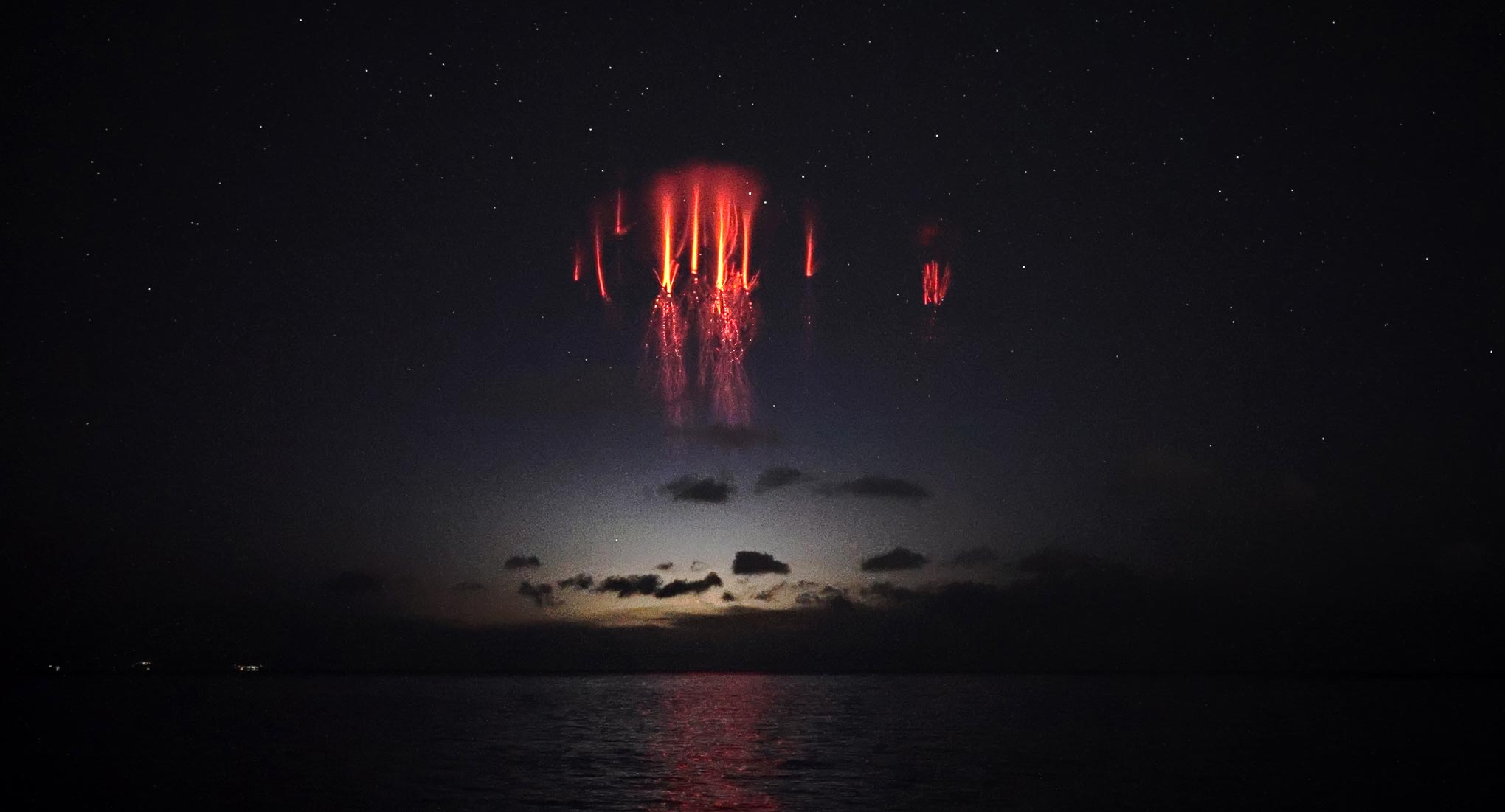
NASA’s Spritacular project calls on the public to photograph sprites, rare electrical phenomena above thunderstorms, to build a database that could answer longstanding scientific questions about these mysterious atmospheric phenomena.
A flash of lightning, and then – something else. High above the storm, a crimson figure blinks in and out of existence. If you saw it, you are a lucky witness to a sprite, one of the least-understood electrical phenomena in Earth’s upper atmosphere. But if you caught it on camera, your photo could contribute to a ground-breaking scientific discovery.
Spritacular (pronounced sprite–tacular), NASA’s newest citizen science project, leverages the power of crowdsourcing to advance the study of sprites and other Transient Luminous Events, or TLEs. TLEs include a range of electrical phenomena that occur above thunderstorms and produce brief flashes of light. The new citizen science project aims to connect professional scientists with members of the public who would like their camerawork to contribute to scientific studies.
“People capture wonderful images of sprites, but they’re shared sporadically over the internet and most of the scientific community is unaware of these captures,” said Dr. Burcu Kosar, Spritacular principal investigator. “Spritacular will bridge this gap by creating the first crowdsourced database of sprites and other TLEs that is accessible and readily available for scientific research.” Kosar is a space physicist at NASA’s Goddard Space Flight Center in Greenbelt, Maryland.
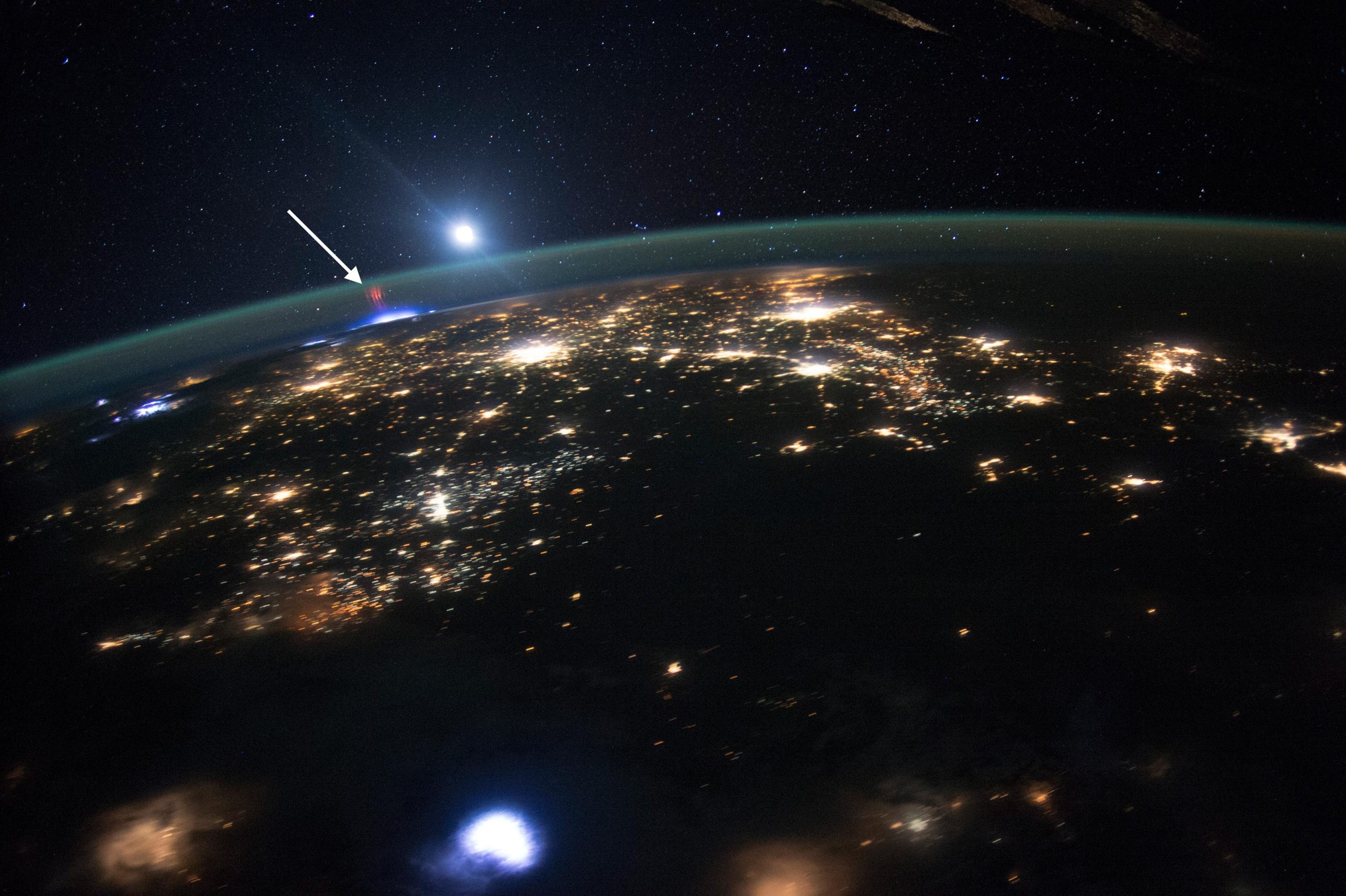
Sprites occur at around 50 miles (80 kilometers) in altitude, high above thunderstorms. They appear moments after a lightning strike – a sudden reddish flash that can take a range of shapes, often combining diffuse plumes and bright, spiny tendrils. Some sprites tend to dance over the storms, turning on and off one after another. There are many questions about how and why they form that remain unanswered.
Eyewitness reports of strange flashes of light above thunderstorms date back hundreds of years, but it wasn’t until 1989 that the first such event was caught on camera. Researchers from the University of Minnesota were testing a low-light TV camera for an upcoming rocket flight mission. By sheer accident, their camera captured the very first credible evidence for what we now call sprites.
“It wasn’t a very high resolution or fast camera – they just captured two luminous blobs above a nearby thunderstorm,” Kosar said. “The whole field was kickstarted because a camera was pointed in the right direction at the right time.”
Scientists dubbed these elusive events “sprites,” a reference to mythical fairy-like creatures from European folklore. As other kinds of TLEs were discovered, the playful naming convention stuck. Today, scientists study ELVES, Halos, Blue Jets, Gigantic Jets, and more.
Unanswered Questions about Sprites and TLEs
Yet we still have far too few observations of sprites and other TLEs, and there is much we don’t know. Some of the major outstanding questions include:
- How often do sprites occur? Why do they take the shapes they do?
- What conditions in the upper atmosphere trigger sprite initiation?
- How do sprites affect Earth’s global electric circuit, and what is their contribution to the energy in Earth’s upper atmosphere?
- How are sprites connected with gravity waves, which send wind-driven ripples of energy through our upper atmosphere?
Answering these questions could lead to major advances in the science of Earth’s upper atmosphere. But to get there, Spritacular needs your help!
Become a Spritacular Citizen Scientist
The first goal of Spritacular is to build an image database: A collection of observations of sprites and other TLEs that will help answer the questions above.
Many commercially available, digital single-lens reflex (DSLR) cameras are suitable for capturing sprites. The hardest part is knowing when and where to look. By bringing together experienced “sprite-chasers” and providing educational support and resources, Spritacular aims to provide all the guidance you need for a successful capture.
If you believe you have captured a photo of a sprite or other TLEs, you can create an account and then submit your photos and photo details (time and location of the photo) to Spritacular. Accurate time and location details are preferred, but approximate time and location will also be accepted with sufficient detail. To submit a photo, you must be the photographer who captured it.
All submitted photos will be reviewed by scientists. Submitters who collaborate with scientists and whose image leads to a scientific study or discovery will be properly acknowledged or listed as a coauthor on the resulting scientific publication, depending on the level of contribution.
The broader goal of Spritacular is to foster a mutual exchange between observers of TLEs and the scientific community and to inspire citizen scientists all around the world to participate in the investigation of these elusive events. As the Spritacular community and image database grows, Kosar is planning to implement new software tools to automatically cross-reference submissions with databases on lightning and thunderstorms. These tools will allow users to analyze their own images and contribute to the scientific method.
Spritacular is a NASA-funded citizen science project in collaboration with the Catholic University of America in Washington, D.C. The principal Investigator is Dr. Burcu Kosar and Co-Investigator is Dr. Jia Yue.
Never miss a breakthrough: Join the SciTechDaily newsletter.
Follow us on Google and Google News.
5 Comments
Regarding the ‘Title picture’ – I presume that as a Meteorology dilettante I would not sound too silly if I ask: where are the thunderstorms clouds gone?
Atmospheric photography suffers from the same problem as photography out on the open ocean—there’s often nothing to inform the viewer’s frame of reference and give a sense of scale. The clouds of that thunderstorm are well over the horizon, and you can only see the sprite because it is enormous, towering tens of kilometers above the clouds.
Consider the second photo in the article, taken from the ISS. Depending on how far out the station is in its orbit at any given time, the visible horizon is anywhere from ~2000 to ~2400 km away. With that sprite appearing to be on or just past the edge of the horizon, it must be huge for the be astronauts to be able to see it from there!
It’s called ELECTRIC UNIVERSE THEORY WEATHER COMES FROM SPACE YES LIGHTNING TO!!!!
Def, Paul Metrich. It should be widely accepted long ago, but now I know precisely what is meant when people talk about entrenched and biased interests. Not sure what’s so controversial. It’s widely accepted the charge of a body after rubbing socked feet on a rug, and a doorknob, is enough to zap a person, so why wouldn’t the same hold true for earth and interstellar objects? Seems basic.
Have you ever looked into the New Madrid earthquake(s) of 1812 and the Tunguska event through this lens?
Not to be a wise acre, Caelia, but is it not equally possible that whoever took the photo instinctively but mistakenly linked the sprites and a thunderstorm that had already passed or not yet occurred? I mean if that’s photographic evidence of a sprite over a thunderstorm then some photographer really krapt the bed! And if it were 50 miles up, and the horizon is 3 miles off (so I’ve been told), wouldn’t the angle of the shot be almost vertical? A roof with a 3/50 angle would essentially be an ultra skinny church steeple.