
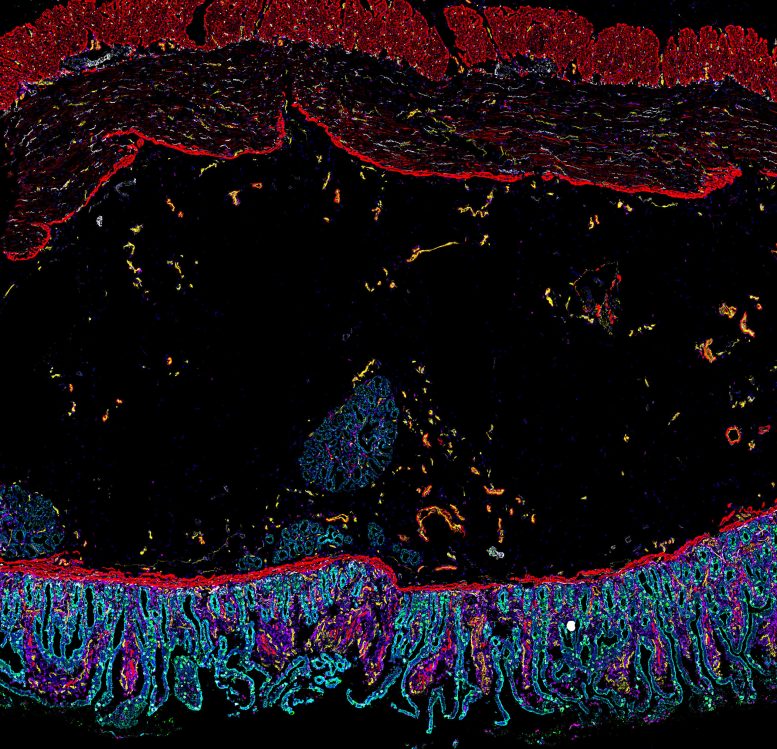
Stanford researchers created a high-resolution map of the intestine, identifying 20 cellular “neighborhoods” that regulate digestion and immune response. The study revealed links between obesity, hypertension, and immune activity, suggesting early disease markers.
When you think about your ideal neighborhood, perhaps you think of tree-lined streets or a close-knit community of people who help each other. You probably don’t think about your digestive system.
But maybe you should. According to a team of scientists led by researchers at Stanford Medicine, there are indeed “neighborhoods” of different cell types cooperating to digest your food and protect you from infection, among other things — and a new, ultra-high-resolution map of these neighborhoods proves your intestine is both functionally impressive and visually striking.
Just like human neighborhoods, which have common elements such as streets, restaurants, and houses in varying numbers, cellular neighborhoods are made up of different quantities of cell types with specific functions. By combining several new imaging and sequencing technologies, the researchers were able to map these neighborhoods down to the level of individual cells.
“This is the first time anyone has made a spatial map of the intestine at the single-cell level,” said Michael Snyder, PhD, professor and chair of genetics and co-senior author of the research, published July 19 in Nature. “It was a bit like exploring a new planet, in that we didn’t know exactly what cell types we would find or how they would be organized.”
Mapping the Gut
Researchers from multiple laboratories, at Stanford Medicine and other institutions, participated in the new mapping effort, part of the Human BioMolecular Atlas Program founded by the National Institutes of Health. Scientists in the program aim to create a comprehensive cellular map of the human body.
To map the gut, scientists examined eight regions of the small and large intestine from nine deceased donors. Using a technology called co-detection by indexing, or CODEX, which involves staining and washing the tissue repeatedly with fluorescent antibodies (substances that bind certain proteins and enable imaging), the researchers identified 20 distinct cellular neighborhoods based on the relative abundance of each cell type.
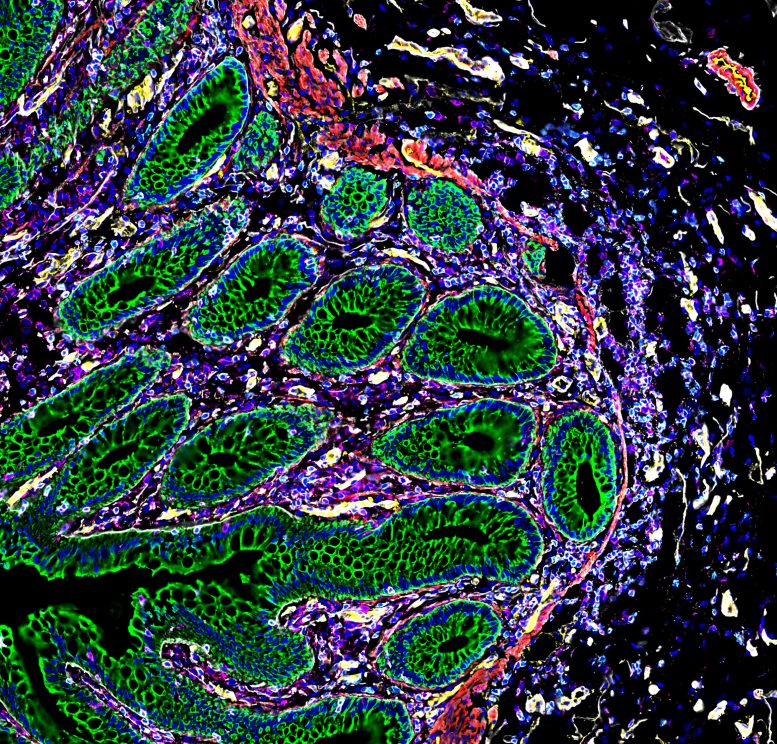
Additional molecular analysis of RNA and chromosomal material from some of the samples provided an even greater level of detail within each cell type.
“Our maps are intended to be a reference for a healthy intestine, with which we can compare everything from irritable bowel disease to early-stage colon cancer,” said Snyder, the Stanford W. Ascherman, MD, FACS Professor in Genetics. “This will be foundational for our understanding of all kinds of digestive diseases.”
Neighborhoods of Specialized Cells
Roughly 20 feet long, the intestine absorbs nutrients from food and protects the body from invading microbes, while also maintaining a healthy balance of the beneficial bacteria that aid digestion.
To perform these tasks, the intestine employs a variety of cell types, including epithelial cells that make up the intestinal lining, connective tissue cells, nerve cells, and immune cells. With the new maps, scientists were able to pinpoint where each cell type is located and which other cells they associate with.
“Looking at the presence or absence of a single cell doesn’t tell you much,” said Garry Nolan, Ph.D., the Rachford and Carlota A. Harris Professor and a professor of pathology, who led the research along with Snyder, the director of the Center for Genomics and Personalized Medicine, and William Greenleaf, Ph.D., professor of genetics. “It’s how cells are grouped together that defines their functionality.”
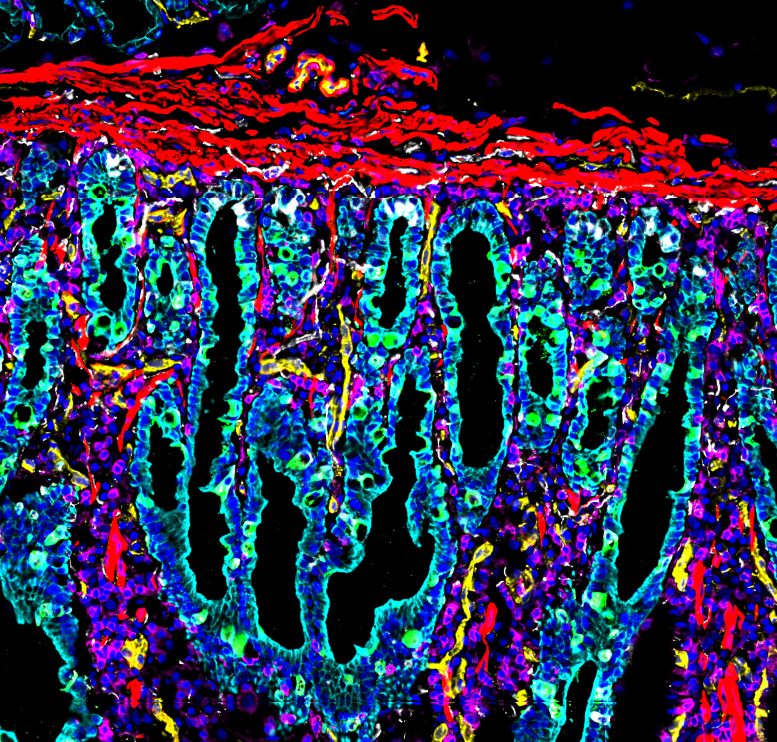
The researchers also wanted to see how the organization of healthy tissue changed throughout the digestive tract, from closer to the stomach to closer to the rectum. “What’s normal in one region might be a sign of disease in another,” said John Hickey, PhD, postdoctoral scholar in microbiology and immunology, and first author on the paper.
Some neighborhoods, such as the one dominated by smooth muscle cells (which control involuntary movements) became more common toward the end of the colon, while other neighborhoods composed primarily of immune cells became less common.
Associations With BMI and Hypertension
In addition to creating a reference for healthy tissue, the new maps revealed some interesting clinical connections. For instance, the researchers found that donors with higher body mass index had a greatly increased number of M1 macrophages, a type of immune cell associated with inflammation.
“People who have a higher body mass index, especially above certain levels, are known to have higher risk for gastrointestinal disease,” Hickey said. “Many of those diseases are associated with chronic inflammation. Even though these donors didn’t have a history of GI disease, the increase in macrophages could be an indicator of a pre-disease process.”
Donors with a history of hypertension also had fewer immune cells of a different type, called CD8 T cells, which play a role in seeking out and destroying possible cancer cells. With the spatial map, the researchers were able to see that the CD8 T cells were missing from one particular neighborhood within the epithelial cells lining the intestine.
“This was an unexpected but important result,” Hickey said, “because we know the immune system plays a role in preventing cancer by pruning out malignant cells. If you have fewer CD8 T cells, you might have a higher risk of cancer.” Indeed, research has shown that patients with hypertension are more likely to develop colorectal cancer.
Future Directions
In this study, all nine samples came from adult donors, and the majority were white and male. “One of our biggest next steps is to increase the diversity of the samples,” Snyder said. “Our goal is to get a much more comprehensive set of individuals, including multiple ethnic backgrounds and age groups.”
The scientists also hope to map the intestine in three dimensions, which will help them better visualize the networks of nerves and blood vessels in the healthy intestine.
“You can’t understand dysfunction until you understand what’s normal,” Nolan said.
Reference: “Organization of the human intestine at single-cell resolution” by John W. Hickey, Winston R. Becker, Stephanie A. Nevins, Aaron Horning, Almudena Espin Perez, Chenchen Zhu, Bokai Zhu, Bei Wei, Roxanne Chiu, Derek C. Chen, Daniel L. Cotter, Edward D. Esplin, Annika K. Weimer, Chiara Caraccio, Vishal Venkataraaman, Christian M. Schürch, Sarah Black, Maria Brbić, Kaidi Cao, Shuxiao Chen, Weiruo Zhang, Emma Monte, Nancy R. Zhang, Zongming Ma, Jure Leskovec, Zhengyan Zhang, Shin Lin, Teri Longacre, Sylvia K. Plevritis, Yiing Lin, Garry P. Nolan, William J. Greenleaf and Michael Snyder, 19 July 2023, Nature.
DOI: 10.1038/s41586-023-05915-x
Never miss a breakthrough: Join the SciTechDaily newsletter.
Follow us on Google and Google News.