
Close Menu
    Facebook X (Twitter) Instagram
    SciTechDaily
    • Biology
    • Chemistry
    • Earth
    • Health
    • Physics
    • Science
    • Space
    • Technology
    Facebook X (Twitter) Pinterest YouTube RSS
    SciTechDaily
    Home»Health»Starved Worms Reveal a Hidden Switch for Cellular Aging
    Health

    Starved Worms Reveal a Hidden Switch for Cellular Aging

    By Max Planck Institute for Biology of AgingJuly 4, 2025No Comments3 Mins Read
    Facebook Twitter Pinterest Telegram LinkedIn WhatsApp Email Reddit
    Share
    Facebook Twitter LinkedIn Pinterest Telegram Email Reddit
    Old Hands Aging Clock Time
    Researchers have discovered that worms, like mammals, can enter a senescent-like state when key cellular regulators are disrupted, opening new possibilities for studying aging and cellular dormancy at the whole-organism level. Credit: Stock

    Worms offer a simple yet powerful whole-organism model for studying senescence, mirroring mammalian aging processes and enabling research into age-related diseases and dormant cancer therapies.

    Researchers triggered a senescent-like state in worms by altering the activity of the transcription factor TFEB. Typically, when worms go through an extended period of fasting and are then reintroduced to food, they regenerate and show signs of rejuvenation.

    But without TFEB, the worms’ stem cells are unable to recover after fasting. Instead, they enter a state resembling cellular senescence. This condition is marked by several indicators, including DNA damage, enlargement of the nucleolus, increased production of mitochondrial reactive oxygen species (ROS), and the activation of inflammatory signals. These features closely mirror those seen in aging cells in mammals.

    “We present a model for studying senescence at the level of the entire organism. It provides a tool to explore how senescence can be triggered and overcome,” explains Adam Antebi, head of the study and director at the Max Planck Institute for Biology of Aging.
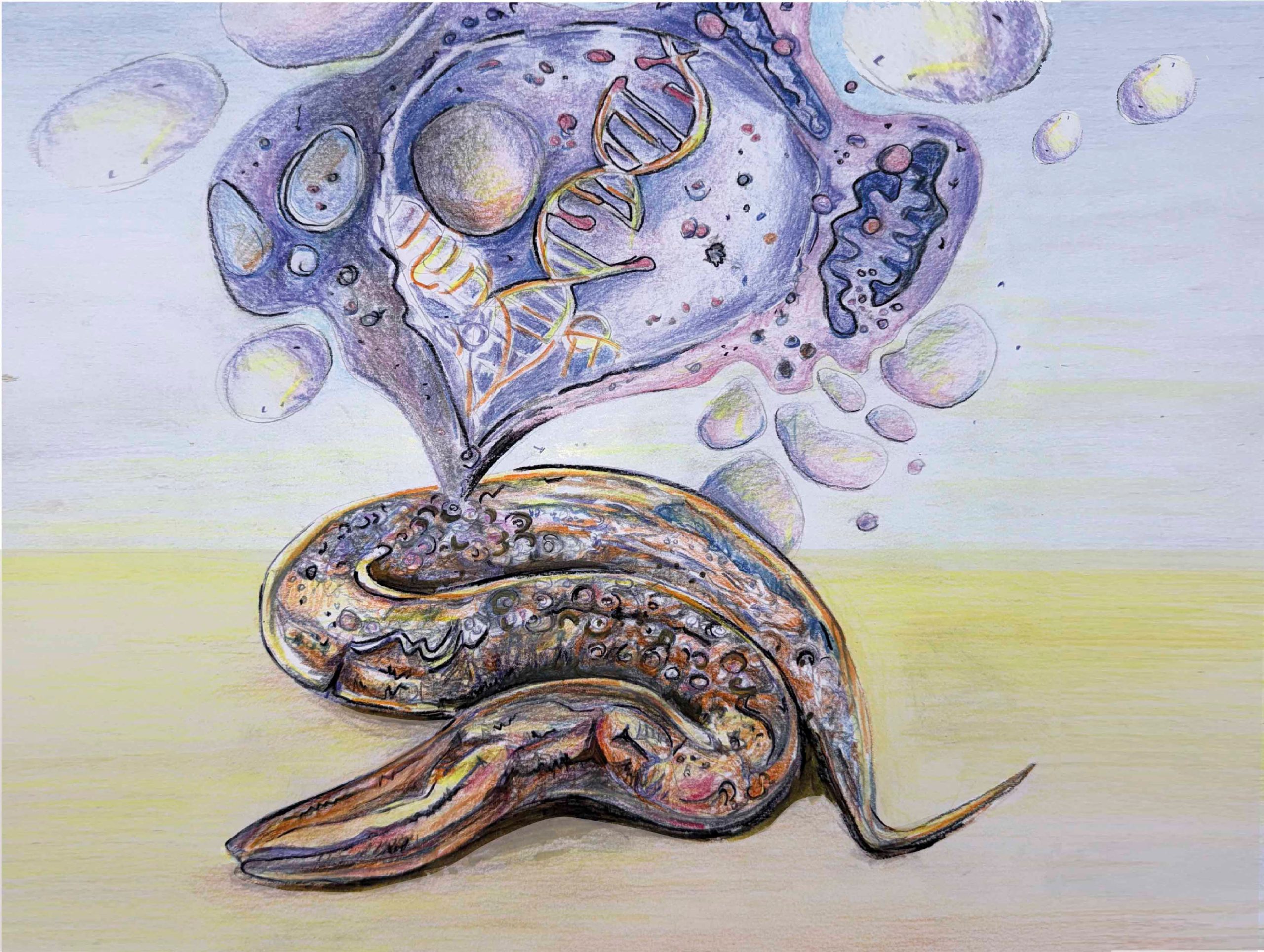
    Worm Senescence Drawing
    Worms can enter a senescence-like state. Credit: B. Gerisch/ Max Planck Institute for Biology of Aging

    The TFEB-growth factor axis

    TFEB is a transcription factor involved in cellular responses to nutrient availability. It plays a crucial role in responding to fasting by regulating gene expression. In its absence, worms attempt to initiate growth programs without sufficient nutrients, leading to senescence.

    “With our new model, we conducted genetic screens to identify mutations that can circumvent senescence. We identified growth factors, including insulin and transforming growth factor beta (TGFbeta), as the key signaling molecules that are dysregulated upon TFEB loss,” Antebi explains.

    The TFEB-TGFbeta signaling axis is also regulated during cancer diapause, a state in which cancer cells remain in a dormant, non-dividing condition to survive chemotherapy. In the future, the researchers want to test whether their worm model can be used to find new treatments targeting senescent cells during aging as well as cancer dormancy.

    Reference: “A TFEB–TGFβ axis systemically regulates diapause, stem cell resilience and protects against a senescence-like state” by Tim J. Nonninger, Jennifer Mak, Birgit Gerisch, Valentina Ramponi, Kazuto Kawamura, Roberto Ripa, Klara Schilling, Christian Latza, Jonathan Kölschbach, Manuel Serrano and Adam Antebi, 30 June 2025, Nature Aging.
    DOI: 10.1038/s43587-025-00911-4

    Never miss a breakthrough: Join the SciTechDaily newsletter.
    Follow us on Google and Google News.

    Aging Genetics Max Planck Institute Molecular Biology Regenerative Medicine
    Share. Facebook Twitter Pinterest LinkedIn Email Reddit

    Related Articles

    As Our Gut Ages, Key Genes Fall Silent. Scientists Now Know Why

    Rewriting the Rules of Aging: New Chromatin Discovery Challenges Conventional Wisdom

    Geneticists Fully Decode a New Genome for Regeneration Research

    New Strategy for the Elimination of Cancer Stem Cells and Cancer Recurrence

    Scientists Discover a Gene for Brain Size

    New PhenIX Diagnostic Procedure Identifies Genetic Diseases

    Researchers Show Potential Basis for the Treatment and Prevention of Parkinson’s Disease

    Naturally Occurring Molecule Enhances Defense Mechanisms Against Neurodegenerative Diseases

    Role of the SMN Gene in Spinal Muscular Atrophy

    Leave A Reply Cancel Reply

    • Facebook
    • Twitter
    • Pinterest
    • YouTube

    Don't Miss a Discovery

    Subscribe for the Latest in Science & Tech!

    Trending News

    New “Nanozyme Hypothesis” Could Rewrite the Story of Life’s Origins

    Anatomy Isn’t Finished: The Human Body Still Holds Secrets

    “Pretty Close to Home”: The Hidden Earthquake Threat Beneath Seattle

    The Surprising Reason You Might Want To Sleep Without a Pillow

    Scientists Say This Natural Hormone Reverses Obesity by Targeting the Brain

    35-Million-Year-Old Mystery: Strange Arachnid Discovered Preserved in Amber

    Is AI Really Just a Tool? It Could Be Altering How You See Reality

    JWST Reveals a “Forbidden” Planet With a Baffling Composition

    Follow SciTechDaily
    • Facebook
    • Twitter
    • YouTube
    • Pinterest
    • Newsletter
    • RSS
    SciTech News
    • Biology News
    • Chemistry News
    • Earth News
    • Health News
    • Physics News
    • Science News
    • Space News
    • Technology News
    Recent Posts
    • Hidden Oceans of Magma Could Be Protecting Alien Life
    • After Decades of Searching, Astronomers Finally Track Down the Universe’s Missing Hydrogen
    • Scientists Capture Hidden Electron Patterns Inside Quantum Materials
    • New Study Challenges Alzheimer’s Theories: It’s Not Just About Plaques
    • Scientists Discover Way To Treat Lung Cancer and Its Deadly Side Effect Together
    Copyright © 1998 - 2026 SciTechDaily. All Rights Reserved.
    • Science News
    • About
    • Contact
    • Editorial Board
    • Privacy Policy
    • Terms of Use

    Type above and press Enter to search. Press Esc to cancel.