
Close Menu
    Facebook X (Twitter) Instagram
    SciTechDaily
    • Biology
    • Chemistry
    • Earth
    • Health
    • Physics
    • Science
    • Space
    • Technology
    Facebook X (Twitter) Pinterest YouTube RSS
    SciTechDaily
    Home»Health»New Strategy for the Elimination of Cancer Stem Cells and Cancer Recurrence
    Health

    New Strategy for the Elimination of Cancer Stem Cells and Cancer Recurrence

    By Dr. Joseph Regan, Charité - Universitätsmedizin BerlinJanuary 19, 2018No Comments3 Mins Read
    Facebook Twitter Pinterest Telegram LinkedIn WhatsApp Email Reddit
    Share
    Facebook Twitter LinkedIn Pinterest Telegram Email Reddit
    New Strategy for the Elimination of Cancer Stem Cells and the Prevention of Cancer Recurrence
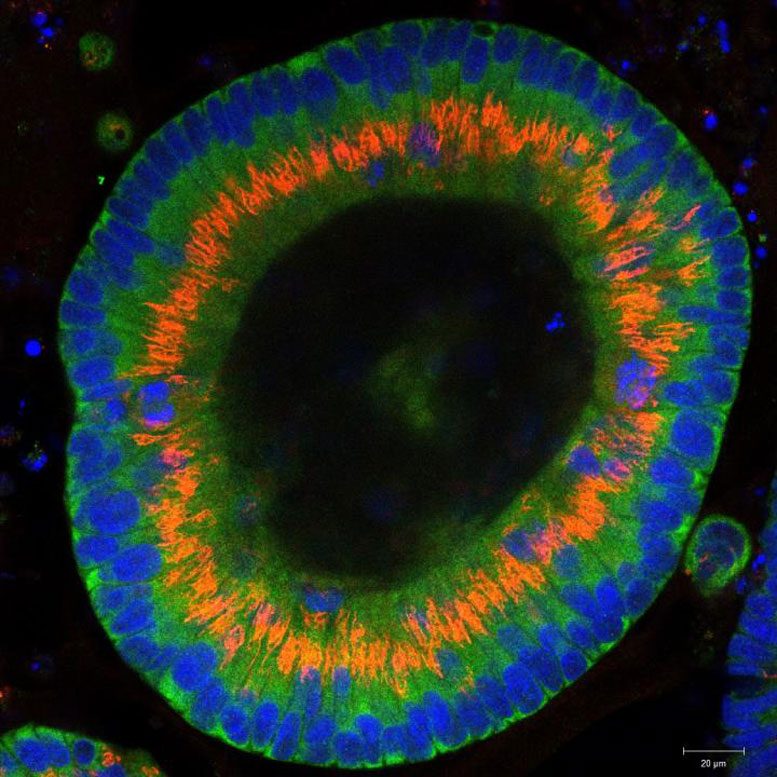
    Colon cancer cells grow into three-dimensional organoids in the culture dish. Credit: Dr. Joseph Regan / Charité – Universitätsmedizin Berlin

    Colon cancer is the third most common cancer and fourth most common cause of death worldwide. Colon tumors consist of different types of cells, which play different roles in the growth of the tumor. The development and spread of cancer are thought to be caused by a subpopulation of cells that possess stem cell characteristics, including the capacity for self-renewal, differentiation, and therapy resistance. These ‘cancer stem cells’ are also thought to be the source of cancer recurrence following initial treatment success.

    As part of OncoTrack project (an international consortium of scientists funded as part of the European Innovative Medicines Initiative), Dr. Joseph Regan and his colleagues at the Charité Comprehensive Cancer Center (CCCC) – working with scientists from the Max Planck Institute for Molecular Genetics, the Medical University of Graz and Bayer AG -investigated a treatment option aimed at treating cancers via the targeted elimination of cancer stem cells. Potentially capable of significantly improving treatment outcomes, this approach requires an in-depth understanding of both the relevant cellular communication pathways within the stem cells, and of the genes regulating them.

    As part of the current study, the researchers carried out genetic sequencing of the colon cancer stem cells and performed functional studies using both mouse models and 3D cell cultures from patient-derived cancer cells. Their research revealed that cancer stem cell survival is controlled by a specific feature of the Hedgehog signaling pathway (SHH-PTCH1), which allows cells to respond to external signals in addition to inhibiting stem cell differentiation.

    “The targeted inhibition of the Hedgehog signaling pathway, used in combination with other standard treatments to shrink tumors, may provide a new strategy for the elimination of cancer stem cells and the prevention of cancer recurrence,” explains Dr. Regan. Similar targeting of the Hedgehog signaling pathway has also produced promising results in other preclinical studies on pancreatic and breast cancer cells. He adds: “Future research will set out to better define the downstream signaling components of the pathway and further investigate how Hedgehog signaling controls cancer stem cell survival.”

    Reference: “Non-Canonical Hedgehog Signaling Is a Positive Regulator of the WNT Pathway and Is Required for the Survival of Colon Cancer Stem Cells” by Joseph L. Regan, Dirk Schumacher, Stephanie Staudte, Andreas Steffen, Johannes Haybaeck, Ulrich Keilholz, Caroline Schweiger, Nicole Golob-Schwarzl, Dominik Mumberg, David Henderson, Hans Lehrach, Christian R.A. Regenbrecht, Reinhold Schäfer and Martin Lange, 5 December 2017, Cell Reports.
    DOI: 10.1016/j.celrep.2017.11.025

    Never miss a breakthrough: Join the SciTechDaily newsletter.
    Follow us on Google and Google News.

    Cancer Genetics Medicine Molecular Biology
    Share. Facebook Twitter Pinterest LinkedIn Email Reddit

    Related Articles

    New Test Helps Identify People at Risk for Five Deadly Diseases

    Molecular Switch Serves as New Target Point for Cancer and Diabetes Therapies

    Scientists Suggest New Treatment for Rare Inherited Cancers

    Researchers Develop New Approach to Personalized Cancer Treatment

    Scientists Reveal a New Therapeutic Target To Fight Metastasis in Ovarian Cancer

    Neu5Gc Sugar is Related to the Appearance of Spontaneous Tumors in Humans

    New Research Shows Cellular Clean-Up Can Also Sweep Away Forms of Cancer

    Researchers Develop New Method for Making “Blood Biopsies”

    MIT Develops New Model To Speed Up Colon Cancer Research

    Leave A Reply Cancel Reply

    • Facebook
    • Twitter
    • Pinterest
    • YouTube

    Don't Miss a Discovery

    Subscribe for the Latest in Science & Tech!

    Trending News

    Scientists Discover How Coffee Impacts Memory, Mood, and Gut Health

    Why Did the Neanderthals Disappear? Scientists Reveal Humans Had a Hidden Advantage

    Physicists Propose Strange Experiment Where Time Goes Quantum

    Magnesium Magic: New Drug Melts Fat Even on a High-Fat, High-Sugar Diet

    Weight-Loss Drugs Like Ozempic May Come With an Unexpected Cost

    Mezcal “Worm” in a Bottle Mystery: DNA Testing Reveals a Surprise

    New Research Reveals That Your Morning Coffee Activates an Ancient Longevity Switch

    This Is What Makes You Irresistible to Mosquitoes

    Follow SciTechDaily
    • Facebook
    • Twitter
    • YouTube
    • Pinterest
    • Newsletter
    • RSS
    SciTech News
    • Biology News
    • Chemistry News
    • Earth News
    • Health News
    • Physics News
    • Science News
    • Space News
    • Technology News
    Recent Posts
    • This New Memory Technology Could Make Devices Last Months on One Charge
    • Scientists Turn Cancer’s Own Bacteria Against It in Breakthrough Therapy
    • Cannabis Can Make You Remember Things That Never Happened
    • Doctors Are Surprised by What This Vaccine Is Doing to the Heart
    • Quantum Breakthrough Turns Simple Forces Into Powerful New Interactions
    Copyright © 1998 - 2026 SciTechDaily. All Rights Reserved.
    • Science News
    • About
    • Contact
    • Editorial Board
    • Privacy Policy
    • Terms of Use

    Type above and press Enter to search. Press Esc to cancel.