

Close Menu
    Facebook X (Twitter) Instagram
    SciTechDaily
    • Biology
    • Chemistry
    • Earth
    • Health
    • Physics
    • Science
    • Space
    • Technology
    Facebook X (Twitter) Pinterest YouTube RSS
    SciTechDaily
    Home»Science»Stone Age Brainwaves: Uncovering the Cognitive Spark of Human Evolution
    Science

    Stone Age Brainwaves: Uncovering the Cognitive Spark of Human Evolution

    By Senckenberg Society for Nature ResearchDecember 6, 2024No Comments3 Mins Read
    Facebook Twitter Pinterest Telegram LinkedIn WhatsApp Email Reddit
    Share
    Facebook Twitter LinkedIn Pinterest Telegram Email Reddit
    Brain Evolution Tool Research
    A researcher demonstrates the tasks the participants were asked to perform during the experiment: on the left, cracking nuts and on the right, cutting leather using stone tools. Credit: Brienna Eteson/Source: Affinito et al., 2024

    A new study reveals that early humans’ ability to use tools precisely may have been pivotal in human evolution.

    By recording brain waves of participants using stone tools, the research identifies significant differences in brain activity required for different tool-using tasks, emphasizing the importance of the frontoparietal regions in cognitive development related to tool use.

    Brain Evolution and Early Tool Use

    A research team led by Dr. Alexandros Karakostis from the University of Tübingen’s Institute for Archaeological Science and the Senckenberg Centre for Human Evolution and Palaeoenvironment suggests that brain evolution may have enabled early humans to use tools with precision, driving the biocultural evolution that shaped modern humanity.

    The team approached the study innovatively, recording brain activity in participants as they used stone tools similar to those employed by early humans. The findings were published in the journal Scientific Reports.

    The Role of Technology in Human Evolution

    “Technological innovations were crucial for human evolution,” says Alexandros Karakostis. “We are interested in what cognitive developments were necessary for the use of relatively simple stone tools – and where humans and other primates differ in their abilities.”

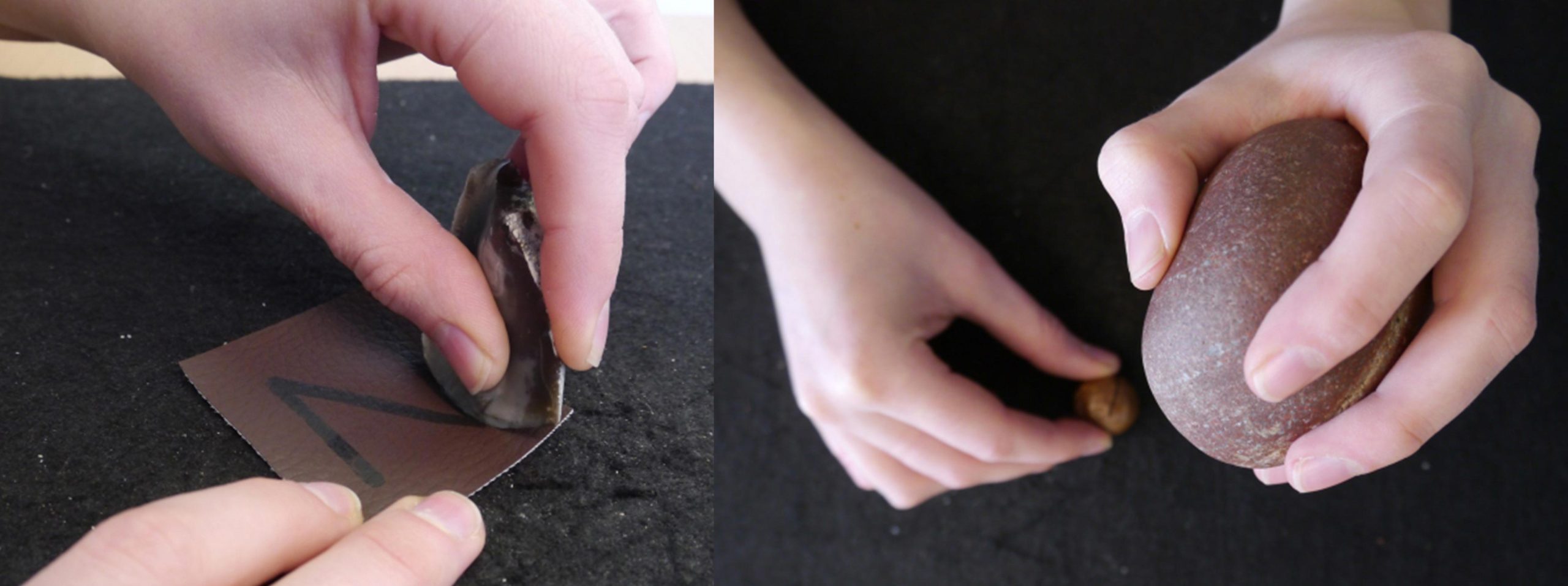
    In the experiment, the researchers investigated two distinct tool-use tasks. Participants first cracked nuts using a stone hammer and then carved patterns into leather using chipped stone tools.
    Brain Evolution Tool Use Research
    A researcher demonstrates which tasks the participants were asked to perform during the experiment – here in the planning phase: on the left, making precise cuts in leather; on the right, cracking nuts using stone tools. Credit: Brienna Eteson/Source: Affinito et al., 2024

    “We replicated stone tools to mirror those discovered in the early archaeological record,” explains Simona Affinito, PhD student in Karakostis’ research group and first author of the study.

    While nut-cracking with stones has also been observed in various animals such as monkeys and apes, the habitual use of chipped stones for cutting is only seen in humans.

    Cognitive Differences in Early Tool Use

    The activity patterns in the test subjects’ brains were recorded in parallel in an electroencephalogram (EEG) as the subjects sought to complete the tasks.

    “Our study provides empirical evidence to support distinct patterns of brain activity during different behaviors and stages of early hominin tool use,” explains Affinito. “The involvement of the frontoparietal regions, particularly during the aiming stage, highlights the importance of these brain areas in planning motor actions.”

    Cognitive Implications of Early Human Tool Usage

    Although both tasks required cognitive effort, the use of cutting tools involved significantly more extensive brain activity than nut-cracking, Karakostis reports.

    “These differences implicitly highlight the cognitive performance required for precise tool-using tasks. They likely enabled early humans to appropriate and shape their environment in a way that was not possible before,” he says.

    The new study has created the basis for further research into the cognitive prerequisites for human technological progress.

    Reference: “Exploring the cognitive underpinnings of early hominin stone tool use through an experimental EEG approach” by Simona Affinito, Brienna Eteson, Lourdes Tamayo Cáceres, Elena Theresa Moos and Fotios Alexandros Karakostis, 19 November 2024, Scientific Reports.
    DOI: 10.1038/s41598-024-77452-0

    Never miss a breakthrough: Join the SciTechDaily newsletter.
    Follow us on Google and Google News.

    Anthropology Archaeology Brain Evolution Evolutionary Anthropology Senckenberg Society for Nature Research
    Share. Facebook Twitter Pinterest LinkedIn Email Reddit

    Related Articles

    New Evidence Shows Humans Mastered Fire Earlier Than Thought

    New View of Human Evolution Unearthed by Rare 10 Million-Year-Old Fossil [Video]

    Scientists Reveal the Complex Story Behind the Beaker Phenomenon

    Anthropologists Shed New Light on Prehistoric Human Migration

    Researchers Discover Oldest Images to Date of Dogs on Leashes

    New Findings Provide Further Evidence That Early Anthropoids Were Minuscule Creatures

    Scientists Discover A New Species of Hominin

    400,000 Year Old Fossil Helps Shed New Light on Human Evolution

    Million-Year-Old Ash in South African Cave Yields Evidence of Cooking

    Leave A Reply Cancel Reply

    • Facebook
    • Twitter
    • Pinterest
    • YouTube

    Don't Miss a Discovery

    Subscribe for the Latest in Science & Tech!

    Trending News

    Artificial Sweeteners May Harm Future Generations, Study Suggests

    Splashdown! NASA Artemis II Returns From Record-Breaking Moon Mission

    What If Consciousness Exists Beyond Your Brain

    Scientists Finally Crack the 100-Million-Year Evolutionary Mystery of Squid and Cuttlefish

    Beyond “Safe Levels”: Study Challenges What We Know About Pesticides and Cancer

    Researchers Have Found a Dietary Compound That Increases Longevity

    Scientists Baffled by Bizarre “Living Fossil” From 275 Million Years Ago

    Your IQ at 23 Could Predict Your Wealth at 27, Study Finds

    Follow SciTechDaily
    • Facebook
    • Twitter
    • YouTube
    • Pinterest
    • Newsletter
    • RSS
    SciTech News
    • Biology News
    • Chemistry News
    • Earth News
    • Health News
    • Physics News
    • Science News
    • Space News
    • Technology News
    Recent Posts
    • What if Dark Matter Has Two Forms? Bold New Hypothesis Could Explain a Cosmic Mystery
    • Researchers Expose Hidden Chemistry of “Ore-Forming” Elements in Biology
    • Geologists Reveal the Americas Collided Earlier Than We Thought
    • 20x Difference: Study Reveals True Source of Airborne Microplastics
    • Scientists Uncover Hidden Force Powering Yellowstone’s Supervolcano
    Copyright © 1998 - 2026 SciTechDaily. All Rights Reserved.
    • Science News
    • About
    • Contact
    • Editorial Board
    • Privacy Policy
    • Terms of Use

    Type above and press Enter to search. Press Esc to cancel.