
A newly described Patagonian fossil reveals the evolutionary origins and global spread of the tiny alvarezsaur dinosaurs.
Researchers led by University of Minnesota Twin Cities paleontologist Peter Makovicky and Argentine scientist Sebastian Apesteguía have identified a 90-million-year-old fossil that fills an important gap in the history of this unusual dinosaur group.
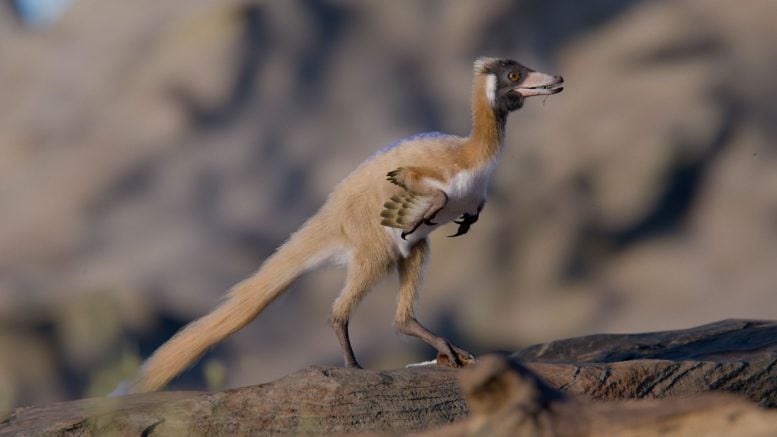
Their findings, published in the peer-reviewed journal Nature, describe a complete skeleton of Alnashetri cerropoliciensis. This dinosaur belonged to the alvarezsaurs, a lineage of bird-like theropods known for their tiny teeth and short forelimbs that ended in a single large thumb claw. Scientists have struggled for years to understand this group because most well-preserved fossils came from Asia, while discoveries in South America were usually incomplete and difficult to study.
Alnashetri belongs to a group of bird-like dinosaurs, known as alvarezsaurs, that are famous for their tiny teeth and stubby arms ending in a single large thumb claw. Credit: Universidad Nacional de Río Negro and University of Minnesota
The nearly complete fossil of Alnashetri was uncovered in 2014 in northern Patagonia, Argentina, at a location famous for its rich collection of Cretaceous fossils. The species had previously been named based on fragmentary remains, but the new specimen provided researchers with the first detailed look at its anatomy. Over the past decade, the team carefully prepared and assembled the delicate bones to avoid damaging them.
A Near-Complete Fossil Solves an Alvarezsaur Mystery
“Going from fragmentary skeletons that are hard to interpret to having a near-complete and articulated animal is like finding a paleontological Rosetta Stone,” said Peter Makovicky, lead author on the paper and a professor in the University of Minnesota Department of Earth and Environmental Sciences. “We now have a reference point that allows us to accurately identify more scrappy finds and map out evolutionary transitions in anatomy and body size.”
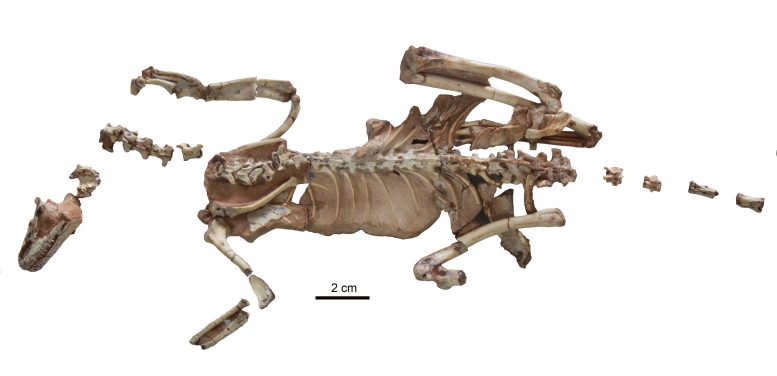
Having a nearly intact skeleton has given scientists new insight into how this group of dinosaurs evolved, became smaller over time, and spread across ancient continents.
- Alnashetri differed from its later relatives in several ways. It had longer arms and larger teeth, features that suggest early alvarezsaurs were not yet specialized for the insect-based feeding habits that later species developed. These findings indicate that some members of the group had already become tiny before evolving the adaptations associated with an ant-eating lifestyle.
- Microscopic examination of the bones indicated that the fossil belonged to a mature individual that was at least four years old. Alvarezsaurs rank among the smallest known non-avian dinosaurs and did not grow much larger. Even the biggest species reached only about the size of an average human, which is unusually small for dinosaurs. Alnashetri itself weighed less than 2 pounds, making it one of the tiniest dinosaurs ever identified from South America.
- By studying earlier alvarezsaur fossils housed in museums in North America and Europe, the researchers concluded that these dinosaurs appeared much earlier than previously believed. They likely originated when Earth’s continents were still joined together as the supercontinent Pangaea. As the continents gradually separated, the dinosaurs spread with them rather than crossing vast oceans.
La Buitrera Fossil Site Reveals Key Small Dinosaur Discoveries
The well-preserved skeleton was excavated from the La Buitrera fossil site, an area that has produced several scientifically important species, including early snakes and small saber-toothed mammals.
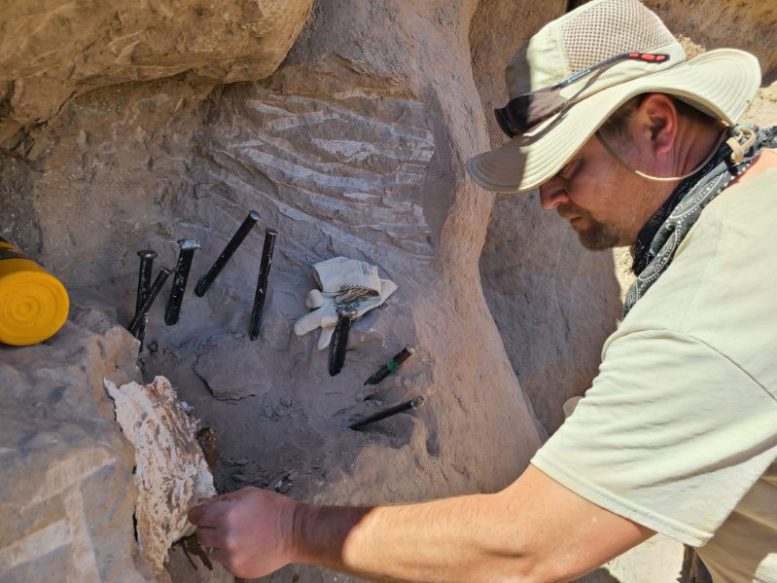
“After more than 20 years of work, the La Buitrera fossil area has given us a unique insight into small dinosaurs and other vertebrates like no other site in South America,” said Apesteguía, a researcher at Universidad Maimónides in Buenos Aires, Argentina.
Scientists are continuing to explore the region, and new discoveries are already emerging from the same area where Alnashetri was found. “We have already found the next chapter of the alvarezsaurid story there, and it is in the lab being prepared right now,” added Makovicky.
Reference: “Argentine fossil rewrites evolutionary history of a baffling dinosaur clade” by Peter J. Makovicky, Jonathan S. Mitchell, Jorge G. Meso, Federico A. Gianechini, Ignacio Cerda and Sebastian Apesteguía, 25 February 2026, Nature.
DOI: 10.1038/s41586-026-10194-3
The research was supported by the National Scientific and Technical Research Council (CONICET), The Field Museum, National Geographic, the University of Minnesota, the United States National Science Foundation, and the Fulbright U.S. Scholar program.
Never miss a breakthrough: Join the SciTechDaily newsletter.
Follow us on Google and Google News.