
Close Menu
    Facebook X (Twitter) Instagram
    SciTechDaily
    • Biology
    • Chemistry
    • Earth
    • Health
    • Physics
    • Science
    • Space
    • Technology
    Facebook X (Twitter) Pinterest YouTube RSS
    SciTechDaily
    Home»Science»Strange New Discovery Reveals UV Radiation Played a Part in Mass Extinction Events
    Science

    Strange New Discovery Reveals UV Radiation Played a Part in Mass Extinction Events

    By University of NottinghamJanuary 6, 20232 Comments3 Mins Read
    Facebook Twitter Pinterest Telegram LinkedIn WhatsApp Email Reddit
    Share
    Facebook Twitter LinkedIn Pinterest Telegram Email Reddit
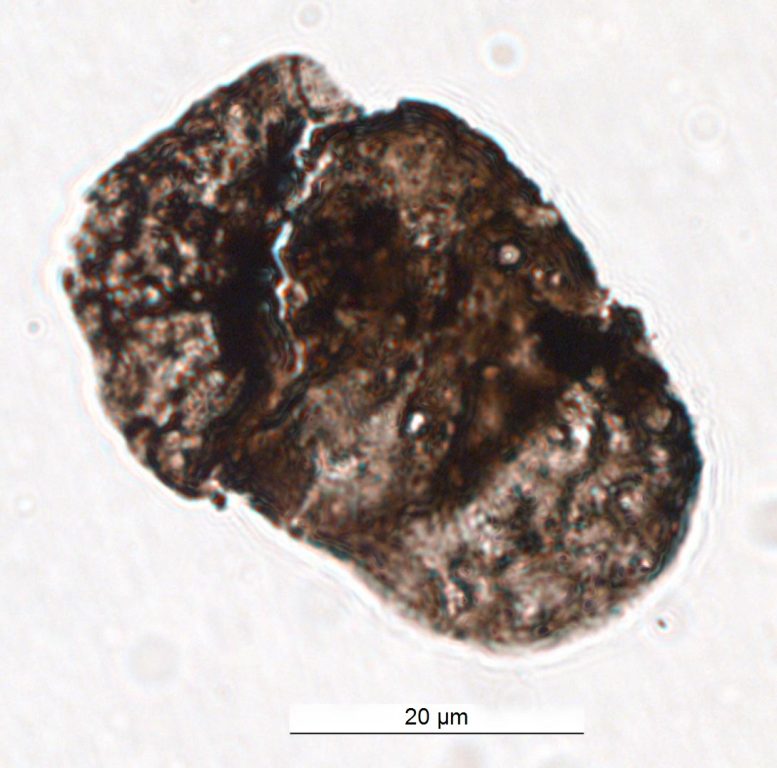
    Alisporites tenuicorpus
    Alisporites tenuicorpus the pollen grain used in this work. Note a human hair is approximately 70µm so the samples analyzed are about half the width of a human hair. Credit: Prof Liu Feng from Nanjing Institute of Geology and Palaeontology

    New discovery of sunscreen-like chemicals in fossil plants reveals UV radiation played a part in mass extinction events.

    New research has uncovered that pollen preserved in 250 million-year-old rocks contain compounds that function like sunscreen, these are produced by plants to protect them from harmful ultraviolet (UV-B) radiation. The findings suggest that a pulse of UV-B played an important part in the end Permian mass extinction event.

    Scientists from the University of Nottingham, China, Germany, and the UK led by Professor Liu Feng from Nanjing Institute of Geology and Palaeontology have developed a new method to detect plant’s sunscreen-like compounds in fossil pollen grains. The research has been published today (January 6, 2023) in the journal Science Advances.

    Linking UV-B Radiation to the End-Permian Extinction

    The end-Permian mass extinction event (250 million years ago) is the most severe of the big five mass extinction events with the loss of ~80% of marine and terrestrial species. This catastrophic loss of biodiversity was a response to a palaeoclimate emergency triggered by the emplacement of a continental-scale volcanic eruption that covers much of modern-day Siberia. The volcanic activity drove the release of massive amounts of carbon that had been locked up in Earth’s interior into the atmosphere, generating large-scale greenhouse warming. Accompanying this global warming event was a collapse in the Earth’s ozone layer. Support for this theory comes from the abundant occurrence of malformed spores and pollen grains that testify to an influx of mutagenic UV irradiation.
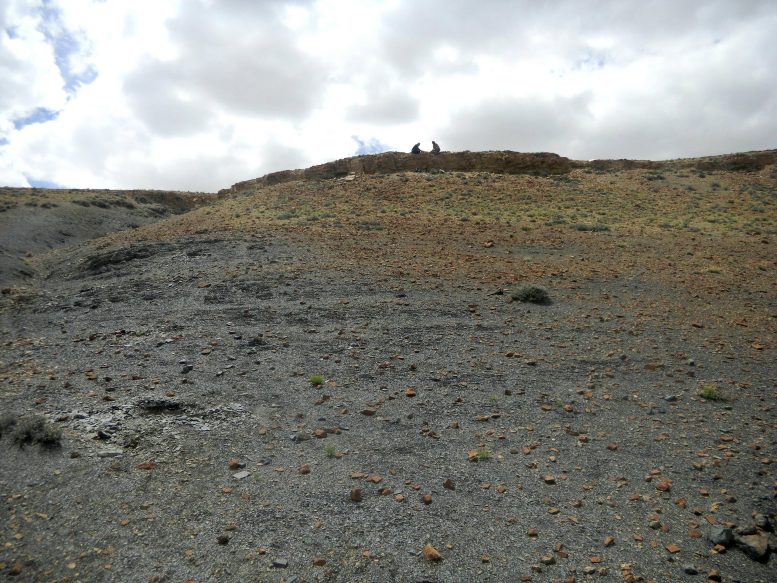
    Field Area Alisporites tenuicorpus Fossils
    Photograph of the field area the fossil samples come from. Credit: Prof Liu Feng from Nanjing Institute of Geology and Palaeontology

    Professor Barry Lomax from the University of Nottingham explains “Plants require sunlight for photosynthesis but need to protect themselves and particularly their pollen against the harmful effects of UV-B radiation. To do so, plants load the outer walls of pollen grains with compounds that function like sunscreen to protect the vulnerable cells to ensure successful reproduction.” 

    Professor Liu Feng adds: “We have developed a method to detect these phenolic compounds in fossil pollen grains recovered from Tibet, and detected much higher concentrations in those grains that were produced during the mass extinction and peak phase of volcanic activity.”

    UV-B Stress on Plants and Ecosystems

    Elevated UV-B levels can have even further-reaching and longer-lasting impacts on the entire Earth System. Recent modeling studies have demonstrated that elevated UV-B stress reduces plant biomass and terrestrial carbon storage, which would exacerbate global warming. The increased concentration of phenolic compounds also makes plant tissue less easily digestible, making a hostile environment even more challenging for herbivores.

    Summarizing the group’s findings Dr. Wes Fraser based at Oxford Brookes University commented: “Volcanism on such a cataclysmic scale impacts on all aspects of the Earth system, from direct chemical changes in the atmosphere, through changes in carbon sequestration rates, to reducing volume of nutritious food sources available for animals.”

    Reference: “Dying in the Sun: direct evidence for elevated UV-B radiation at the end-Permian mass extinction” by Feng Liu, Huiping Peng, John E. A. Marshall, Barry H. Lomax, Benjamin Bomfleur, Matthew S. Kent, Wesley T. Fraser and Phillip E. Jardine, 6 January 2023, Science Advances.
    DOI: 10.1126/sciadv.abo6102

    Never miss a breakthrough: Join the SciTechDaily newsletter.
    Follow us on Google and Google News.

    Extinction Event Fossils Paleontology Popular University of Nottingham
    Share. Facebook Twitter Pinterest LinkedIn Email Reddit

    Related Articles

    Scientists Just Rewrote the Story of the Dinosaurs’ Final Days

    Landmark Study: Dinosaurs Were in Their Prime When Asteroid Hit Earth

    Researchers Discover Four Dinosaurs in Montana: Fieldwork Pieces Together Life at the End of “Dinosaur Era”

    Fossils Reveal Headbutts May Have Been Used as a Dinosaur Courtship Behavior

    Jaw Structures of Fossils Seems to Suggest That Three Homo Species Roamed Africa Concurrently

    Prehistoric Fossilized Eocene Epoch Turtles Died Locked In Coitus

    Cretaceous Period Sankofa Pyrenaica Fossilized Eggs Are Unusually Shaped

    Microraptor Feathers Were Black With Iridescent Sheen

    Hundreds of Lost Fossils From the Darwin Collection Rediscovered by the British Geological Survey

    2 Comments

    1. Ken Towe on January 8, 2023 12:09 pm

      “Accompanying this global warming event was a collapse in the Earth’s ozone layer.”
      A collapse of the ozone layer would have killed off all life on land and in the surface waters from the unattenuated UV radiation from the Sun.. Such a collapse would require a massive loss of atmospheric oxygen. There is no geological evidence to support that loss. It didn’t happen.

      Reply
    2. Michael on January 16, 2023 9:39 am

      They mention a spike at 1510 cm^-1 but I see no spike in Figure 7?

      Reply
    Leave A Reply Cancel Reply

    • Facebook
    • Twitter
    • Pinterest
    • YouTube

    Don't Miss a Discovery

    Subscribe for the Latest in Science & Tech!

    Trending News

    Largest-Ever Study Finds Medicinal Cannabis Ineffective for Anxiety, Depression, PTSD

    250-Million-Year-Old Egg Solves One of Evolution’s Biggest Mysteries

    Living With Roommates Might Be Changing Your Gut Microbiome Without You Knowing

    Century-Old Cleaning Chemical Linked to 500% Increased Risk of Parkinson’s Disease

    What if Your Memories Never Happened? Physicists Take a New Look at the Boltzmann Brain Paradox

    One of the Universe’s Largest Stars May Be Getting Ready To Explode

    Scientists Discover Enzyme That Could Supercharge Ozempic-Like Weight Loss Drugs

    Popular Sweetener Linked to DNA Damage – “It’s Something You Should Not Be Eating”

    Follow SciTechDaily
    • Facebook
    • Twitter
    • YouTube
    • Pinterest
    • Newsletter
    • RSS
    SciTech News
    • Biology News
    • Chemistry News
    • Earth News
    • Health News
    • Physics News
    • Science News
    • Space News
    • Technology News
    Recent Posts
    • AI Reveals Explosive Growth of Floating Algae Across the World’s Oceans
    • 5.5 Million Bees Discovered Living Beneath a New York Cemetery
    • Scientists Reverse Brain Aging With Simple Nasal Spray
    • The Surprising Diet Rule That Makes “Good” Parasites Work
    • This Simple Blood Test Could Outperform “Bad Cholesterol” in Preventing Heart Disease
    Copyright © 1998 - 2026 SciTechDaily. All Rights Reserved.
    • Science News
    • About
    • Contact
    • Editorial Board
    • Privacy Policy
    • Terms of Use

    Type above and press Enter to search. Press Esc to cancel.