
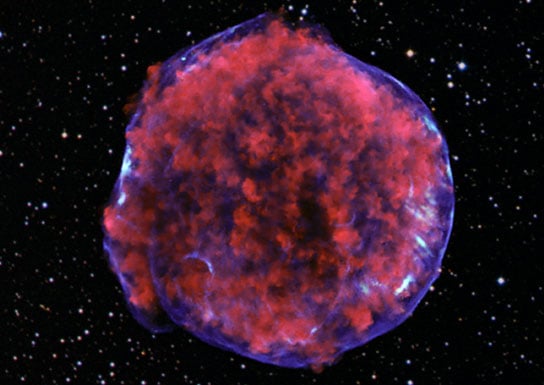
A newly published study from the Harvard Smithsonian Center for Astrophysics details two models supporting the origin of Type Ia supernovae, finding that both the single-degenerate model and the double-degenerate model are correct.
The exploding stars known as Type Ia supernovae serve an important role in measuring the universe, and were used to discover the existence of dark energy. They’re bright enough to see across large distances, and similar enough to act as a “standard candle” — an object of known luminosity. The 2011 Nobel Prize in Physics was awarded for the discovery of the accelerating universe using Type Ia supernovae. However, an embarrassing fact is that astronomers still don’t know what star systems make Type Ia supernovae.
Two very different models explain the possible origin of Type Ia supernovae, and different studies support each model. New evidence shows that both models are correct — some of these supernovae are created one way and some the other.
“Previous studies have produced conflicting results. The conflict disappears if both types of explosion are happening,” explained Smithsonian astronomer and Clay Fellow Ryan Foley (Harvard-Smithsonian Center for Astrophysics).
Type Ia supernovae are known to originate from white dwarfs – the dense cores of dead stars. White dwarfs are also called degenerate stars because they’re supported by quantum degeneracy pressure.
In the single-degenerate model for a supernova, a white dwarf gathers material from a companion star until it reaches a tipping point where a runaway nuclear reaction begins and the star explodes. In the double-degenerate model, two white dwarfs merge and explode. Single-degenerate systems should have gas from the companion star around the supernova, while the double-degenerate systems will lack that gas.
“Just like mineral water can be with or without gas, so can supernovae,” said Robert Kirshner, Clowes Professor of Astronomy at Harvard University and a co-author on the study.
Foley and his colleagues studied 23 Type Ia supernovae to look for signatures of gas around the supernovae, which should be present only in single-degenerate systems. They found that the more powerful explosions tended to come from “gassy” systems, or systems with outflows of gas. However, only a fraction of supernovae show evidence of outflows. The remainder seem to come from double-degenerate systems.
“There are definitely two kinds of environments — with and without outflows of gas. Both are found around Type Ia supernovae,” Foley said.
This finding has important implications for measurements of dark energy and the expanding universe. If two different mechanisms are at work in Type Ia supernovae, then the two types must be considered separately when calculating cosmic distances and expansion rates.
“It’s like measuring the universe with a mix of yardsticks and meter sticks – you’ll get about the same answer, but not quite. To get an accurate answer, you need to separate the yardsticks from the meter sticks,” Foley explained.
This study raises an interesting question – if two different mechanisms create Type Ia supernovae, why are they homogeneous enough to serve as standard candles?
“How can supernovae coming from different systems look so similar? I don’t have the answer for that,” said Foley.
The paper describing this research will appear in the Astrophysical Journal.
Reference: “Linking Type Ia Supernova Progenitors and their Resulting Explosions” by Ryan J. Foley, Joshua D. Simon, Christopher R. Burns, Avishay Gal-Yam, Mario Hamuy, Robert P. Kirshner, Nidia I. Morrell, Mark M. Phillips, Gregory A. Shields and Assaf Sternberg, 31 May 2012, The Astrophysical Journal.
DOI: 10.1088/0004-637X/752/2/101
Never miss a breakthrough: Join the SciTechDaily newsletter.
Follow us on Google and Google News.