
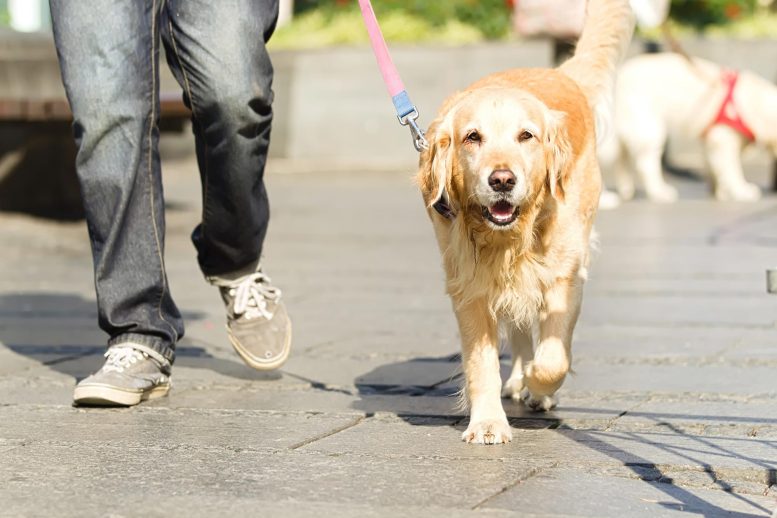
‘Paws on the Street’ Makes High-Trust Areas Safer
If you want to find a safe neighborhood to live in, choose one where the residents trust each other – and have a lot of dogs to walk.
To find a safe neighborhood to live in, choose a community where people trust one another and have plenty of dogs to walk.
Researchers discovered that neighborhoods in Columbus, Ohio with more dogs had lower rates of homicide, robbery and, to a lesser extent, aggravated assaults compared to areas with fewer dogs, at least in cases when residents also had high levels of trust in each other.
How Dog Walking Boosts Neighborhood Safety
The results indicate that people walking their dogs puts more “eyes on the street,” which can discourage crime, according to Nicolo Pinchak, lead author of the study and a doctoral student in sociology at The Ohio State University.
“People walking their dogs are essentially patrolling their neighborhoods,” Pinchak said. “They see when things are not right, and when there are suspect outsiders in the area. It can be a crime deterrent.”
The study was recently published in the journal Social Forces.
Trust and Local Surveillance: The Theory Behind Crime Prevention
Sociologists have long theorized that a combination of mutual trust and local surveillance among residents of a neighborhood can deter criminals, said study co-author Christopher Browning, a professor of sociology at Ohio State.
However, there hasn’t been a good measure of how residents provide surveillance of neighborhood streets. “We thought that dog walking probably captures that pretty well, which is one reason why we decided to do this study,” Browning said.
For the study, researchers looked at crime statistics from 2014 to 2016 for 595 census block groups – the equivalent of neighborhoods – in the Columbus area.
They obtained survey data from a marketing firm that asked Columbus residents in 2013 if they had a dog in their household.
Finally, they used data from the Adolescent Health and Development in Context study (which Browning runs) to measure trust in individual neighborhoods. As part of that study, residents were asked to rate how much they agreed that “people on the streets can be trusted” in their neighborhoods.
Research has shown that trust among neighbors is an important part of deterring crime, because it suggests residents will help each other when facing a threat and have a sense of “collective efficacy” that they can have a positive impact on their area, Pinchak said.
Results of this study showed, as expected, that neighborhoods with high levels of trust had lower levels of homicide, robbery and aggravated assaults when compared to neighborhoods with low levels of trust.
But among high-trust neighborhoods, those with high concentrations of dogs showed an additional drop in crime compared to those with low concentrations of dogs.
Among the high-trust neighborhoods, neighborhoods high in dog concentration had about two-thirds the robbery rates of those low in dog concentration and about half the homicide rates, the study found.
It really has to do with the dog walking, Pinchak said.
“Trust doesn’t help neighborhoods as much if you don’t have people out there on the streets noticing what is going on. That’s what dog walking does,” Pinchak said. And that’s why dogs have a crime-fighting advantage over cats and other pets that don’t need walking.
“When people are out walking their dogs, they have conversations, they pet each other’s dogs. Sometimes they know the dog’s name and not even the owners. They learn what’s going on and can spot potential problems.”
Results showed that the trust and dog-walking combination helped reduce street crimes: those crimes like homicides and robberies that tend to occur in public locations, including streets and sidewalks.
Protective Effects Against Property Crimes
The study found that more dogs in a neighborhood was also related to fewer property crimes, like burglaries, irrespective of how much residents trust each other, Pinchak said.
That’s because barking and visible dogs can keep criminals away from buildings where the dogs are found – and neighborhood trust and surveillance are not needed as a factor, as it is in street crimes.
The protective effect of dogs and trust was found even when a wide range of other factors related to crime was taken into account, including the proportion of young males in the neighborhood, residential instability and socioeconomic status.
Overall, the results suggest that it is beneficial to have a lot of trust in your neighbors to prevent crime – particularly if you add a lot of dogs and dog walkers.
“There has already been a lot of research that shows dogs are good for the health and well-being of their human companions,” Pinchak said.
“Our study adds another reason why dogs are good for us.”
Reference: “Paws on the Street: Neighborhood-Level Concentration of Households with Dogs and Urban Crime” by Nicolo P Pinchak, Christopher R Browning, Bethany Boettner, Catherine A Calder and Jake Tarrence, 25 June 2022, Social Forces.
DOI: 10.1093/sf/soac059
Pinchak and Browning are members of Ohio State’s Institute for Population Research, which supported the study.
Other co-authors of the study were Bethany Boettner of Ohio State, and Catherine Calder and Jake Tarrence of the University of Texas at Austin.
The study was based on work supported by the National Science Foundation. The Adolescent Health and Development in Context study is funded by the National Institute on Drug Abuse, the Eunice Kennedy Shriver National Institute on Child Health and Human Development, and the William T. Grant Foundation.
Never miss a breakthrough: Join the SciTechDaily newsletter.
Follow us on Google and Google News.
1 Comment
The ancient Romans used geese (anseres) to protect their villages and act as warning of danger…..Then they ate them….another use for Canada Geese???????