
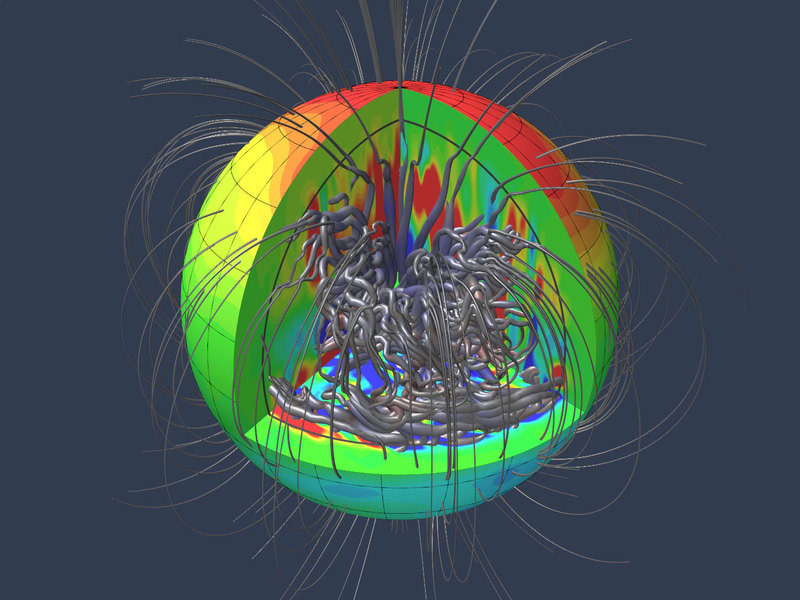
With the aid of computer simulations, a team of scientists has now succeeded in explaining the origin of the magnetic field deep inside Jupiter.
Superlatives are the trademark of the planet Jupiter. The magnetic field at the top edge of the cloud surrounding the largest member of the solar system is around ten times stronger than Earth’s, and is by far the largest magnetosphere around a planet. Just why this field has a similar structure to that of our own planet although the interiors of the two celestial objects have a completely different structure, has mystified researchers for a long time. With the aid of the most detailed computer simulations to date, a team headed by the Max Planck Institute for Solar System Research in Göttingen has now succeeded in explaining the origin of the magnetic field deep inside the gaseous giant.
Magnetic fields are always generated when electric currents flow. The Earth is surrounded by a magnetic field because, deep in its interior, there is a circulating molten mass of iron and nickel. This motion gives rise to electric currents that generate Earth’s familiar dipolar magnetic field, in much the same way as a bicycle dynamo operates. Physicists call it the geo-dynamo. But how does the dynamo inside of Jupiter work?
Jupiter consists predominantly of hydrogen and helium. Photos of the planet show colored bands of cloud and gigantic tornados such as the Great Red Spot. The temperature at the upper cloud boundary is minus 100 degrees Celsius (-148 degrees Fahrenheit), but temperature, pressure, and electrical conductivity increase enormously with increasing depth.
At a depth of just under 10,000 kilometers (6,200 miles) and a pressure of several million atmospheres, the hydrogen even becomes conductive like a metal – an exotic state of matter which does not exist on Earth. It is still unclear whether there is a rocky core at the center of the planet; it could possibly amount to around 20 percent of the Jupiter radius – corresponding to 14,000 kilometers (8,700 miles).
Previous computer simulations on the formation of the magnetic field had to greatly simplify this complex structure. The upper gaseous region and the lower metallic region were treated separately, for example. Thus, no computation correctly reproduced the strength and the form of the magnetic field as determined by space probes.
“Several colleagues assumed that certain physical quantities changed suddenly at the transition to the region of the metal-like conducting hydrogen,” says project leader Johannes Wicht from the Max Planck Institute for Solar System Research in Göttingen. But new models from colleagues at the University of Rostock seem to prove that this is probably not the case. The properties change gradually over the whole gas layer so that the separate treatment of the outer and inner region is hardly justified.
The important step forward here was the fact that, for the first time, the Göttingen-based physicists dealt with all regions of the planet in the same simulation. To this effect, the Max Planck Society’s huge Hydra supercomputer in Garching had to spend around six months on the computation.
The result was impressive: it portrayed Jupiter’s magnetic field more or less as space probes had determined it in nature. “The main part of the magnetic field, which looks so similar to Earth’s magnetic field, is generated deep inside the planet, where the properties no longer change so strongly,” says Wicht.
The new simulations indicate that a second, weaker dynamo is also active, however. It operates in the transition zone to the metallic layer near the equator. It is brought about by a strong wind blowing towards the east, a so-called jet, which can be recognized from the cloud movements. In the outer, cool regions of the atmosphere it is not yet possible for a magnetic field to be generated, as the conductivity here is too low.
But at greater depths, the temperature rises, and from around 8,000 kilometers (5,000 miles) below the cloud cover, the electrical conductivity, thanks to the formation of plasma, is high enough for the dynamo to start.
“Crucial here is the product of wind speed and electrical conductivity,” explains Moritz Heimpel from the University of Alberta in Edmonton, Canada. As soon as it exceeds a specific value, a magnetic field can form. “The jet shears the magnetic field in the east-west direction and produces a characteristic magnetic band structure in the equatorial region,” says Thomas Gastine, a staff member at the Max Planck Institute for Solar System Research.
“In order to portray the special properties of the two dynamo processes involved, it was particularly important to model the interior properties of the planet as accurately as possible,” adds Lucia Duarte, who carried out the first computation during her doctoral work at the Max Planck Institute in Göttingen.
Hence, two magnetic fields form, which superimpose: the Earth-like one in the deep layer of the metal-like conducting hydrogen, and the weaker band structure generated by the equatorial jet. “The Earth-like field corresponds in strength and structure to the measurement data to date provided by space probes, which do not allow the band structure to be resolved,” says Thomas Gastine.
The simulations span a period of around 6,500 years and also reveal changes. The field strength should vary, for example, and the inclination of the axis should change by around 0.02 degrees per year. It will soon be possible for the Juno space probe to check this and further properties predicted by the new model.
The American spacecraft was launched three years ago and is due to enter into an orbit around the giant planet in August 2016. “With the new measurement data, we will find out much more about the inner structure and the magnetic field than has been possible to date, and can hopefully confirm the band structures as well,” says Johannes Wicht.
Reference: “Explaining Jupiter’s magnetic field and equatorial jet dynamics” by T. Gastine, J. Wicht, L. Duarte, M. Heimpel and A. Becker, 29 July 2014, Geophysical Research Letters.
DOI: 10.1002/2014GL060814
arXiv: 1407.5940
Never miss a breakthrough: Join the SciTechDaily newsletter.
Follow us on Google and Google News.