

Superdeep Diamonds Formed Between 650 and 450 Million Years Ago Show How Continents Developed and Moved
The analysis of ancient, superdeep diamonds dug up from mines in Brazil and Western Africa, has unveiled previously unknown mechanisms behind the evolution and movement of continents during the early evolution of complex life on Earth.
These diamonds which were formed between 650 and 450 million years ago on the base of the supercontinent Gondwana, were analyzed by an international team of experts, and have shown how supercontinents such as Gondwana were formed, stabilized, and how they move around the planet.
Valuable Insights From Diamonds
“Superdeep diamonds are extremely rare and we now know that they can tell us a lot about the whole process of continent formation,” says Dr Karen Smit of the Wits School of Geosciences, who was part of the study. “We wanted to date these diamonds to try and understand how the earliest continents formed.”
Formed millions to billions of years ago, diamonds can shine light into the darkest and oldest parts of the Earth’s mantle. Continents drift across Earth’s surface creating “supercontinents” and destroying them. Collectively, these migrations are known as the “supercontinent cycle” and diamonds are one of the few minerals strong enough to survive and record these ancient cycles of creation and destruction.
Deep Tectonic Insights
Supercontinents can focus deep oceanic plate subduction – the driver of plate tectonics – in very specific regions. Such deep geologic processes, especially in the past, have been very difficult to study directly because the oceanic crust is young, and the continental crust only provides a limited view of Earth’s deep workings. Old diamonds offer a direct window into the deep plate tectonic engine and how it might relate to the supercontinent cycle.
By dating the tiny silicate and sulfide inclusions inside the diamonds, the team led by Dr Suzette Timmerman of the University of Bern, Switzerland, dated the diamonds that formed 300 to 700km deep under the base of Gondwana. The goal was to trace how material was added to the keel of the supercontinent. While doing this, the team recognized a previously unknown geologic process. The research was recently published in the journal Nature.
“The geochemical analyses and dating of inclusions in the diamonds, combined with existing plate tectonic models of continent migration, showed that diamonds formed at great depths beneath Gondwana when the supercontinent covered the South Pole, between 650–450 million years ago,” says Smit.
Diamonds’ Role in Supercontinent Growth
The host rocks to the diamonds became buoyant during diamond formation, transporting subducted mantle material plus the diamonds. This material was added to the base of the root of Gondwana, in essence, ‘growing’ the supercontinent from below.
“Around 120 million years ago, Gondwana started to break apart to form the present oceans such as the Atlantic. At 90 million years ago, the diamonds, carrying trapped tiny inclusions of the host rock, were brought to Earth’s surface in violent volcanic eruptions.”

The current locations for these volcanic eruptions are on the continental fragments of Brazil and Western Africa, two of the key components of Gondwana. Thus, the diamonds must have migrated together with different parts of the former supercontinent as they dispersed, “glued” to their base.
“This complex history of the diamonds shows that they are remarkably well-traveled, both vertically, and horizontally, within the Earth – tracing both the formation of the supercontinent and the latter stages of its evolution. The accretion of relatively young material to the roots of the continents thickens and welds together these ancient continental fragments indicating a potential new mode of continent growth.”
Further Research and Development
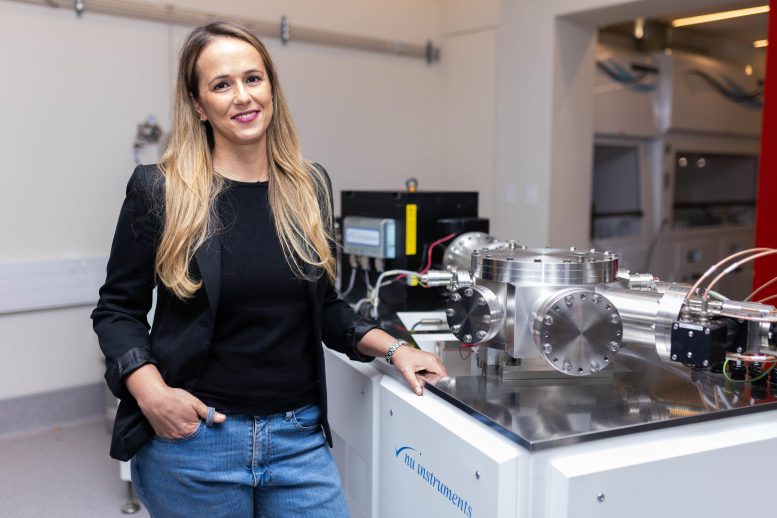
Smit conducted the isotope analyses of sulfide inclusions at the Carnegie Institution for Science. Smit is now based at the University of the Witwatersrand where she is part of a team developing a new isotope lab and methodologies so that diamond inclusion analyses can ultimately be conducted at Wits.
“We have installed the necessary equipment in 2022 and are working towards getting the highly specialized skills and equipment together so we can do this type of diamond work in South Africa, where previously it could only be done overseas,” says Smit.
“We need this type of research to understand how continents evolve and move. Without continents, there wouldn’t be life. This research gives us insight into how continents form, and it links to how life evolved and what makes our planet, Earth, different from other planets.”
Reference: “Sublithospheric diamond ages and the supercontinent cycle” by Suzette Timmerman, Thomas Stachel, Janne M. Koornneef, Karen V. Smit, Rikke Harlou, Geoff M. Nowell, Andrew R. Thomson, Simon C. Kohn, Joshua H. F. L. Davies, Gareth R. Davies, Mandy Y. Krebs, Qiwei Zhang, Sarah E. M. Milne, Jeffrey W. Harris, Felix Kaminsky, Dmitry Zedgenizov, Galina Bulanova, Chris B. Smith, Izaac Cabral Neto, Francisco V. Silveira, Antony D. Burnham, Fabrizio Nestola, Steven B. Shirey, Michael J. Walter, Andrew Steele and D. Graham Pearson, 18 October 2023, Nature.
DOI: 10.1038/s41586-023-06662-9
Never miss a breakthrough: Join the SciTechDaily newsletter.
Follow us on Google and Google News.
1 Comment
They said to see a sun light it takes 350 years to reach earth. So If one can create a machine with speed of sun light, today and leaves today and return tomorrow he will travel 700 years so that’s means when he will be coming back where he went tomorrow he will find no one on earth