

Stunning new photographs taken by Wellesley College astronomers using the James Webb Space Telescope have unveiled a newly forming galaxy, dubbed the “Firefly Sparkle,” which closely resembles a young Milky Way.
This discovery shows the galaxy forming about 600 million years post-Big Bang, featuring ten distinct star clusters. This observation provides a unique look into our galaxy’s early formation and promises to aid future astronomical research.
The “Firefly Sparkle” Galaxy Formation
Astronomers led by Wellesley College have captured stunning new images of a forming galaxy that closely resembles a young Milky Way.
The extraordinary images, taken with NASA’s James Webb Space Telescope, reveal a glittering galaxy featuring 10 distinct star clusters that formed at different times—much like the Milky Way’s early structure.

Cocooned in a faint arc and shimmering like fireflies on a summer night, the newly discovered galaxy has been named the “Firefly Sparkle” by the Wellesley team. It began forming approximately 600 million years after the Big Bang, coinciding with the early development of our own galaxy.
Wellesley College astronomer Lamiya Mowla, co-lead author of the study, shared the team’s findings in a paper published on December 11 in the journal Nature.
Mowla says the discovery is particularly important because the mass of the Firefly Sparkle is similar to what the Milky Way’s mass might have been at the same stage of development. (Other galaxies Webb has detected from this time period are significantly more massive.)
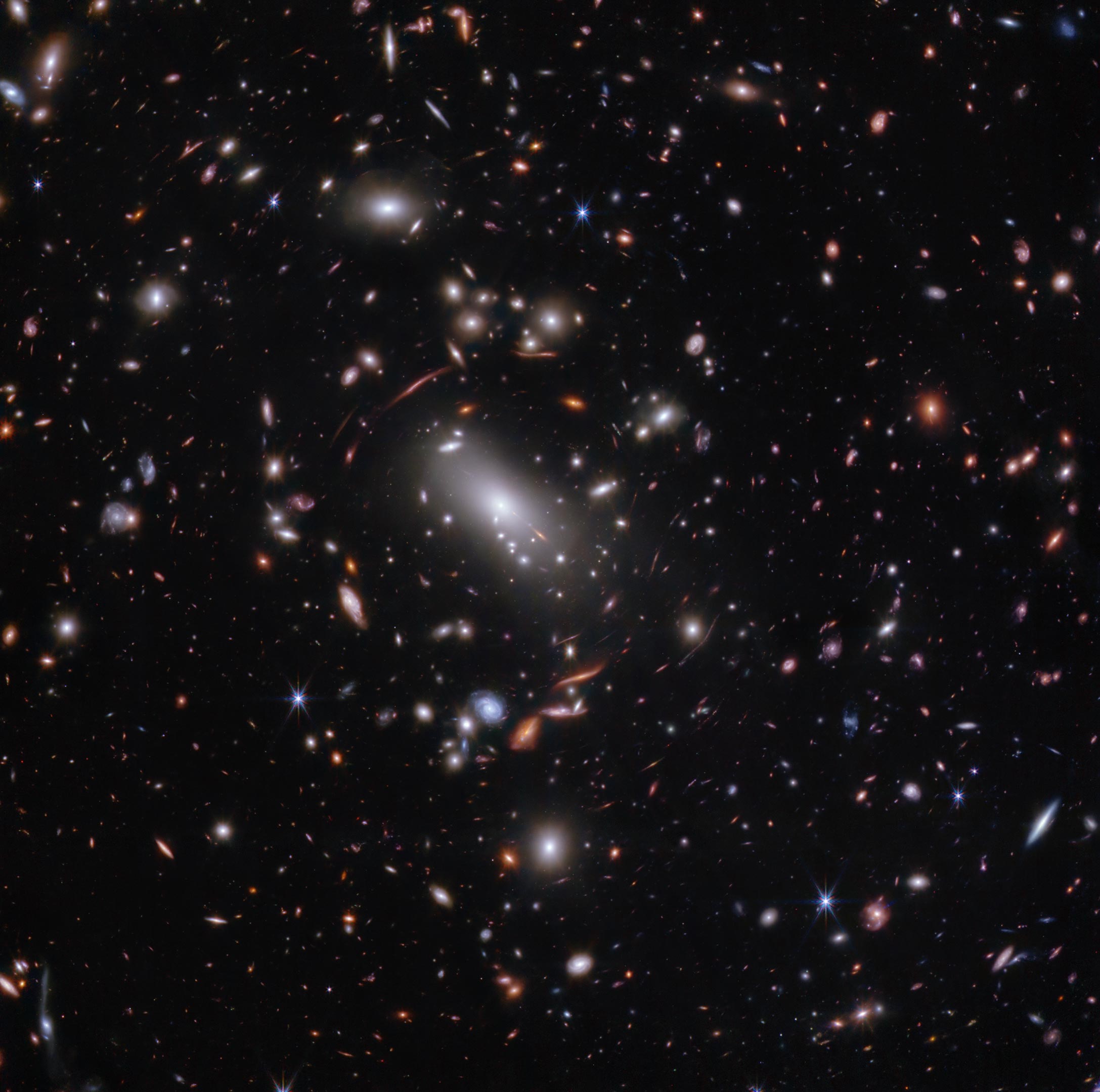
Credit: NASA, ESA, CSA, STScI, Chris Willott (NRC-Canada), Lamiya Mowla (Wellesley College), Kartheik Iyer (Columbia)
Insights from the Firefly Sparkle Images
“These remarkable images give us an unprecedented picture of what our own galaxy might have looked like when it was being born,” Mowla says. “By examining these photos of the Firefly Sparkle, we can better understand how our own Milky Way took shape.”
Glimpses of a young galaxy forming in a way so similar to our own are unparalleled, Mowla says. The JWST images show a Milky Way-like galaxy in the early stages of its assembly in a universe that’s only 600 million years old.

Research and Future Studies
“As an observational astronomer studying the structural evolution of astronomical objects in the early Universe, I want to understand how the first stars, star clusters, galaxies, and galaxy clusters formed in the infant Universe and how they changed as the Universe got older,” Mowla notes. Of the Firefly Sparkle, she says, “I didn’t think it would be possible to resolve a galaxy that existed so early in the universe into so many distinct components, let alone find that its mass is similar to our own galaxy’s when it was in the process of forming.
“There is so much going on inside this tiny galaxy, including so many different phases of star formation,” Mowla told NASA. “These images are the very first glimpse of something that we’ll be able to study—and learn from—for many years to come.”
For more on this discovery, see Webb Reveals Milky Way’s Ancient Twin Sparkling From the Cosmic Dawn.
Reference: “Formation of a low-mass galaxy from star clusters in a 600-million-year-old Universe” by Lamiya Mowla, Kartheik Iyer, Yoshihisa Asada, Guillaume Desprez, Vivian Yun Yan Tan, Nicholas Martis, Ghassan Sarrouh, Victoria Strait, Roberto Abraham, Maruša Bradač, Gabriel Brammer, Adam Muzzin, Camilla Pacifici, Swara Ravindranath, Marcin Sawicki, Chris Willott, Vince Estrada-Carpenter, Nusrath Jahan, Gaël Noirot, Jasleen Matharu, Gregor Rihtaršič and Johannes Zabl, 11 December 2024, Nature.
DOI: 10.1038/s41586-024-08293-0
Mowla, who co-led the project with Kartheik Iyer, a NASA Hubble Fellow at Columbia University in New York, is an assistant professor of physics and astronomy at Wellesley, and a 2013 graduate of the college.
Never miss a breakthrough: Join the SciTechDaily newsletter.
Follow us on Google and Google News.
4 Comments
Stunning James Webb Images Reveal the Birtof a Milky Way Twin
Topological Spins Create Everything, Topological Spins Shape World.
Relevance?
Besides, we don’t see that. Don’t you trust the data!? Topological spins are a topic in solid state matter physics of quantum materials, not in astrophysics:
“By combining these measurements with advanced density functional theory (DFT) calculations, the researchers confirmed that the kagome geometry in TbV6Sn6 does indeed give rise to a gap between the Dirac band and the nearly flat band. Such a gap is common to all kagome lattices that show spin-orbit coupling, but while physicists had known about the gap’s existence for years, no one had previously measured a property called topological quantum spin curvature that results from the gap and is related to the curved space in which electrons reside.
“In the same way that the space-time of our universe is curved by matter, stars, galaxies and black holes, the space in which the electrons move can also be curved,” Di Sante explains. “We have detected this curvature in kagome metals.”
The new work represents a first step towards a thorough characterization of this curved space – a key goal in the field of quantum geometry, Di Sante adds. “This is a property of quantum materials that we’ve started exploring only recently and we already know that quantum geometry is also intimately linked to superconductivity and other fascinating phenomena,” he says. “We hope that the protocol we have introduced here will help to shed light on the physics of quantum materials.””
[Physics world, Topological matter Research update
Physicists measure electron’s ‘topological spin’
12 Jul 2023 Isabelle Dumé]
But our Milky Way Galaxy has stars that are the age of this ‘ firefly..’ galaxy, many of them. How does that work?
I think the universe is older than we think, much older. Here is my go at answering this problem.
Normalisation of CMB Redshift with Local Hubble Redshift Values Increases the Age of the Universe to 8.8 Trillion Years https://zenodo.org/records/14499134