

NASA’s James Webb Space Telescope has discovered a galaxy named Firefly Sparkle, existing just 600 million years post-Big Bang and bearing similar mass to the early Milky Way.
Like fireflies “dancing” on a warm summer night, 10 distinct star clusters sparkle in NASA’s James Webb Space Telescope’s observations. These clusters are surrounded by a soft halo of diffuse light from other scattered stars. This newly discovered galaxy, named Firefly Sparkle, was forming around 600 million years after the Big Bang.
Using Webb’s detailed images and data, researchers determined that Firefly Sparkle’s mass is similar to what the Milky Way’s might have been if we could “turn back time” to weigh it as it was assembling.
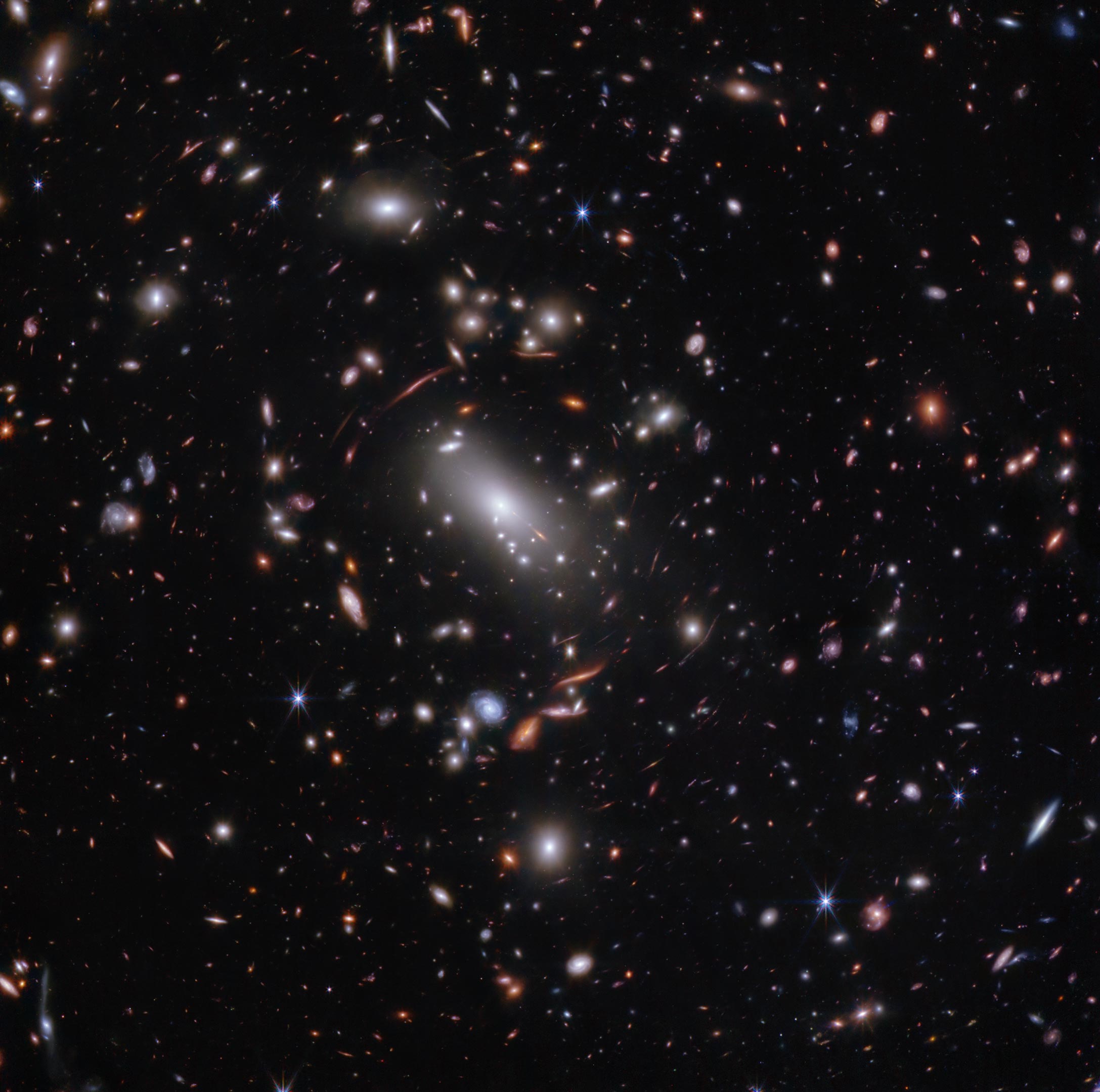
How did they achieve this level of precision? Through a phenomenon called gravitational lensing, where a massive foreground object magnifies and distorts light from distant galaxies, effectively “zooming in” on them. Paired with Webb’s advanced near-infrared imaging capabilities, this effect allowed astronomers to study Firefly Sparkle with unprecedented clarity.
Dr. Jonathan Gardner presents the latest JWST images of the “Firefly Sparkle” galaxy, showcasing intricate details and structures. There is so much going on inside this seemingly tiny galaxy, it appears like a swarm of lightning bugs on a warm summer night, this galaxy is gleaming with star clusters. This is the very first time NASA’s James Webb Space Telescope has detected and examined a galaxy that existed around 600 million years after the Big Bang, that carries many resemblances to our own Milky Way at a similar stage of its own development.
Found: First Actively Forming Galaxy as Lightweight as Young Milky Way
For the first time, NASA’s James Webb Space Telescope has detected and “weighed” a distant galaxy from about 600 million years after the Big Bang. Remarkably, this galaxy appears to have a mass similar to what the Milky Way’s might have been at the same stage of development. Most galaxies Webb has observed from this era are much larger. Researchers nicknamed the newly discovered galaxy “Firefly Sparkle” because of its bright, glowing star clusters — 10 in total — which they studied in detail.
“I didn’t think it would be possible to resolve a galaxy that existed so early in the universe into so many distinct components, let alone find that its mass is similar to our own galaxy’s when it was in the process of forming,” said Lamiya Mowla, co-lead author of the paper and an assistant professor at Wellesley College in Massachusetts. “There is so much going on inside this tiny galaxy, including so many different phases of star formation.”
Webb’s Remarkable Imaging Capability
Webb was able to image the galaxy in crisp detail for two reasons. One is a benefit of the cosmos: A massive foreground galaxy cluster radically enhanced the distant galaxy’s appearance through a natural effect known as gravitational lensing. And when combined with the telescope’s specialization in high-resolution infrared light, Webb delivered unprecedented new data about the galaxy’s contents.
“Without the benefit of this gravitational lens, we would not be able to resolve this galaxy,” said Kartheik Iyer, co-lead author and NASA Hubble Fellow at Columbia University in New York. “We knew to expect it based on current physics, but it’s surprising that we actually saw it.”
Mowla, who spotted the galaxy in Webb’s image, was drawn to its gleaming star clusters, because objects that sparkle typically indicate they are extremely clumpy and complicated. Since the galaxy looks like a “sparkle” or swarm of lightning bugs on a warm summer night, they named it the Firefly Sparkle galaxy.

Reconstructing the Galaxy’s Appearance
The research team modeled what the galaxy might have looked like if it weren’t stretched and discovered that it resembled an elongated raindrop. Suspended within it are two star clusters toward the top and eight toward the bottom. “Our reconstruction shows that clumps of actively forming stars are surrounded by diffuse light from other unresolved stars,” said Iyer. “This galaxy is literally in the process of assembling.”
Webb’s data shows the Firefly Sparkle galaxy is on the smaller side, falling into the category of a low-mass galaxy. Billions of years will pass before it builds its full heft and a distinct shape. “Most of the other galaxies Webb has shown us aren’t magnified or stretched, and we are not able to see their ‘building blocks’ separately. With Firefly Sparkle, we are witnessing a galaxy being assembled brick by brick,” Mowla said.
Stretched Out and Shining, Ready for Close Analysis
Since the galaxy is warped into a long arc, the researchers easily picked out 10 distinct star clusters, which are emitting the bulk of the galaxy’s light. They are represented here in shades of pink, purple, and blue. Those colors in Webb’s images and its supporting spectra confirmed that star formation didn’t happen all at once in this galaxy, but was staggered in time.
“This galaxy has a diverse population of star clusters, and it is remarkable that we can see them separately at such an early age of the universe,” said Chris Willott from the National Research Council of Canada’s Herzberg Astronomy and Astrophysics Research Centre, a co-author and the observation program’s principal investigator. “Each clump of stars is undergoing a different phase of formation or evolution.”
The galaxy’s projected shape shows that its stars haven’t settled into a central bulge or a thin, flattened disk, another piece of evidence that the galaxy is still forming.
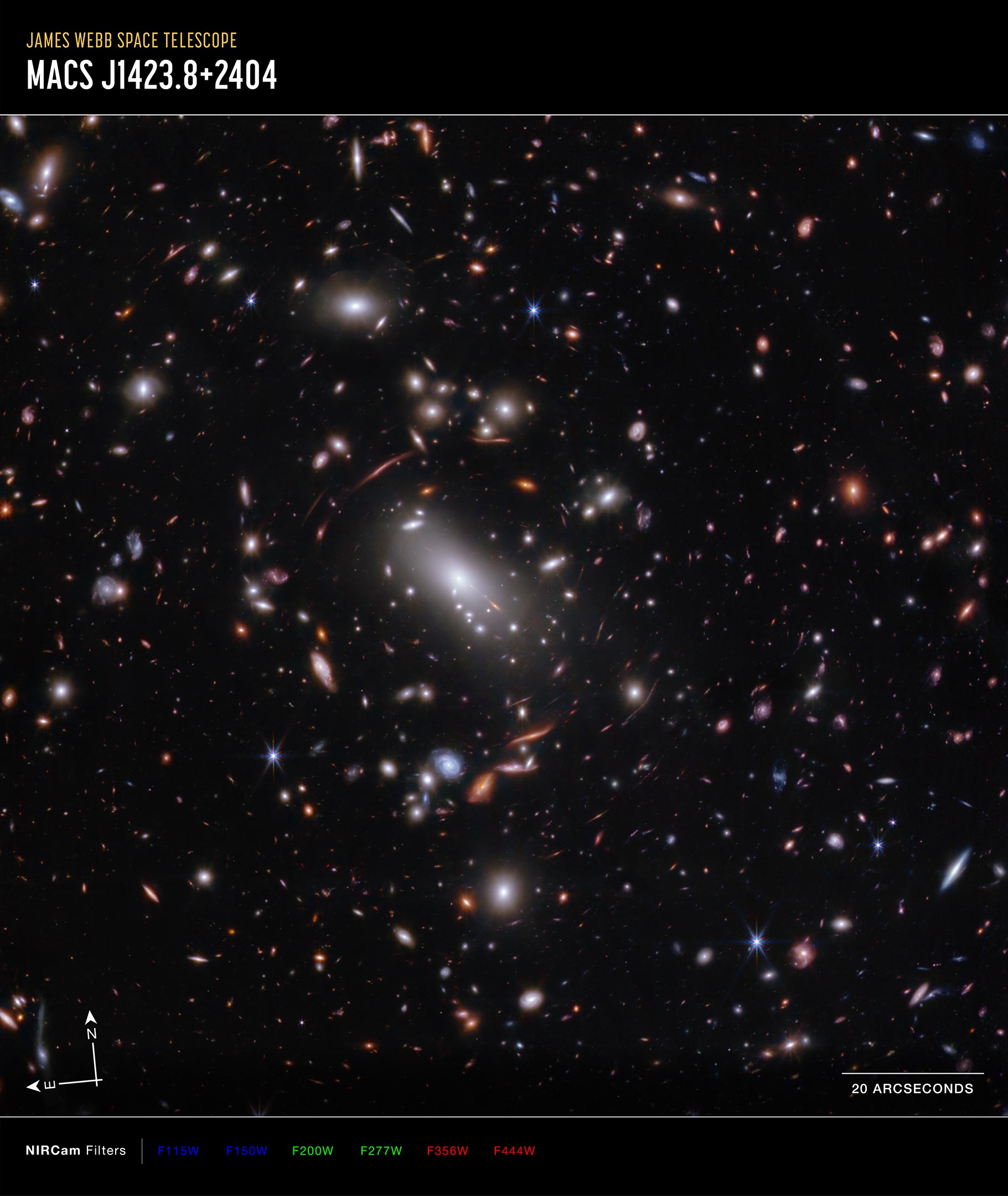
The north and east compass arrows show the orientation of the image on the sky.
The scale bar is labeled in arcseconds, which is a measure of angular distance on the sky. One arcsecond is equal an angular measurement of 1/3600 of one degree. There are 60 arcminutes in a degree and 60 arcseconds in an arcminute. (The full Moon has an angular diameter of about 30 arcminutes.) The actual size of an object that covers one arcsecond on the sky depends on its distance from the telescope.
This image shows invisible near-infrared wavelengths of light that have been translated into visible-light colors. The color key shows which NIRCam filters were used when collecting the light. The color of each filter name is the visible light color used to represent the infrared light that passes through that filter.
Credit: NASA, ESA, CSA, STScI, Chris Willott (NRC-Canada), Lamiya Mowla (Wellesley College), Kartheik Iyer (Columbia)
‘Glowing’ Companions
Researchers can’t predict how this disorganized galaxy will build up and take shape over billions of years, but there are two galaxies that the team confirmed are “hanging out” within a tight perimeter and may influence how it builds mass over billions of years.
Firefly Sparkle is only 6,500 light-years away from its first companion, and its second companion is separated by 42,000 light-years. For context, the fully formed Milky Way is about 100,000 light-years across — all three would fit inside it. Not only are its companions very close, the researchers also think that they are orbiting one another.
Each time one galaxy passes another, gas condenses and cools, allowing new stars to form in clumps, adding to the galaxies’ masses. “It has long been predicted that galaxies in the early universe form through successive interactions and mergers with other tinier galaxies,” said Yoshihisa Asada, a co-author and doctoral student at Kyoto University in Japan. “We might be witnessing this process in action.”
This work was published on December 11, 2024, in the journal Nature.
Reference: “Formation of a low-mass galaxy from star clusters in a 600-million-year-old Universe” by Lamiya Mowla, Kartheik Iyer, Yoshihisa Asada, Guillaume Desprez, Vivian Yun Yan Tan, Nicholas Martis, Ghassan Sarrouh, Victoria Strait, Roberto Abraham, Maruša Bradač, Gabriel Brammer, Adam Muzzin, Camilla Pacifici, Swara Ravindranath, Marcin Sawicki, Chris Willott, Vince Estrada-Carpenter, Nusrath Jahan, Gaël Noirot, Jasleen Matharu, Gregor Rihtaršič and Johannes Zabl, 11 December 2024, Nature.
DOI: 10.1038/s41586-024-08293-0
The research team based their findings on data from Webb’s CAnadian NIRISS Unbiased Cluster Survey (CANUCS). This survey uses near-infrared images from NIRCam (Near-Infrared Camera) and spectral data from the microshutter array on NIRSpec (Near-Infrared Spectrograph). The CANUCS field was intentionally chosen because it overlaps with a region previously imaged by NASA’s Hubble Space Telescope during its Cluster Lensing And Supernova Survey with Hubble (CLASH) program.
The James Webb Space Telescope is the world’s leading space science observatory. It explores mysteries within our solar system, studies distant exoplanets, and investigates the universe’s origins and cosmic structures. Webb is an international collaboration led by NASA, with key partners ESA (European Space Agency) and CSA (Canadian Space Agency).
Never miss a breakthrough: Join the SciTechDaily newsletter.
Follow us on Google and Google News.