
Close Menu
    Facebook X (Twitter) Instagram
    SciTechDaily
    • Biology
    • Chemistry
    • Earth
    • Health
    • Physics
    • Science
    • Space
    • Technology
    Facebook X (Twitter) Pinterest YouTube RSS
    SciTechDaily
    Home»Space»Stunning NASA Image Shows Ganymede Casting a Massive Shadow Across Jupiter
    Space

    Stunning NASA Image Shows Ganymede Casting a Massive Shadow Across Jupiter

    By NASAOctober 26, 2022No Comments2 Mins Read
    Facebook Twitter Pinterest Telegram LinkedIn WhatsApp Email Reddit
    Share
    Facebook Twitter LinkedIn Pinterest Telegram Email Reddit
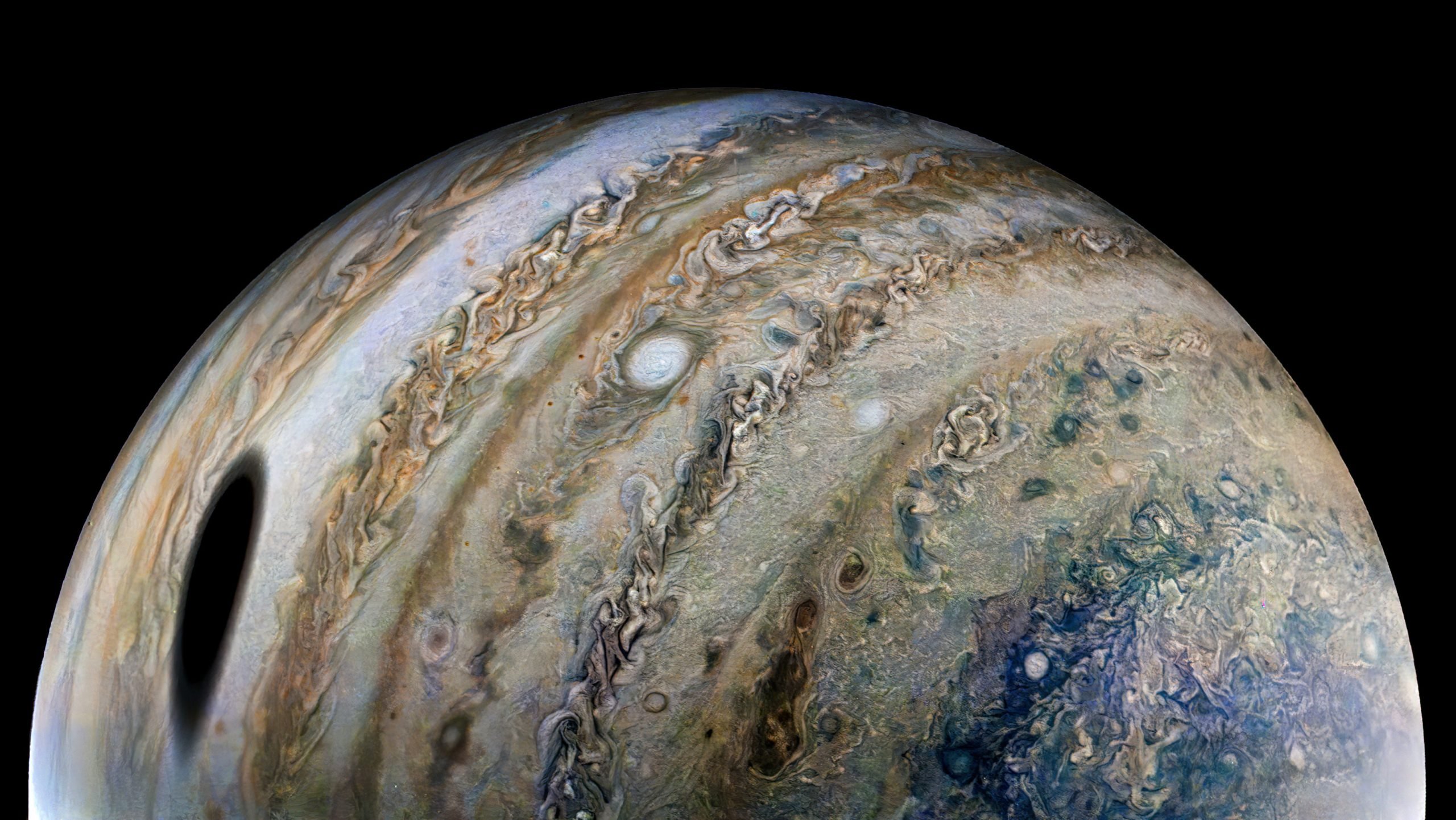
    Juno Captures Moon Shadow on Jupiter
    Citizen scientist Thomas Thomopoulos created this enhanced-color image using raw data from the JunoCam instrument. At the time the raw image was taken, the Juno spacecraft was about 44,000 miles (71,000 kilometers) above Jupiter’s cloud tops, at a latitude of about 55 degrees south, and 15 times closer than Ganymede, which orbits about 666,000 miles (1.1 million kilometers) away from Jupiter. Credit: NASA/JPL-Caltech/SwRI/MSSS, Image processing by Thomas Thomopoulos © CC BY

    NASA’s Juno spacecraft saw Ganymede cast a large, dark spot on Jupiter during its 40th close pass by the planet on February 25, 2022.

    JunoCam captured this image from very close to Jupiter, making Ganymede’s shadow appear especially large. The Juno spacecraft was about 44,000 miles (71,000 kilometers) above Jupiter’s cloud tops and 15 times closer to the planet than Ganymede at the time the raw image was taken.

    An observer at Jupiter’s cloud tops within the oval shadow would experience a total eclipse of the Sun. Total eclipses are more common on Jupiter than on Earth for a number of reasons: Jupiter has four major moons (Ganymede, Io, Callisto, and Europa) that often pass between Jupiter and the Sun, and since Jupiter’s moons orbit in a plane close to Jupiter’s orbital plane, the moon shadows are often cast upon the planet.

    Jupiter is, by far, the largest planet in the solar system. In fact, it is more than twice as massive as all the other planets combined. It is fifth in line from the Sun. Jupiter’s iconic Great Red Spot is a gigantic storm bigger than Earth that has raged for hundreds of years. Its familiar stripes and swirls are actually cold, windy clouds of ammonia and water, floating in an atmosphere of hydrogen and helium.

    Never miss a breakthrough: Join the SciTechDaily newsletter.
    Follow us on Google and Google News.

    Astronomy Ganymede Juno Spacecraft Jupiter NASA
    Share. Facebook Twitter Pinterest LinkedIn Email Reddit

    Related Articles

    Ganymede Casts a Massive Shadow Across Jupiter in Spectacular New Image From NASA’s Juno Spacecraft

    Hubble Finds First Evidence of Water Vapor in the Atmosphere of Jupiter’s Moon Ganymede

    Cause of Jupiter’s X-Ray Aurora Revealed – Mystery Has Puzzled Scientists for 40 Years

    “Beautiful!” – Ride With NASA’s Juno Spacecraft As It Flies Past the Solar System’s Biggest Moon and Jupiter

    40-Year Mystery Solved: Source of Jupiter’s Strange X-Ray Flares Uncovered

    Close Encounters of the Jovian Kind: NASA’s Juno to Get a Close Look at Jupiter’s Moon Ganymede

    NASA’s Juno Mission Expands Into the Future – To Explore Jupiter and Its Rings and Moons

    Why Do Colorful Cloud Bands Encircle Jupiter?

    Cyclones at Jupiter’s North Pole Appear As Swirls of Striking Colors

    Leave A Reply Cancel Reply

    • Facebook
    • Twitter
    • Pinterest
    • YouTube

    Don't Miss a Discovery

    Subscribe for the Latest in Science & Tech!

    Trending News

    Collapsing Plasma May Hold the Key to Cosmic Magnetism

    This Breakthrough Solar Panel Generates Power From Both Sunlight and Raindrops

    Scientists Uncover New Metabolic Effects Beyond Weight Loss of Mounjaro

    Scientists Discover Cancer Tumors Are “Addicted” to This Common Antioxidant

    1,800 Miles Down: Scientists Uncover Mysterious Movements at the Edge of Earth’s Core

    Scientists Discover Hidden “Good Fats” in Green Rice That Could Transform Nutrition

    Your Child’s Clothes Could Contain Toxic Lead, Study Finds

    Researchers Break a 150-Year-Old Math Law With a Surprising Donut Discovery

    Follow SciTechDaily
    • Facebook
    • Twitter
    • YouTube
    • Pinterest
    • Newsletter
    • RSS
    SciTech News
    • Biology News
    • Chemistry News
    • Earth News
    • Health News
    • Physics News
    • Science News
    • Space News
    • Technology News
    Recent Posts
    • Natural Oils vs. Antibiotics: The Swine Study That Could Change Farming
    • The Biggest Volcanic Event in Earth’s History Transformed an Entire Oceanic Plate
    • Scientists Warn: Humanity Has Pushed the Planet Past Its Limits
    • Stronger Flu Shot Linked to Nearly 55% Lower Alzheimer’s Risk, Study Finds
    • Researchers Say That Eating Mango With Avocado Offers Surprising Heart Benefits
    Copyright © 1998 - 2026 SciTechDaily. All Rights Reserved.
    • Science News
    • About
    • Contact
    • Editorial Board
    • Privacy Policy
    • Terms of Use

    Type above and press Enter to search. Press Esc to cancel.