
Close Menu
    Facebook X (Twitter) Instagram
    SciTechDaily
    • Biology
    • Chemistry
    • Earth
    • Health
    • Physics
    • Science
    • Space
    • Technology
    Facebook X (Twitter) Pinterest YouTube RSS
    SciTechDaily
    Home»Physics»Successful Installation of the CMS Pixel Tracker at the Large Hadron Collider
    Physics

    Successful Installation of the CMS Pixel Tracker at the Large Hadron Collider

    By CERNAugust 11, 2021No Comments2 Mins Read
    Facebook Twitter Pinterest Telegram LinkedIn WhatsApp Email Reddit
    Share
    Facebook Twitter LinkedIn Pinterest Telegram Email Reddit
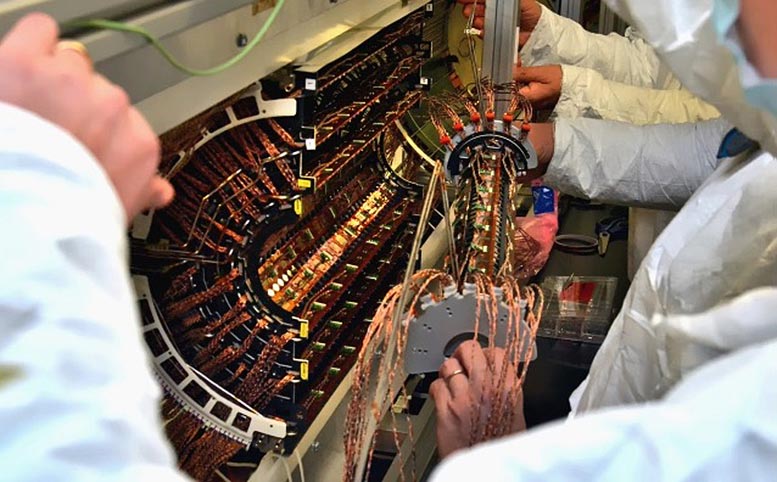
    CMS Pixel Tracker
    The pixel tracker is the subdetector that is closest to the beamline in the CMS experiment. Credit: CERN

    After more than two years of maintenance and upgrades, the Pixel Tracker has been installed at the center of the Compact Muon Solenoid (CMS) detector at the Large Hadron Collider (LHC) and is now ready for commissioning. 

    Of all the CMS subdetectors, the Pixel Tracker is the closest to the interaction point (IP) – the point of collision between the proton beams. In the core of the detector, it reconstructs the paths of high-energy electrons, muons, and electrically charged hadrons, but also the decay of very short-lived particles such as those containing beauty or “b” quarks. Those decays are used, among other things, to study the differences between matter and antimatter.

    The Pixel Tracker is composed of concentric layers and rings of 1800 small silicon modules. Each of these modules contains about 66,000 individual pixels, for a total of 120 million pixels. The pixels’ tiny size (100×150 μm2) allows the trajectory of a particle passing through the detector to be precisely measured and its origin determined with a precision of about 10 μm.

    Due to its location very close to the IP, the Pixel Tracker suffers a great deal of radiation damage from particle collisions. In the innermost layer, a mere 2.9 cm (1.1 in) away from the beam pipe, around 600 million particles pass through one square centimeter of the detector every second. Low temperatures help to protect the Pixel Tracker from this high radiation (it is kept at -20 °C or -4 °F), but some damage still occurs. 

    To tackle this issue, the subdetector underwent extensive repairs and upgrades in the clean room where it was stored after its extraction from the cavern at the beginning of Long Shutdown 2. Its design was improved and its innermost layer replaced. The pixel detector was then reinstalled at the center of the CMS detector and is now ready for commissioning. 

    The final installation was the latest of the many achievements of the CMS Tracker group, one of the largest sub-groups of the CMS collaboration with about 600 people from over 70 institutions in 19 countries.

    Never miss a breakthrough: Join the SciTechDaily newsletter.
    Follow us on Google and Google News.

    CERN Large Hadron Collider Particle Physics
    Share. Facebook Twitter Pinterest LinkedIn Email Reddit

    Related Articles

    New CERN Study Suggests Subatomic Particles Could Defy the Standard Model

    CERN Reports Observation of Pentaquark Particles

    Physicists Confirm Discovery of Four-Quark Hadron

    New Results Indicate That Particle Discovered at LHC Is a Higgs Boson

    The Large Hadron Collider Prepares for Shutdown

    CERN to Announce the Latest Results from ATLAS and CMS

    Discussing the Search for the Higgs Particle

    More Data of Elusive Higgs Boson from Defunct US Tevatron Collider

    Higgs Boson Signals Gain Strength at Large Hadron Collider

    Leave A Reply Cancel Reply

    • Facebook
    • Twitter
    • Pinterest
    • YouTube

    Don't Miss a Discovery

    Subscribe for the Latest in Science & Tech!

    Trending News

    Scientists Uncover Potential Brain Risks of Popular Fish Oil Supplements

    Scientists Discover a Surprising Way To Make Bread Healthier and More Nutritious

    After 60 Years, Scientists Uncover Unexpected Brain Effects of Popular Diabetes Drug Metformin

    New Research Uncovers Hidden Side Effects of Popular Weight-Loss Drugs

    Scientists Rethink Extreme Warming After Surprising Ocean Discovery

    Landmark Study Links Never Marrying to Significantly Higher Cancer Risk

    Researchers Discover Unknown Beetle Species Just Steps From Their Lab

    Largest-Ever Study Finds Medicinal Cannabis Ineffective for Anxiety, Depression, PTSD

    Follow SciTechDaily
    • Facebook
    • Twitter
    • YouTube
    • Pinterest
    • Newsletter
    • RSS
    SciTech News
    • Biology News
    • Chemistry News
    • Earth News
    • Health News
    • Physics News
    • Science News
    • Space News
    • Technology News
    Recent Posts
    • Scientists Discover Hidden Pathway Inside Catalysts That Defies Decades of Assumptions
    • Scientists Finally Crack Decades-Old Mystery of “Breathing” Lasers
    • “Like Liquid Metal”: Scientists Create Strange Shape-Shifting Material
    • Early Warning Signals of Esophageal Cancer May Be Hiding in Plain Sight
    • Researchers Have Discovered a THC-Free Cannabis Compound That May Replace Opioids
    Copyright © 1998 - 2026 SciTechDaily. All Rights Reserved.
    • Science News
    • About
    • Contact
    • Editorial Board
    • Privacy Policy
    • Terms of Use

    Type above and press Enter to search. Press Esc to cancel.