
Close Menu
    Facebook X (Twitter) Instagram
    SciTechDaily
    • Biology
    • Chemistry
    • Earth
    • Health
    • Physics
    • Science
    • Space
    • Technology
    Facebook X (Twitter) Pinterest YouTube RSS
    SciTechDaily
    Home»Space»Sun Erupts With Massive X3.3 Flare, Captured by NASA’s Solar Dynamics Observatory
    Space

    Sun Erupts With Massive X3.3 Flare, Captured by NASA’s Solar Dynamics Observatory

    By SciTechDaily.comOctober 25, 2024No Comments3 Mins Read
    Facebook Twitter Pinterest Telegram LinkedIn WhatsApp Email Reddit
    Share
    Facebook Twitter LinkedIn Pinterest Telegram Email Reddit
    X3.3 Solar Flare October 2024
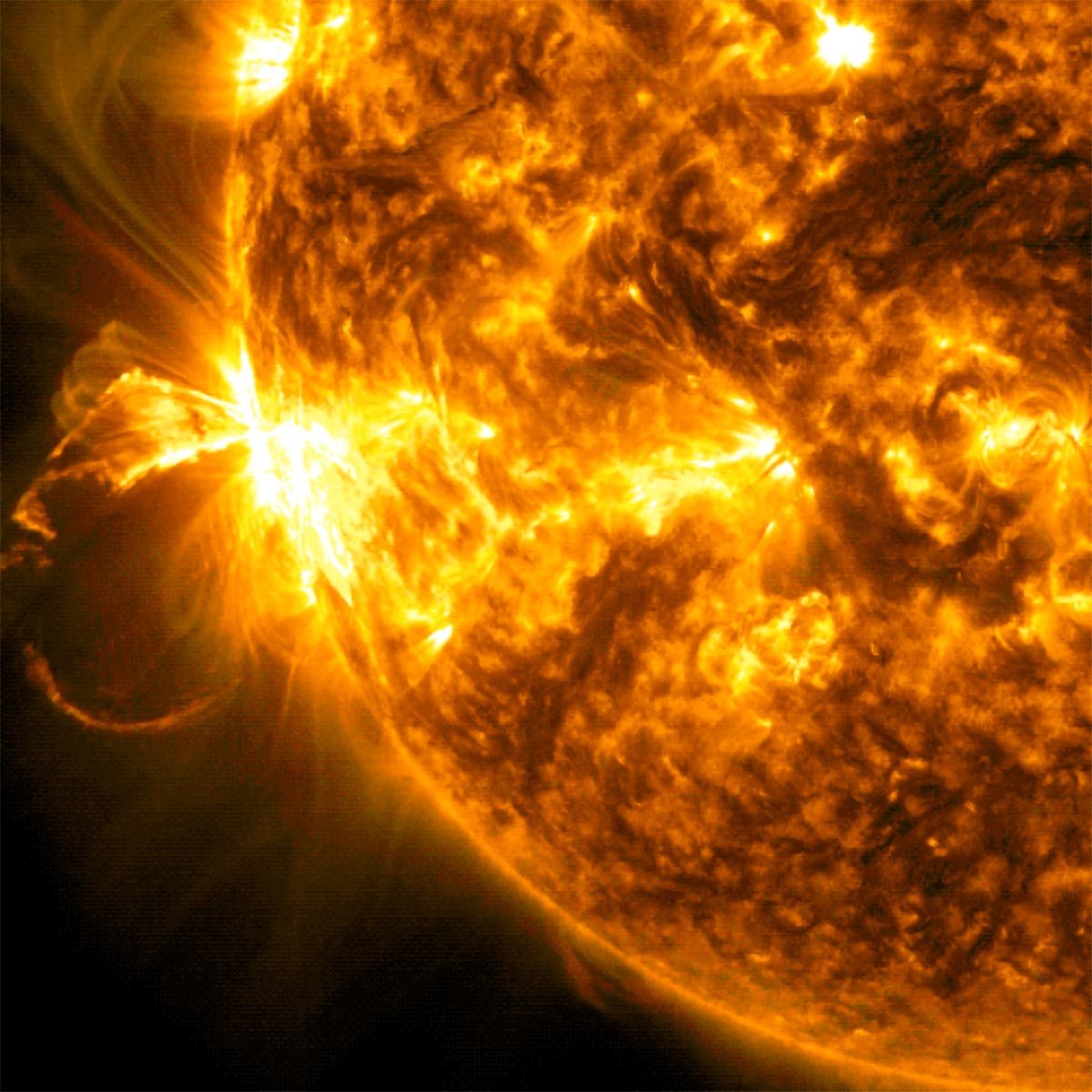
    NASA’s Solar Dynamics Observatory captured this image of a solar flare, visible as the bright flash on the left, on October 23, 2024. The image shows a portion of extreme ultraviolet light, which reveals the intense heat of the flare material, colorized here in orange for clarity. Credit: NASA/SDO

    On October 23, 2024, NASA’s Solar Dynamics Observatory captured a powerful solar flare that peaked at 11:57 p.m. ET. This flare, classified as an X3.3, represents a high-intensity event capable of disrupting radio communications, navigation systems, and electrical grids, as well as posing risks to astronauts and spacecraft.

    Solar flares are intense bursts of radiation and energy released from the Sun’s surface, triggered by the sudden release of magnetic energy stored in the Sun’s atmosphere. These flares often occur near sunspots, which are highly magnetic regions, and can range in intensity from mild to extremely powerful. Classified into categories such as C, M, and X, with X being the most intense, solar flares can produce energy levels equivalent to millions of hydrogen bombs exploding simultaneously.

    X3.3 Solar Flare October 2024
    NASA’s Solar Dynamics Observatory captured this image of a solar flare — seen as the bright flash on the left — on Oct. 23, 2024. The image shows a subset of extreme ultraviolet light that highlights the extremely hot material in flares and which is colorized in orange. Credit: NASA/SDO

    The effects of solar flares can extend well beyond the Sun itself, impacting Earth by disrupting radio communications, GPS signals, and even electrical power grids. Flares also pose radiation risks for astronauts and spacecraft, especially during intense X-class events. Scientists study solar flares to better understand and predict “space weather,” helping to protect technology and human activities that may be vulnerable to these dramatic solar events.

    NASA’s Solar Dynamics Observatory (SDO) is a satellite launched in 2010 to observe the Sun in unprecedented detail and help scientists understand the Sun’s influence on Earth and space weather. Equipped with advanced instruments, SDO continuously monitors the Sun’s atmosphere, capturing high-resolution images and data across multiple wavelengths. This allows it to track solar activity, such as flares, sunspots, and coronal mass ejections, in real time.

    SDO’s observations are essential for studying the Sun’s magnetic field, solar winds, and energetic events that can impact technology on Earth, including communications and navigation systems. By providing insights into the mechanics of solar activity, SDO helps scientists predict and mitigate the effects of space weather on our technology-dependent society.

    Never miss a breakthrough: Join the SciTechDaily newsletter.
    Follow us on Google and Google News.

    NASA Solar Dynamics Observatory Solar Flares
    Share. Facebook Twitter Pinterest LinkedIn Email Reddit

    Related Articles

    Powerful X-class Solar Flare Erupts From Sun

    NASA’s Solar Dynamics Observatory Spots Burst of Light and Energy on the Sun: A B-Class Flare

    M7.9-Class Solar Flare Seen by Solar Dynamics Observatory

    NASA’s Solar Dynamics Observatory Views M-Class Solar Flare

    New SDO Image of X-Class Solar Flare

    NASA’s SDO Reveals Images of X4.9-Class Solar Flare

    NASA’s Solar Dynamics Observatory Views Two New Solar Flares

    New Light Shed on the Origins of Extreme Space Storms

    Solar Flare Causes Powerful Solar Radiation Storm

    Leave A Reply Cancel Reply

    • Facebook
    • Twitter
    • Pinterest
    • YouTube

    Don't Miss a Discovery

    Subscribe for the Latest in Science & Tech!

    Trending News

    One of the Universe’s Largest Stars May Be Getting Ready To Explode

    Scientists Discover Enzyme That Could Supercharge Ozempic-Like Weight Loss Drugs

    Popular Sweetener Linked to DNA Damage – “It’s Something You Should Not Be Eating”

    Ancient “Rock” Microbes May Reveal How Complex Life Began

    Researchers Capture Quantum Interference in One of Nature’s Rarest Atoms

    “A Plague Is Upon Us”: The Mass Death That Changed an Ancient City Forever

    Scientists Discover Game-Changing New Way To Treat High Cholesterol

    This Small Change to Your Exercise Routine Could Be the Secret to Living Longer

    Follow SciTechDaily
    • Facebook
    • Twitter
    • YouTube
    • Pinterest
    • Newsletter
    • RSS
    SciTech News
    • Biology News
    • Chemistry News
    • Earth News
    • Health News
    • Physics News
    • Science News
    • Space News
    • Technology News
    Recent Posts
    • Scientists Prove There Are Just Six Degrees of Separation in a Social Network
    • Bee Bacteria Could Fix a Major Flaw in Plant-Based Milk
    • Scientists Discover a Surprising Way To Make Bread Healthier and More Nutritious
    • Natural Compounds Boost Bone Implant Success While Killing Bacteria and Cancer Cells
    • After 60 Years, Scientists Uncover Unexpected Brain Effects of Popular Diabetes Drug Metformin
    Copyright © 1998 - 2026 SciTechDaily. All Rights Reserved.
    • Science News
    • About
    • Contact
    • Editorial Board
    • Privacy Policy
    • Terms of Use

    Type above and press Enter to search. Press Esc to cancel.