
Close Menu
    Facebook X (Twitter) Instagram
    SciTechDaily
    • Biology
    • Chemistry
    • Earth
    • Health
    • Physics
    • Science
    • Space
    • Technology
    Facebook X (Twitter) Pinterest YouTube RSS
    SciTechDaily
    Home»Earth»Suomi NPP Satellite Views Aurora Borealis Over North America
    Earth

    Suomi NPP Satellite Views Aurora Borealis Over North America

    By Mike Carlowicz, NASAApril 25, 2018No Comments2 Mins Read
    Facebook Twitter Pinterest Telegram LinkedIn WhatsApp Email Reddit
    Share
    Facebook Twitter LinkedIn Pinterest Telegram Email Reddit
    Suomi NPP Satellite Views Aurora Borealis
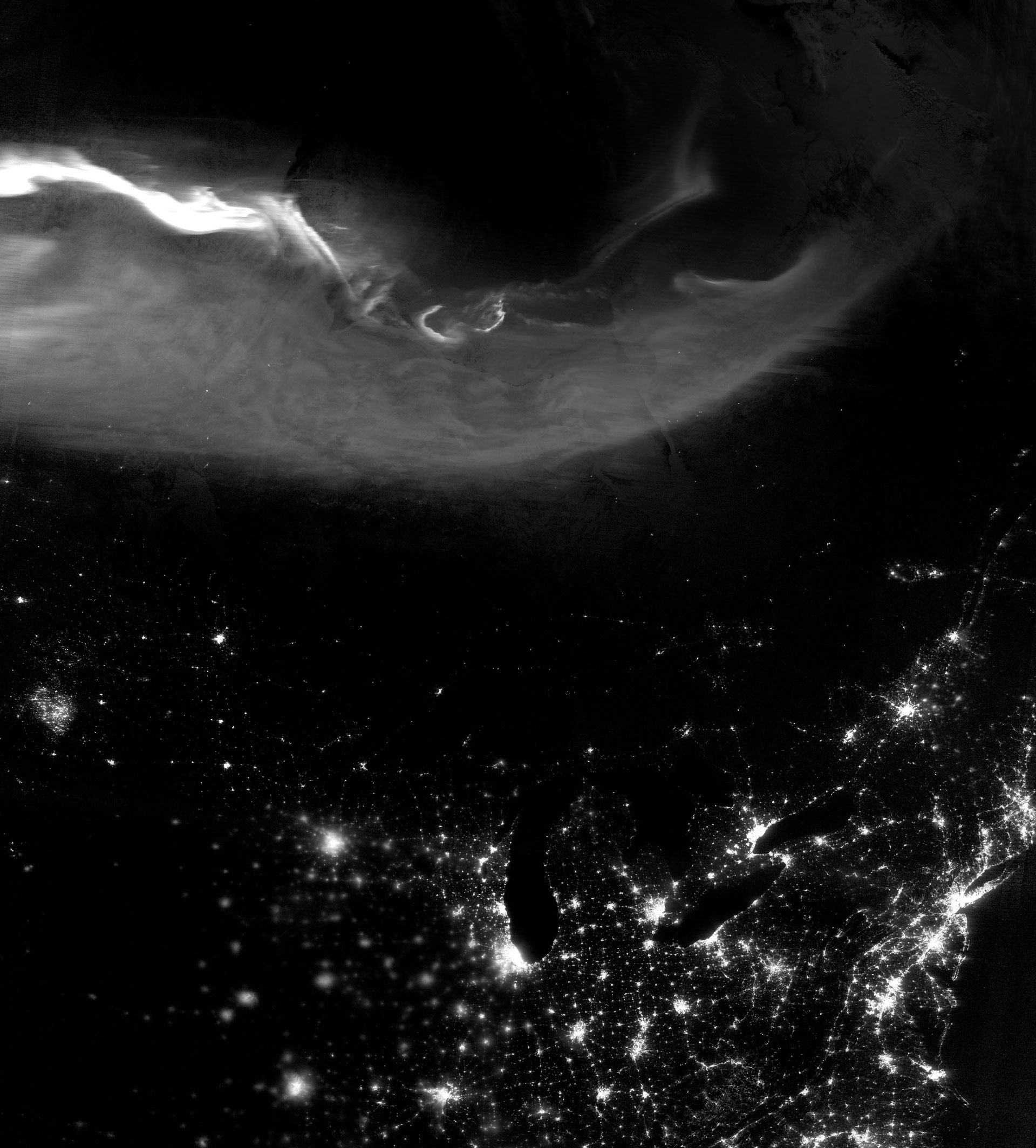
    Aurora borealis over North America. Credit: NASA/Joshua Stevens/Suomi-NPP

    Our Sun provides the light and heat that energizes our plants, our solar panels and our weather, among other things. But its influence stretches over the horizon into our nights, as well. As our nearest star, the Sun bathes Earth in a steady stream of energetic particles, magnetic fields and radiation that can stimulate our atmosphere and light up the night sky, like the aurora borealis, or northern lights.

    At 3:46 a.m. Eastern Time on April 21, 2018, the Visible Infrared Imaging Radiometer Suite (VIIRS) on the Suomi NPP satellite acquired this image of the aurora borealis over North America. The nighttime image was made possible through VIIRS “day-night band,” which detects light in a range of wavelengths from green to near-infrared and uses filtering techniques to observe signals such as airglow, auroras, wildfires, city lights, and reflected moonlight.

    In this image, the sensor detected the visible light emissions that occurred as energetic particles from Earth’s magnetosphere rained down into the oxygen and nitrogen gases of the upper atmosphere. Around April 19, the Sun spewed a potent stream of particles and electromagnetic energy—a strong blast of solar wind—that arrived at Earth a few days later and stirred up our magnetic field. The interaction between these solar emissions and our magnetic field causes the particles already trapped around the planet to be accelerated down toward the atmosphere. The collisions make the auroral light.

    Scientists recently discovered a new type of atmospheric light emission related to auroras and known as strong thermal emission velocity enhancements or STEVE. STEVE is a thin purple ribbon of light that can appear in the presence of an aurora, although it was not reported during the April 21 event. You can participate in a citizen-science project to track auroras and help find new observations of STEVE through Aurorasaurus.

    Annotated image: NASA Earth Observatory

    Never miss a breakthrough: Join the SciTechDaily newsletter.
    Follow us on Google and Google News.

    Aurora Borealis Suomi NPP Satellite
    Share. Facebook Twitter Pinterest LinkedIn Email Reddit

    Related Articles

    Experiments Show Source of the Aurora Borealis: Electrons Surfing on Alfvén Waves

    Brilliant Borealis: A Blast of High-Speed Solar Wind Provoked Dancing Auroras

    “Surfing” Particles on Alfvén Waves: Physicists Solve a Mystery Surrounding Aurora Borealis

    At Last, Physicists Report Definitive Evidence of How Brilliant Auroras Are Created

    Astronomers Solve the Mystery of Purple Lights in the Upper Atmosphere

    NASA Scientists Reveal the Role of Electrons in Pulsating Auroras

    NASA Launched Rocket into Aurora Borealis

    NASA’s Newest CERES Instrument Scans Earth

    Amazing Time-Lapse Video of Earth from the International Space Station

    Leave A Reply Cancel Reply

    • Facebook
    • Twitter
    • Pinterest
    • YouTube

    Don't Miss a Discovery

    Subscribe for the Latest in Science & Tech!

    Trending News

    The Universe Is Expanding Too Fast and Scientists Can’t Explain Why

    “Like Liquid Metal”: Scientists Create Strange Shape-Shifting Material

    Early Warning Signals of Esophageal Cancer May Be Hiding in Plain Sight

    Common Blood Pressure Drug Shows Surprising Power Against Deadly Antibiotic-Resistant Superbug

    Scientists Uncover Dangerous Connection Between Serotonin and Heart Valve Disease

    Scientists Discover a “Protector” Protein That Could Help Reverse Hair Loss

    Bone-Strengthening Discovery Could Reverse Osteoporosis

    Scientists Uncover Hidden Trigger Behind Stem Cell Aging

    Follow SciTechDaily
    • Facebook
    • Twitter
    • YouTube
    • Pinterest
    • Newsletter
    • RSS
    SciTech News
    • Biology News
    • Chemistry News
    • Earth News
    • Health News
    • Physics News
    • Science News
    • Space News
    • Technology News
    Recent Posts
    • Scientists Overcome Major Quantum Bottleneck, Potentially Transforming Teleportation and Computing
    • Quantum Physics’ Strangest Problem May Hold the Key to Time Itself
    • Scientists Create “Liquid Gears” That Spin Without Touching
    • The Simple Habit That Could Help Prevent Cancer
    • Forgotten Medicinal Plant Shows Promise in Fighting Dangerous Superbugs
    Copyright © 1998 - 2026 SciTechDaily. All Rights Reserved.
    • Science News
    • About
    • Contact
    • Editorial Board
    • Privacy Policy
    • Terms of Use

    Type above and press Enter to search. Press Esc to cancel.