
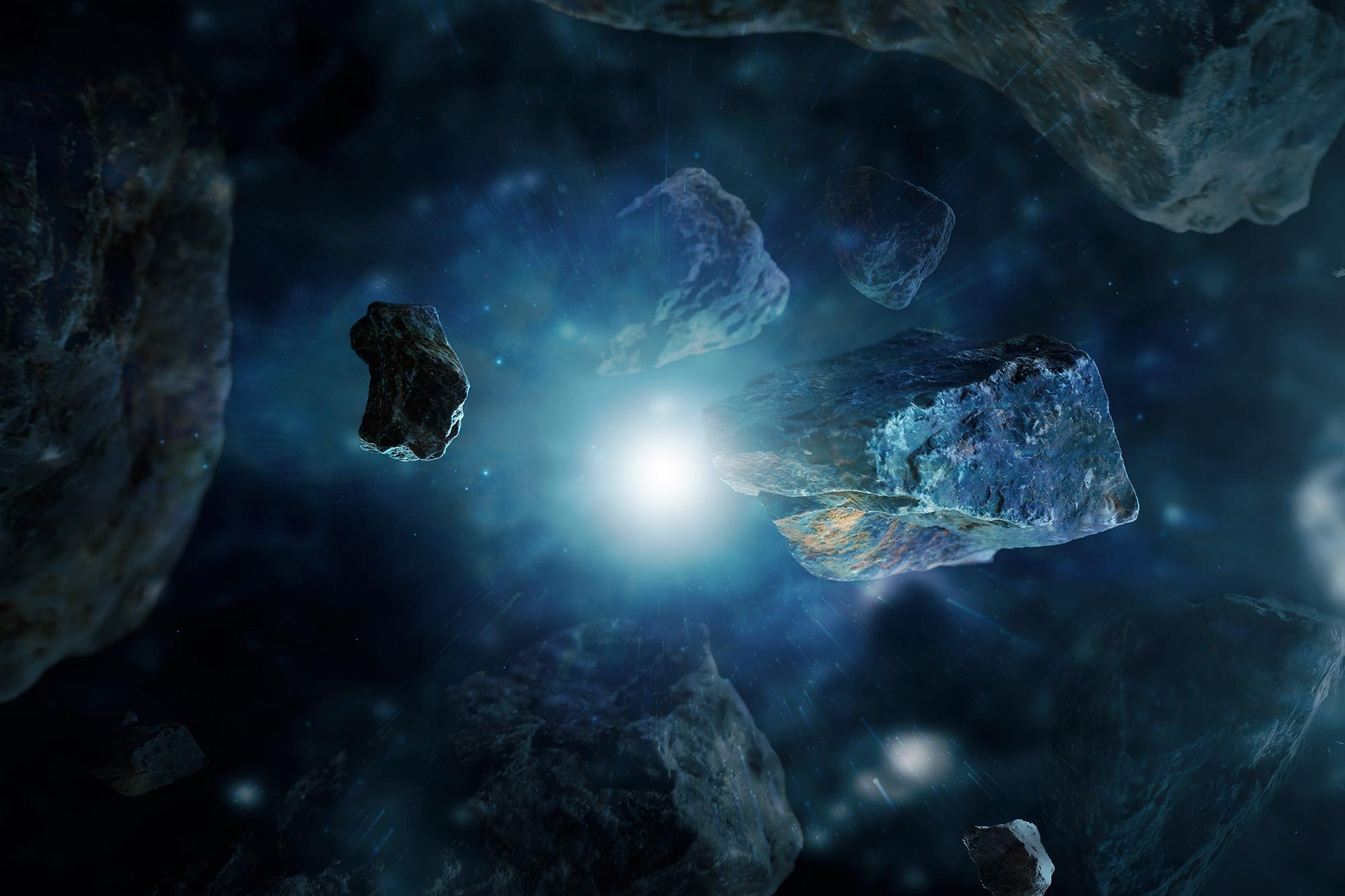
- Radiation from dying stars is luminous enough to easily spin up orbiting asteroids to break-up speed
- New study led by University of Warwick astronomer computes the cascade of destruction down to boulder-size fragments
- Break-ups form a vast asteroid debris field much like the classic arcade game, including fragments which revolve around each other as “double asteroids”
- Scientists predict that the Solar System’s asteroid belt will be pulverized by the Sun’s light in 6 billion years
The majority of stars in the universe will become luminous enough to blast surrounding asteroids into successively smaller fragments using their light alone, according to a University of Warwick astronomer.
Electromagnetic radiation from stars at the end of their ‘giant branch’ phase — lasting just a few million years before they collapse into white dwarfs — would be strong enough to spin even distant asteroids at high speed until they tear themselves apart again and again. As a result, even our own asteroid belt will be easily pulverized by our Sun billions of years from now.
The new study from the University of Warwick’s Department of Physics, published in the journal Monthly Notices of the Royal Astronomical Society, analyses the number of successive break-up events and how quickly this cascade occurs.
The authors have concluded that all but the most distant or smallest asteroids in a system would be disintegrated in a relatively short one million years, leaving behind debris that scientists can find and analyze around dead white dwarf stars. Some of this debris may be in the form of ‘double asteroids’ which revolve around each other while they orbit the Sun.
After main sequence stars like our Sun have burnt all their hydrogen fuel, they then become hundreds of times larger during a ‘giant branch’ phase and increase their luminosity ten-thousand-fold, giving out intense electromagnetic radiation. When that expansion stops, a star sheds its outer layers, leaving behind a dense core known as a white dwarf.
The radiation from the star will be absorbed by orbiting asteroids, redistributed internally and then emitted from a different location, creating an imbalance. This imbalance creates a torque effect that very gradually spins up the asteroid, eventually to break-up speed at one full rotation every 2 hours (the Earth takes almost 24 hours to complete a full rotation). This effect is known as the YORP effect, named after four scientists (Yarkovsky, O’Keefe, Radzievskii, Paddack) who contributed ideas to the concept.
Eventually, this torque will pull the asteroid apart into smaller pieces. The process will then repeat itself in several stages, much like how in the classic arcade game ‘Asteroids’ they break down into smaller and smaller asteroids after each destruction event. The scientists have calculated that in most cases there will be more than ten fission events — or break-ups — before the pieces become too small to be affected.
Lead author Dr. Dimitri Veras, from the University of Warwick’s Astronomy and Astrophysics Group, said: “When a typical star reaches the giant branch stage, its luminosity reaches a maximum of between 1,000 and 10,000 times the luminosity of our Sun. Then the star contracts down into an Earth-sized white dwarf very quickly, where its luminosity drops to levels below our Sun’s. Hence, the YORP effect is very important during the giant branch phase, but almost non-existent after the star has become a white dwarf.
“For one solar-mass giant branch stars — like what our Sun will become — even exo-asteroid belt analogs will be effectively destroyed. The YORP effect in these systems is very violent and acts quickly, on the order of a million years. Not only will our own asteroid belt be destroyed, but it will be done quickly and violently. And due solely to the light from our Sun.”
The remains of these asteroids will eventually form a debris disc around the white dwarf, and the disc will be drawn into the star, ‘polluting it’. This pollution can be detected from Earth by astronomers and analyzed to determine its composition.
Dr. Veras adds: “These results help locate debris fields in giant branch and white dwarf planetary systems, which is crucial to determining how white dwarfs are polluted. We need to know where the debris is by the time the star becomes a white dwarf to understand how discs are formed. So the YORP effect provides important context for determining where that debris would originate.”
When our Sun dies and runs out of fuel in about 6 billion years it too will shed its outer layers and collapse into a white dwarf. As its luminosity grows it will bombard our asteroid belt with increasingly intense radiation, subjecting the asteroids to the YORP effect and breaking them into smaller and smaller pieces, just like in a game of ‘Asteroids’.
Most asteroids are what are known as ‘rubble piles’ — a collection of rocks loosely held together — which means they have little internal strength. However, smaller asteroids have greater internal strength, and while this effect will break down larger objects quite quickly, the debris will plateau at objects around 1-100 meters in diameter. Once the ‘giant branch’ phase starts the process will continue unabated until reaching this plateau.
The effect lessens with increasing distance from the star and with increasing internal strength of the asteroid. The YORP effect can break up asteroids at hundreds of AU (Astronomical Units), much further away than where Neptune or Pluto resides.
However, the YORP effect will only influence asteroids. Objects larger than Pluto will likely escape this fate due to their size and internal strength — unless they are broken up by another process, such as a collision with another planet.
Reference: “Post-main-sequence debris from rotation-induced YORP break-up of small bodies – II. Multiple fissions, internal strengths, and binary production” by Dimitri Veras and Daniel J Scheeres, 20 December 2019, Monthly Notices of the Royal Astronomical Society.
DOI: 10.1093/mnras/stz3565
The research received support from the UK’s Science and Technology Facilities Council.
Never miss a breakthrough: Join the SciTechDaily newsletter.
Follow us on Google and Google News.