
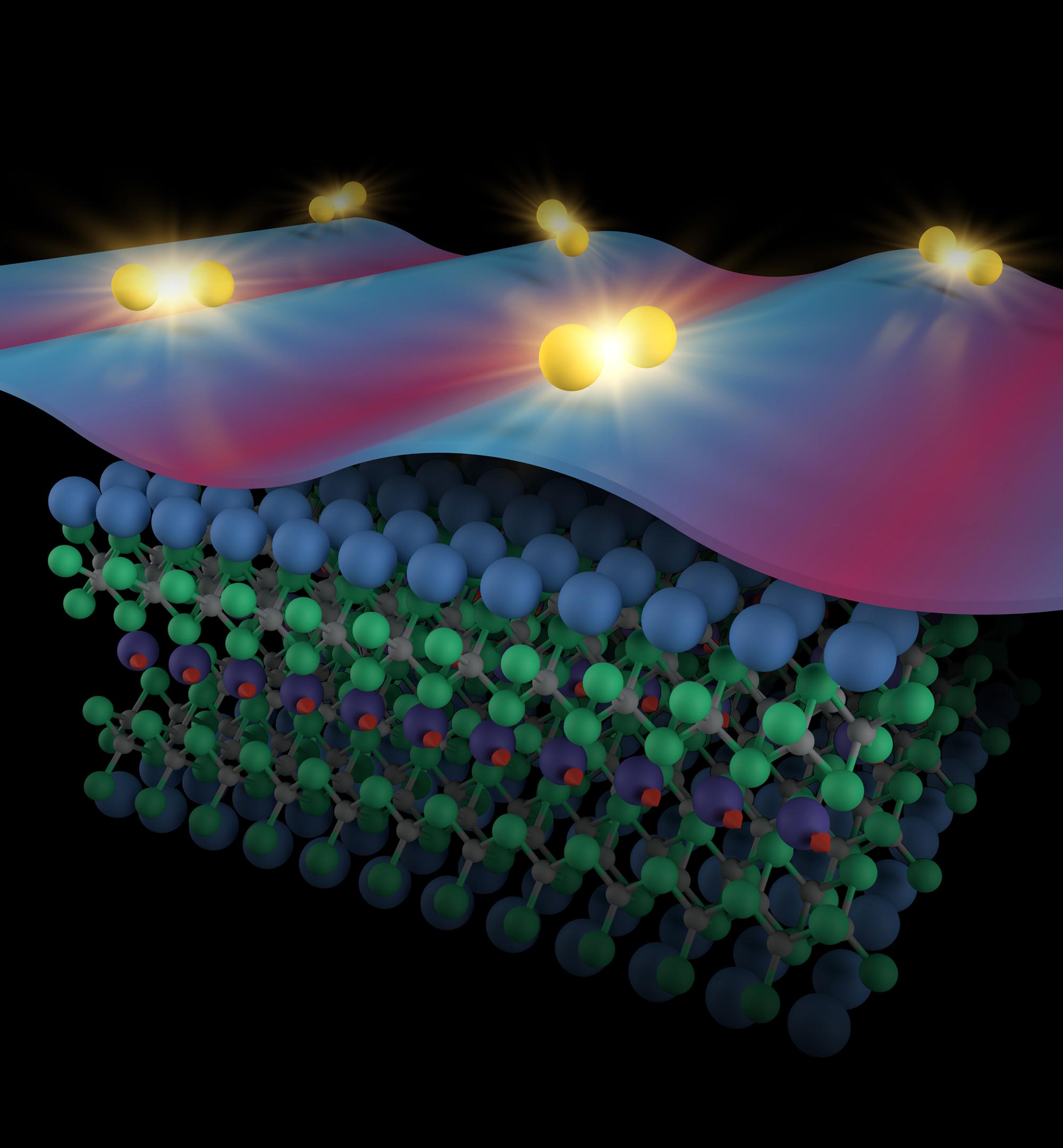
Tunneling spectroscopy uncovers the clearest proof yet that this exotic superconducting state of matter exists without a magnetic field in an iron-based superconductor.
Researchers discovered an alternate superconducting state, called a pair density wave (PDW), in a non-magnetic environment, challenging previous understandings of superconductivity. This breakthrough in an iron-based superconductor that also exhibits ferromagnetism opens up new potential for superconductivity research and could revolutionize the field.
In the field of superconductivity—the phenomenon in which electrons can flow through a material with essentially zero resistance—the “holy grail” of discovery is a superconductor that can perform under everyday temperatures and pressures. Such a material could revolutionize modern life. But currently, even the “high-temperature” (high-Tc) superconductors that have been discovered must be kept very cold to function—too cold for most applications.
Scientists still have much to learn before room-temperature superconductivity can be realized, largely because superconductors are highly complex materials with interwoven and sometimes competing magnetic and electronic states. These different states, or phases, can be very difficult to untangle and interpret.
One such state is an alternate superconducting state of matter known as a pair density wave (PDW), which is characterized by coupled pairs of electrons that are constantly in motion. PDWs have been thought to only arise when a superconductor is placed within a large magnetic field—until now, that is.
A Breakthrough in Iron-Based Superconductors
Recently, researchers from the U.S. Department of Energy’s Brookhaven National Laboratory, Columbia University, and Japan’s National Institute of Advanced Industrial Science and Technology directly observed a PDW in an iron-based superconducting material with no magnetic field present. They describe their results in the June 28, 2023, online edition of the journal Nature.
“Researchers in our field have theorized that a PDW could exist on its own, but the evidence has been ambiguous at best,” said Kazuhiro Fujita, a physicist at Brookhaven who participated in the study. “This iron-based superconductor is the first material in which the evidence clearly points to a zero-magnetic-field PDW. This is an exciting result that opens new potential avenues of research and discovery for superconductivity.”
The material, the iron pnictide EuRbFe4As4 (Eu-1144), which has a layered crystalline structure, is also quite notable because it naturally exhibits both superconductivity and ferromagnetism. This unusual dual identity is what initially drew the group to the material and led them to study it.
“We wanted to see, is this magnetism linked to the superconductivity? In general, superconductors are destabilized by magnetic order, so when both superconductivity and magnetism exist together in a single compound, it is interesting to see how the two of them coexist,” said physicist Abhay Pasupathy, one of the paper’s co-authors, who is affiliated with both Brookhaven and Columbia. “It’s conceivable that the two phenomena exist in different parts of the compound and have nothing to do with each other. But, instead, we found that there is a beautiful connection between the two.”
The spatially modulated superconductivity was detected upon appearance of the magnetism.
“This is an exciting result that opens new potential avenues of research and discovery for superconductivity.” Brookhaven Lab physicist Kazuhiro Fujita
Advanced Imaging Techniques Reveal PDW Signatures
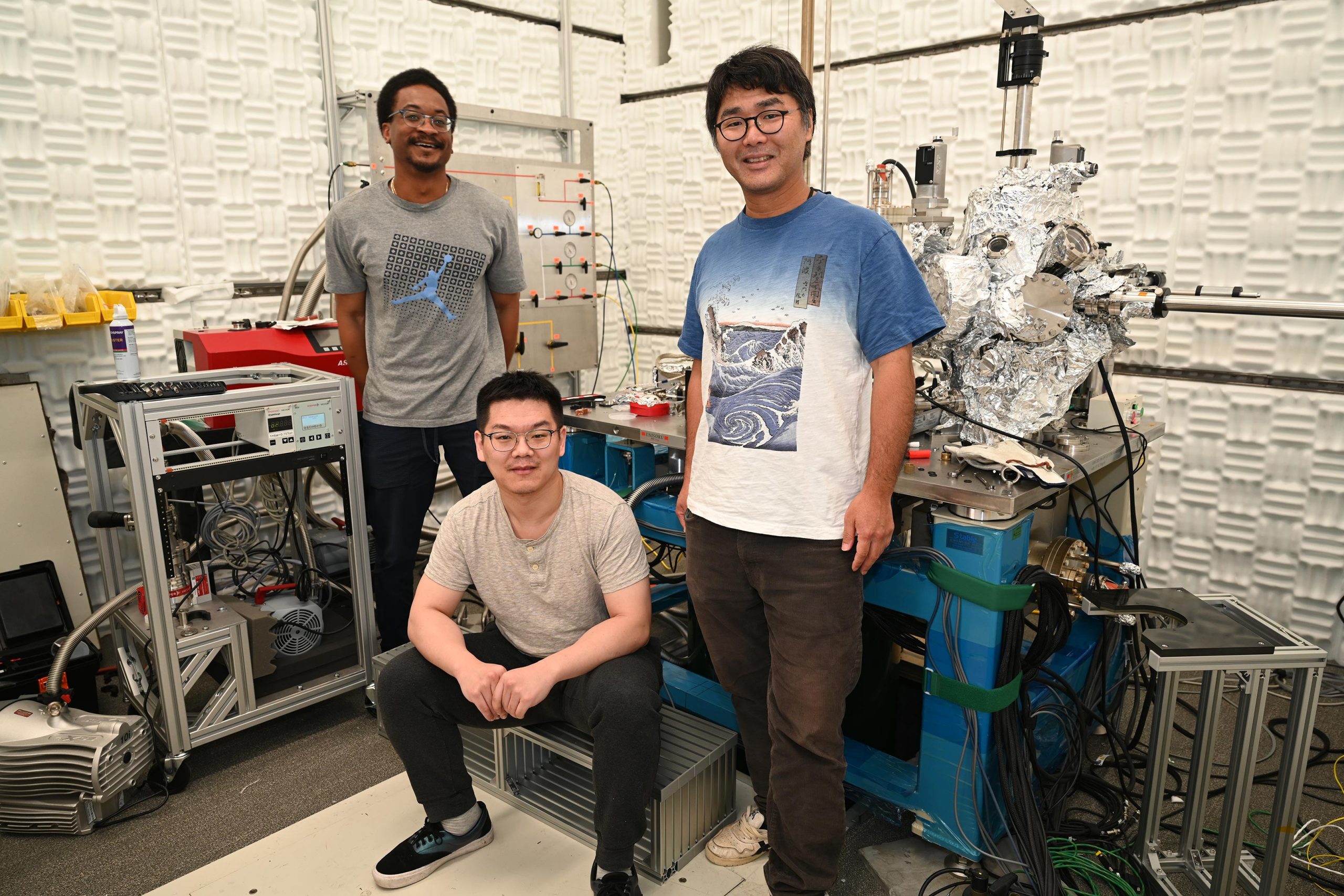
Pasupathy and his colleagues studied Eu-1144 at Brookhaven’s ultra-low vibration laboratory using a state-of-the-art spectroscopic-imaging scanning tunneling microscope (SI-STM).
“This microscope measures how many electrons at a specific location in the material ‘tunnel’ back and forth between the sample’s surface and the tip of the SI-STM as the voltage between the tip and the surface is varied,” said Fujita. “These measurements allow us to create a map of both the sample’s crystal lattice and the number of electrons at different energies at each atomic location.”
They performed measurements on their sample as its temperature was increased, passing through two critical points: the magnetism temperature, below which the material exhibits ferromagnetism, and the superconducting temperature, below which the material is able to carry current with zero resistance.
Below the sample’s critical superconducting temperature, the measurements revealed a gap in the spectrum of electron energies. This gap is an important marker because its size is equivalent to the energy it takes to break apart the electron pairs that carry the superconducting current. Modulations in the gap reveal variations in the electrons’ binding energies, which oscillate between a minimum and maximum. These energy gap modulations are a direct signature of a PDW.
This discovery points researchers in some new directions, such as trying to reproduce this phenomenon in other materials. There are also other aspects of a PDW that can be investigated, such as trying to indirectly detect the movement of the electron pairs via signatures that show up in other properties of the material.
“Many of our collaborators have shown great interest in our work and are already planning different types of experiments on this material, such as using x-rays and muons,” said Pasupathy.
Reference: “Smectic pair-density-wave order in EuRbFe4As4” by He Zhao, Raymond Blackwell, Morgan Thinel, Taketo Handa, Shigeyuki Ishida, Xiaoyang Zhu, Akira Iyo, Hiroshi Eisaki, Abhay N. Pasupathy and Kazuhiro Fujita, 28 June 2023, Nature.
DOI: 10.1038/s41586-023-06103-7
This research group also includes He Zhao (Brookhaven Lab), Raymond Blackwell (Brookhaven Lab), Morgan Thinel (Columbia University), Taketo Handa (Columbia University), Shigeyuki Ishida (National Institute of Advanced Industrial Science and Technology, Japan), Xiaoyang Zhu (Columbia University), Akira Iyo (National Institute of Advanced Industrial Science and Technology, Japan), and Hiroshi Eisaki (National Institute of Advanced Industrial Science and Technology, Japan). The work was funded by the DOE Office of Science (BES), the National Science Foundation, the Air Force Office of Scientific Research, and the Japan Society for the Promotion of Science.
Never miss a breakthrough: Join the SciTechDaily newsletter.
Follow us on Google and Google News.
1 Comment
Topological vortices are points in a two-dimensional field. According to the topological vortex gravitational field theory, the Zero-Field Pair that are constantly in motion is possible. Good luck to you.