
Close Menu
    Facebook X (Twitter) Instagram
    SciTechDaily
    • Biology
    • Chemistry
    • Earth
    • Health
    • Physics
    • Science
    • Space
    • Technology
    Facebook X (Twitter) Pinterest YouTube RSS
    SciTechDaily
    Home»Space»Supermassive Black Holes Like to Eat, but Have a Variety of Table Manners
    Space

    Supermassive Black Holes Like to Eat, but Have a Variety of Table Manners

    By University of GroningenApril 29, 2021No Comments3 Mins Read
    Facebook Twitter Pinterest Telegram LinkedIn WhatsApp Email Reddit
    Share
    Facebook Twitter LinkedIn Pinterest Telegram Email Reddit
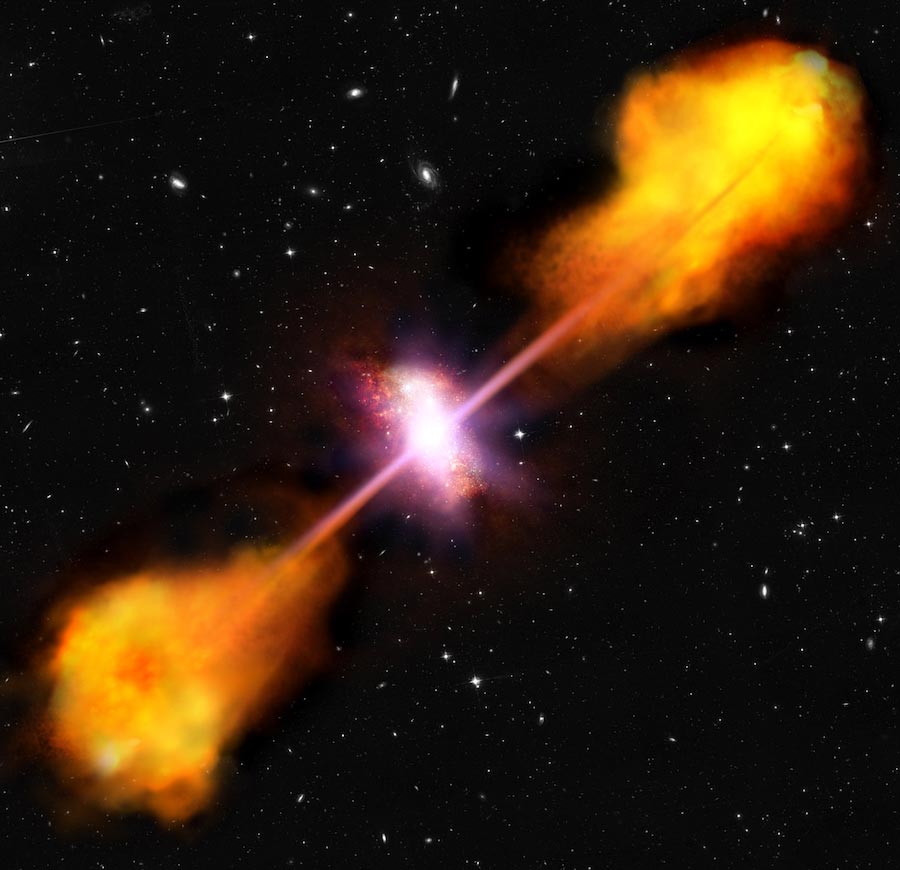
    Galaxy With Active Nucleus Supermassive Black Hole
    Artist’s impression of a galaxy with an active nucleus, a supermassive black hole in the center. When the black hole swallows matter, two powerful jets can form at the edges of the black hole. These jets form gigantic ‘radio clouds’ that can be detected by radio telescopes. Credit: ESA/C. Carreau

    All supermassive black holes in the centers of galaxies appear to have periods when they swallow matter from their close surroundings. But that is about as far as the similarities go. That’s the conclusion reached by British and Dutch astronomers from their research with ultra-sensitive radio telescopes in a well-studied region of the universe. They publish their findings in two articles in the international journal Astronomy & Astrophysics.

    Astronomers have studied active galaxies since the 1950s. Active galaxies have a super-massive black hole at their center that is swallowing matter. During these active phases, the objects often emit extremely strong radio, infrared, ultraviolet, and X-ray radiation.

    In two new publications, an international team of astronomers focused on all the active galaxies in the well-studied GOODS-North region in the constellation of Ursa Major. Until now that region had been studied mainly by space telescopes collecting visible light, infrared light, and UV light. The new observations add data from sensitive networks of radio telescopes, including the UK’s e-MERLIN national facility and the European VLBI Network (EVN).

    Thanks to this systematic study, three things become clear. Firstly, it turns out that the nuclei of many different types of galaxies can be active, in different ways. Some are extremely greedy, gobbling up as much material as they can, others digest their ‘food’ more slowly, and others are nearly starving of hunger.

    Secondly, occasionally an accretion phase occurs simultaneously with a star-formation phase, and sometimes not. If star formation is ongoing, activity in the nucleus is difficult to detect.

    Thirdly, the nuclear accretion process may, or may not, generate radio jets – regardless of the speed at which the black hole swallows its food.

    According to principal investigator Jack Radcliffe (formerly University of Groningen and ASTRON in the Netherlands and University of Manchester in the United Kingdom, now University of Pretoria, South Africa), the observations also show that radio telescopes are optimally useful to study the eating habits of black holes in the distant universe. “That’s good news because the SKA radio telescopes are coming and they will allow us to look deeper into the universe with even more detail.”

    Co-author Peter Barthel (University of Groningen, the Netherlands) adds: “We are getting more and more indications that all galaxies have enormously massive black holes in their centers. Of course, these must have grown to their current mass. It seems that, thanks to our observations, we now have these growth processes in view and are slowly but surely starting to understand them.”

    Co-author Michael Garrett (University of Manchester, United Kingdom) adds: “These beautiful results demonstrate the unique capacities of radio astronomy. Telescopes such as the VLA, e-MERLIN, and the EVN are transforming our view of how galaxies evolve in the early universe.”

    References:

    “Nowhere to Hide: Radio-faint AGN in the GOODS-N field. II. Multi-wavelength AGN selection techniques and host galaxy properties” by J. F. Radcliffe, P. D. Barthel, A. P. Thomson, M. A. Garrett, R. J. Beswick and T. W. B. Muxlow, 6 May 2021, Astronomy & Astrophysics.
    DOI: 10.1051/0004-6361/202038591

    “The radio emission from active galactic nuclei” by J. F. Radcliffe, P. D. Barthel, M. A. Garrett, R. J. Beswick, A. P. Thomson and T. W. B. Muxlow, 7 May 2021, Astronomy & Astrophysics.
    DOI: 10.1051/0004-6361/202140791

    Never miss a breakthrough: Join the SciTechDaily newsletter.
    Follow us on Google and Google News.

    Astronomy Astrophysics Black Hole University of Groningen
    Share. Facebook Twitter Pinterest LinkedIn Email Reddit

    Related Articles

    NASA Investigates an “Old Faithful” Active Galaxy That Erupts Every 114 Days

    Astronomers Discover Evidence for Substance on Liquid-Gas Boundary on Exoplanet WASP-31b

    Deepening Mystery: Astronomers on the Hunt for a Missing Supermassive Black Hole [Video]

    When Galaxies Collide: How Galactic Collisions Can Starve Massive Black Holes

    Massive Stellar Triples Leading to Sequential Binary Black-Hole Mergers

    Astronomers Discover Earliest Supermassive Black Hole and Quasar in the Universe – 1000x More Luminous Than the Milky Way

    Most Distant Quasar Discovered Sheds Light on How Supermassive Black Holes Grow

    Deepening Astronomical Mystery: On the Hunt for a Missing Giant Black Hole

    Supermassive Black Hole’s Dust Ring May Be Casting Shadows From Heart of a Galaxy

    Leave A Reply Cancel Reply

    • Facebook
    • Twitter
    • Pinterest
    • YouTube

    Don't Miss a Discovery

    Subscribe for the Latest in Science & Tech!

    Trending News

    Once-in-a-Century Impact: NASA Just Found a Massive New Crater on the Moon

    Anak Krakatau Just Blasted Ash 50,000 Feet Into the Sky

    NASA’s Chandra Reveals Galaxies Being Torn Apart, Blasted by Black Holes, and Reborn in Stars

    Ozempic’s Active Ingredient Shows Surprising Anti-Aging Effects

    Scientists Discover Canada’s First Dinosaur Tracks From a Rarely Documented Cretaceous Age

    Astronomers Just Caught a Giant Planet in the Act of Forming

    Two Dead Stars Are Racing Around Each Other Every 6.2 Minutes

    Natural Compound May Help Protect the Brain and Heart From Excess Salt

    Follow SciTechDaily
    • Facebook
    • Twitter
    • YouTube
    • Pinterest
    • Newsletter
    • RSS
    SciTech News
    • Biology News
    • Chemistry News
    • Earth News
    • Health News
    • Physics News
    • Science News
    • Space News
    • Technology News
    Recent Posts
    • They Flew Around the Moon. Now NASA Has a New Mission for Them
    • NASA’s Roman Telescope Opens Its 300-Megapixel Eye on the Universe
    • This Strange Planet Is Going Backwards – and Scientists Don’t Know Why
    • Losing the Same Weight Didn’t Produce the Same Health Benefits
    • Feeling Lonely Could Take Nearly 6 Years From Your Healthy Lifespan
    Copyright © 1998 - 2026 SciTechDaily. All Rights Reserved.
    • Science News
    • About
    • Contact
    • Editorial Board
    • Privacy Policy
    • Terms of Use

    Type above and press Enter to search. Press Esc to cancel.