

Researchers have discovered a method to surpass traditional thermodynamic limits in converting waste heat into electricity.
Japanese researchers have discovered a way to overcome long-standing thermodynamic limits, such as the Carnot efficiency, by using quantum states that do not undergo thermalization. Their innovative method employs a non-thermal Tomonaga-Luttinger liquid to transform waste heat into electrical energy with greater efficiency than conventional systems. This advancement could lead to more energy-efficient electronics and future progress in quantum computing.
Energy harvesters are devices that collect power from surrounding environmental sources, offering a means to improve the efficiency of modern electronics and industrial operations. Waste heat is produced continuously by everyday technologies, including computers, smartphones, and factory machinery, as well as by large-scale systems like power plants. Energy-harvesting techniques make it possible to reclaim this otherwise lost heat and convert it into usable electricity, reducing dependence on traditional energy supplies.
Traditional energy-harvesting technologies, however, remain limited by the fundamental principles of thermodynamics. Systems that operate under thermal equilibrium face strict boundaries on how much heat can be turned into electrical power. The ratio between generated electricity and the heat drawn from a waste source is defined by the Carnot efficiency. Additional constraints, such as the Curzon-Ahlborn efficiency (which represents the efficiency achievable at maximum power output), have further restricted how much practical energy can be recovered from waste heat.
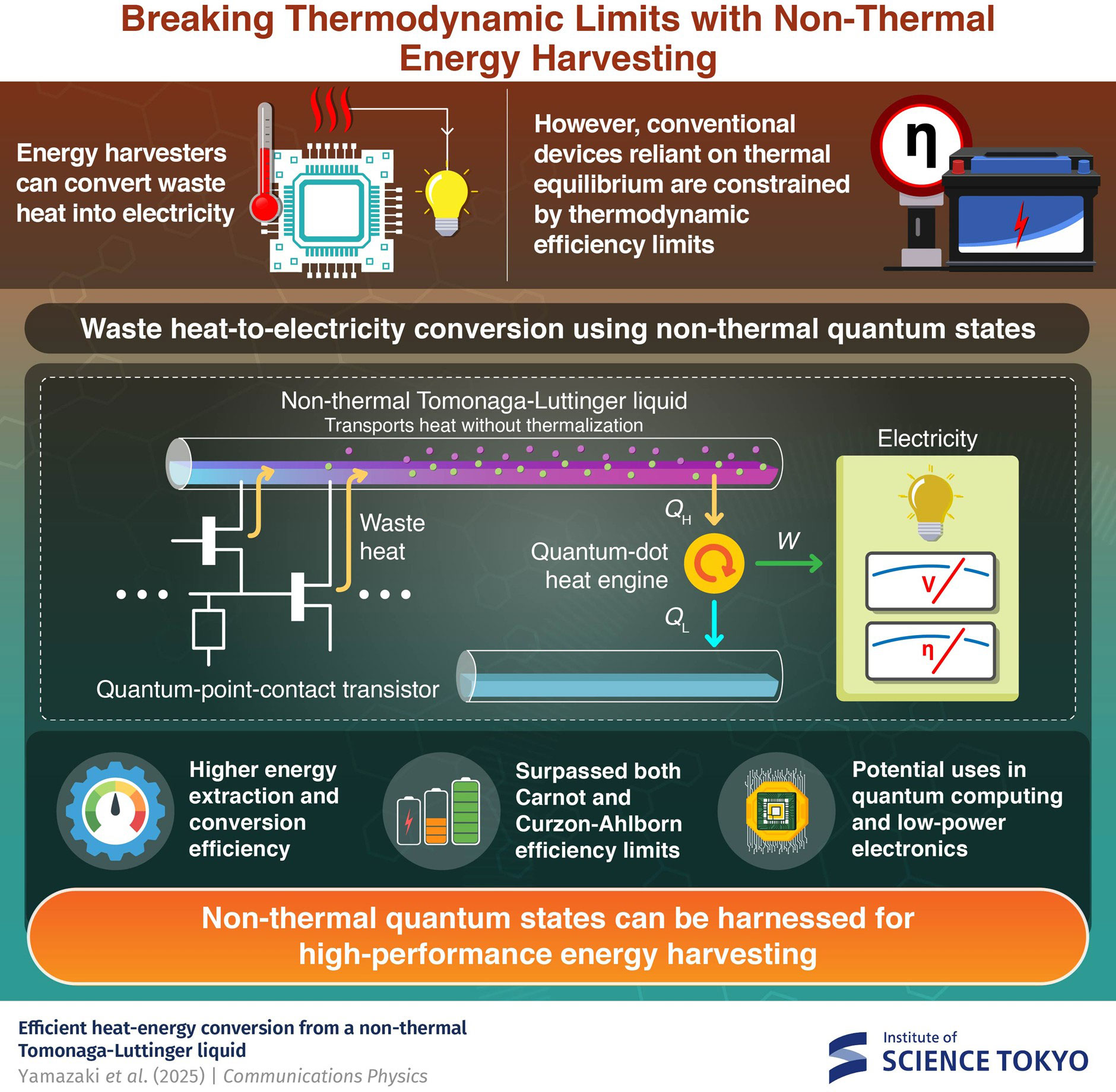
Now, a research team led by Professor Toshimasa Fujisawa from the Department of Physics at Institute of Science Tokyo (Science Tokyo), Japan, in collaboration with Senior Distinguished Researcher Koji Muraki from NTT Basic Research Laboratories, Japan, has found a way to bypass this barrier. In their paper published in Communications Physics on September 30, 2025, the team introduced a novel energy-harvesting technique that uses unique quantum states to achieve efficiencies that go beyond the conventional thermodynamic limits.
A Quantum Solution from Japan
Instead of relying on traditional thermal states, the researchers harnessed the properties of a non-thermal Tomonaga-Luttinger (TL) liquid. This is a special type of one-dimensional electron system that, due to its quantum nature, does not thermalize. This means that when heat is introduced, the system holds onto its non-thermal, high-energy state rather than spreading the energy out evenly, as happens in a conventional thermal system.
The research team designed an experiment to demonstrate the potential of this concept. They injected waste heat from a quantum point contact transistor—a device that controls electron flow—into a TL liquid. This non-thermal heat was transported several micrometers to a quantum-dot heat engine, which is a microscopic device that converts heat into electricity through quantum effects. The researchers found that this unconventional heat source produced a significantly higher electrical voltage and achieved higher conversion efficiency, performing much better than a conventional, quasi-thermalized heat source. “These results encourage us to utilize TL liquids as a non-thermal energy resource for new energy-harvesting designs,” says Fujisawa.
Subsequently, the researchers developed a model based on a binary Fermi distribution to provide a description of non-thermal electron states in the proposed system. Using it, they showed that their technique surpasses not only the Carnot efficiency but also the Curzon-Ahlborn efficiency, which describes the efficiency at maximum power output of conventional heat engines.
Overall, this research opens the door to a new generation of energy harvesting, leveraging non-thermal quantum states. “Our findings suggest that waste heat from quantum computers and electronic devices can be converted into usable power via high-performance energy harvesting,” remarks Fujisawa. With any luck, further efforts in this field will make future technologies more powerful and sustainable.
Reference: “Efficient heat-energy conversion from a non-thermal Tomonaga-Luttinger liquid” by Hikaru Yamazaki, Masashi Uemura, Haruhi Tanaka, Tokuro Hata, Chaojing Lin, Takafumi Akiho, Koji Muraki and Toshimasa Fujisawa, 30 September 2025, Communications Physics.
DOI: 10.1038/s42005-025-02297-6
Funding: Japan Society for the Promotion of Science, Ministry of Education, Culture, Sports, Science and Technology
Never miss a breakthrough: Join the SciTechDaily newsletter.
Follow us on Google and Google News.
6 Comments
CB memo 2510080326_Source1.Reinterpreting【
Source 1.
https://scitechdaily.com/surpassing-thermodynamic-limits-quantum-energy-harvesters-exceed-carnot-efficiency/
1.
Beyond Thermodynamic Limits: Quantum Energy Harvester Exceeds Carnot Efficiency.
_A Japanese research team used non-thermal quantum states to break the classical thermodynamic limit and convert waste heat into electricity with record efficiency.
_This innovative method uses non-thermal Domona-Luttinger liquids to convert waste heat into electrical energy with higher efficiency than conventional systems.
1-2.
_ These advances can lead to the development of more energy-efficient electronic devices and future developments in quantum computing.
2.
_Systems operating in thermal equilibrium face strict limits on how much heat can be converted into electricity.
_The ratio of heat extracted from the produced electricity and waste is defined as the Carnot efficiency. Additional constraints such as the Cousin-Albon efficiency, which exhibits achievable efficiency at maximum output, further limit the amount of substantial energy that can be recovered from waste heat.
2-1.
_Implementing this strategy in practice can help convert waste heat from electronic devices into usable power.
2-2. Japan’s Quantum Solution
_Instead of relying on conventional thermal states, the researchers utilized the properties of nonthermal Tomonaga-Luttinger (TL) liquids.
_[
The Tomonaga-Luttinger liquid is a theoretical model for describing interacting fermions in one-dimensional (1D) conductors, which is required in one dimension as traditional Fermi liquid models are not applied.
]
_It is a special type of one-dimensional electronic system that does not deteriorate due to its quantum properties. In other words, when heat is applied, the system maintains a nonthermal high energy state instead of evenly distributing energy like conventional thermal systems.
[Excited low heat means high energy?
>>> This equation shows that the low temperature of A.sample1.oms.vix.ain.side and the high energy of B.qqms are on the same side. A=B. Is it really the right scheme?
>>> If correct, it’s a huge discovery. Isn’t it because of the low temperature requirements required for high energy to produce random particles that are so cold on the outskirts of the huge universe?
>>I have not been able to properly explain the domain of A and B (*). Now, if A=B is established,
>>Why is the universe so close to absolute temperature (with thermodynamic third law maintenance and nonthermal release) that the low temperature becomes enormous like the universe,
>> As such, it can be seen whether a group of quantum elementary particles constituting the standard model has been formed when maintaining thermodynamics.
>>>>> Of course, when thermodynamics is terminated (non-thermal quantum state), on a multiverse side scale
>>>>> Lower negative temperatures will mass-produce Adam’s Eve-size elementary particles of neutrinos with smaller ultrahigh energies. Uh-huh.
(*)>>>>> The boundary of mside one dimensions is also the periphery of the msoss.dark_matter theory, which includes the Fermi.domona-Luttinger liquid theory, where charge and spin are separated. Good good!!!
】
3.
The team designed the experiment to demonstrate the potential of the concept. The TL liquid was injected with waste heat generated by quantum dot contact transistors, a device that controls electron flow.
_This nonthermal heat was transferred to a quantum dot heat engine at a distance of several micrometers, which is a microscopic device that converts heat into electricity through quantum effects.
_The researchers found that this new heat source achieves significantly higher voltage and higher conversion efficiency than conventional quasi-thermal heat sources, resulting in significantly better performance.
ㅡㅡㅡㅡㅡㅡ
_Note 1.
[
Fermi Liquid Model:
A theory used to explain the behavior of conducting electrons in metals in high-temperature and three-dimensional systems. It simplifies the system of interacting particles to the concept of ‘quasiparticles’.
Tomonaga-Luttinger Liquid:
It explains the phenomenon that occurs when the interaction between particles in a one-dimensional electronic system breaks down the assumption of Fermi liquid theory. This model shows a phenomenon called ‘spin-charge separation’ in which the spin and charge of electrons move in a one-dimensional system.
Spin-Charge Separation:
The phenomenon in which the spin and charge parts of electrons move at different velocities in a one-dimensional system is an important feature of the Domona-Luttinger liquid theory.
_Why do you need this model?
The specificity of a one-dimensional system:
In one dimension, the Fermi liquid model is no longer valid when particles interact with each other.
_Unique conduction characteristics:
Domonaga-Luttinger liquid theory is essential for explaining the unique electrical properties of one-dimensional materials such as carbon nanotubes.
]
With any luck, further efforts in this field will make future technologies more powerful and sustainable.
VERY GOOD! Please continue.
Based on the Topological Vortex Theory (TVT), space is an incompressible physical entity, and space-time vortices are the products of topological phase transitions at critical points in space. They create all things and shape the world through spin and self-organization. Topological vortices are point defects in spacetime. Point defects not only affect thermodynamic processes, but are also the core of dynamic processes.
In today’s physics, some so-called peer-reviewed journals—including Physical Review Letters, Nature, Science, and others—stubbornly insist on and promote the following:
1. Even though θ and τ particles exhibit differences in experiments, physics can claim they are the same particle. This is science.
2. Even though topological vortices and antivortices have identical structures and opposite rotational directions, physics can define their structures and directions as entirely different. This is science.
3. Even though two sets of cobalt-60 rotate in opposite directions and experiments reveal asymmetry, physics can still define them as mirror images of each other. This is science.
4. Even though vortex structures are ubiquitous—from cosmic accretion disks to particle spins—physics must insist that vortex structures do not exist and require verification. Only the particles that like God, Demonic, or Angelic are the most fundamental structures of the universe. This is science.
5. Even though everything occupies space and maintains its existence in time, physics must still debate and insist on whether space exists and whether time is a figment of the human mind. This is science.
6. Even though space, with its non-stick, incompressible, and isotropic characteristics, provides a solid foundation for the development of physics, physics must still insist that the ideal fluid properties of space do not exist. This is science.
and go on.
Is this the counterintuitive science they widely promote? What are the shames? Contemporary physics and so-called peer-reviewed publications (including Physical Review Letters, Science, Nature, etc.) stubbornly believe that two sets of counter rotating cobalt-60 are two mirror images of each other, constructing a more shocking pseudoscientific theoretical framework in the history of science than the “geocentric model”. This pseudo scientific framework and system have seriously hindered scientific progress and social development.
For nearly a century, physics has been manipulated by this pseudo scientific theoretical system and the interest groups behind it, wasting a lot of manpower, funds, and time. A large amount of pseudo scientific research has been conducted, and countless pseudo scientific papers have been published, causing serious negative impacts on scientific and social progress, as well as humanistic development.
Fortunately, not every member of the public is gullible. Topology is reconfiguring the cognitive framework of modern civilization. With the gradual refinement of artificial intelligence (AI), we are no longer entirely reliant on mediated deception by some so-called peer-reviewed publications (including Physical Review Letters, Science, Nature, etc.). We now possess the means to leverage AI’s efficiency to enhance scientific rigor and productivity.
With any luck, further efforts in this field will make future technologies more powerful and sustainable.
VERY GOOD! Please continue.
Based on the Topological Vortex Theory (TVT), space is an incompressible physical entity, and space-time vortices are the products of topological phase transitions at critical points in space. They create all things and shape the world through spin and self-organization. Topological vortices are point defects in spacetime. Point defects not only affect thermodynamic processes, but are also the core of dynamic processes.
In today’s physics, some so-called peer-reviewed journals—including Physical Review Letters, Nature, Science, and others—stubbornly insist on and promote the following:
1. Even though θ and τ particles exhibit differences in experiments, physics can claim they are the same particle. This is science.
2. Even though topological vortices and antivortices have identical structures and opposite rotational directions, physics can define their structures and directions as entirely different. This is science.
3. Even though two sets of cobalt-60 rotate in opposite directions and experiments reveal asymmetry, physics can still define them as mirror images of each other. This is science.
4. Even though vortex structures are ubiquitous—from cosmic accretion disks to particle spins—physics must insist that vortex structures do not exist and require verification. Only the particles that like God, Demonic, or Angelic are the most fundamental structures of the universe. This is science.
5. Even though everything occupies space and maintains its existence in time, physics must still debate and insist on whether space exists and whether time is a figment of the human mind. This is science.
6. Even though space, with its non-stick, incompressible, and isotropic characteristics, provides a solid foundation for the development of physics, physics must still insist that the ideal fluid properties of space do not exist. This is science.
and go on.
Is this the counterintuitive science they widely promote? What are the shames?
the setup is wrong, if you used a light source and fusion subsodies as the power source instead of electricity. then modified the fusions you could find stability
also you could use a non gravity setting to study the uses
using fusions to break down wast is also beneficial because you could break down the waste with such fusions and use the fumes. salt fusions for instance. Use the salt to make a linear fusion