
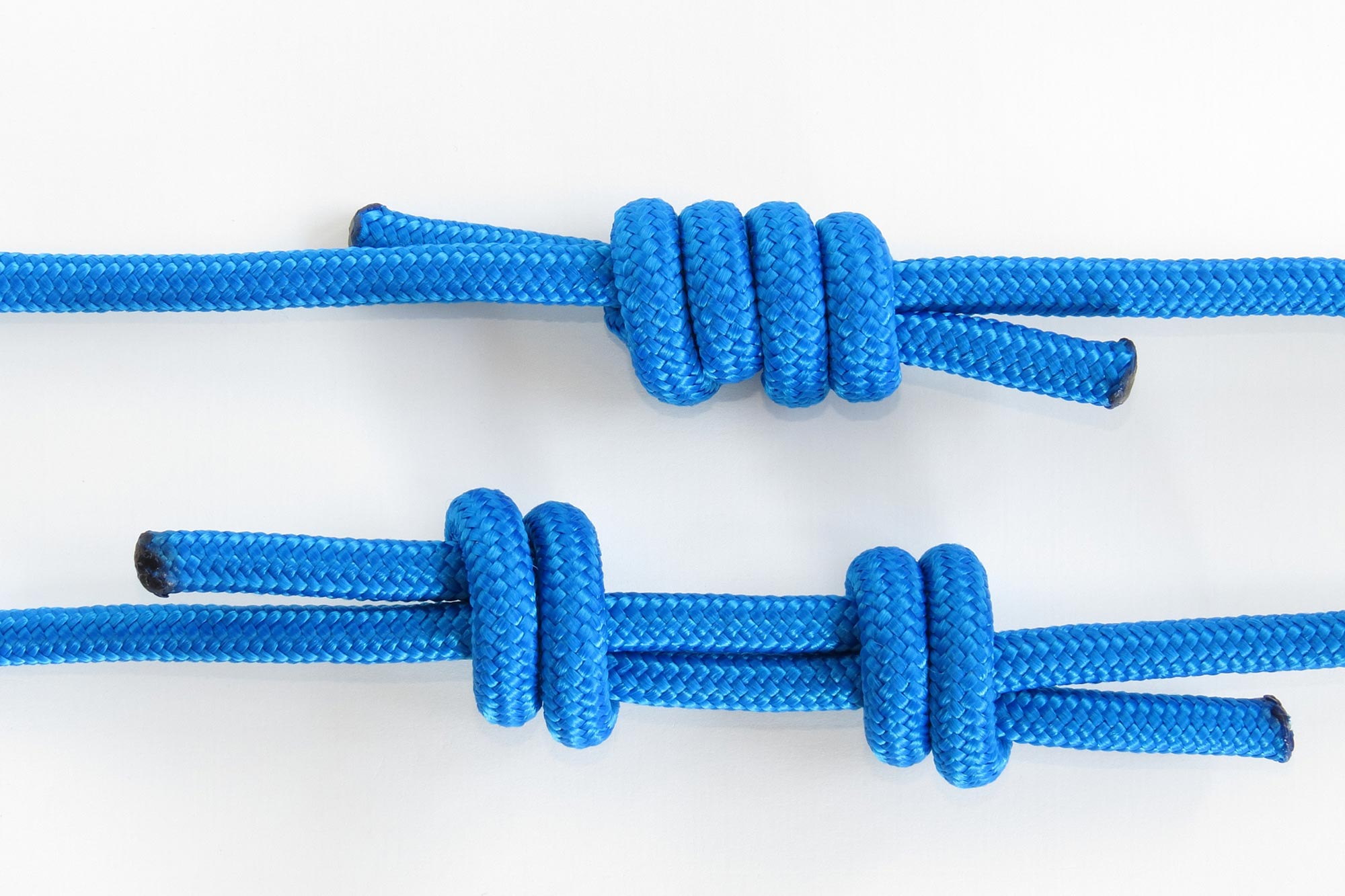
An experiment uncovers a new blind spot in our understanding of physical reasoning.
Despite our everyday encounters with knots—tying shoes, fastening neckties, or managing power cords—most people struggle to distinguish between a weak knot and a strong one, according to new research from Johns Hopkins University.
In the study, participants were shown images of two different knots and asked to identify the stronger one. They couldn’t.
They showed people videos of each knot, where the knots spin slowly so they could get a good long look. They still failed.
People couldn’t even manage it when researchers showed them each knot next to a diagram of the knots’ construction.
“People are terrible at this,” said co-author Chaz Firestone, who studies perception. “Humanity has been using knots for thousands of years. They’re not that complicated—they’re just some string tangled up. Yet you can show people real pictures of knots and ask them for any judgment about how the knot will behave and they have no clue.”
The work, newly published in the cognitive science journal Open Mind, reveals a new blind spot in our physical reasoning.

The Inspiration Behind the Experiment
The experiment is the brainchild of a PhD student in Firestone’s lab, Sholei Croom, who happens to be an avid embroiderer. Croom was working on a project, flipped it over to the elaborate and daunting tangle of embroidery floss, and was unable to make heads or tails of it—even though it was Croom’s own craftwork. Croom, who studies intuitive physics, or what people understand about the environment just from looking at it, suspected knots might be a rare vulnerability.
“People make predictions all the time about how the physics of the world will play out but something about knots didn’t feel intuitive to me,” Croom said. “You don’t need to touch a stack of books to judge its stability. You don’t have to feel a bowling ball to guess how many pins it will knock over. But knots seem to strain our judgement mechanisms in interesting ways.”
Testing Intuitive Physics with Knots
The experiment was simple: The researchers showed participants four knots that are physically similar but have a hierarchy of strength. People were asked to look at the knots, two at a time, and point to the strongest one.
Participants were consistently incorrect. What’s more, the few times they guessed right, they did so for the wrong reasons, pointing to aspects of the knot that had nothing to do with its strength.
The knots ranged from one of the strongest basic knots in existence, the reef knot, to one so weak that it can unravel if gently nudged, the aptly named grief knot. Even between those two, side by side, people couldn’t point to the strong one.
“We tried to give people the best chance we could in the experiment, including showing them videos of the knots rotating and it didn’t help at all—if anything people’s responses were even more all over the place,” Croom said. “The human psychological system just fails to ascertain any physical knowledge from the properties of the knot.”
Objects that aren’t rigid, such as string, may be harder for people to reason about than solid ones, Croom said. Even our deep experience with knots from tying shoelaces and unraveling cords cannot overcome the deficit, though Croom guesses that a sailor or a survivalist whose livelihoods rely on knot strength might perform better in the experiment than the non-experts who were tested.
“We’re just not able to extract a salient sense of a knot’s internal structure by looking at it,” Croom said. “It’s a nice case study into how many open questions still remain in our ability to reason about the environment.”
Reference: “Tangled Physics: Knots Strain Intuitive Physical Reasoning” by Sholei Croom and Chaz Firestone, 23 September 2024, Open Mind.
DOI: 10.1162/opmi_a_00159
The study was funded by the U.S. National Science Foundation and the National Science Foundation Graduate Research Fellowship Program.
Never miss a breakthrough: Join the SciTechDaily newsletter.
Follow us on Google and Google News.
3 Comments
So, that’s why many survive hanging.
I suspect the results would have been different if done a couple hundred years ago, especially with sailors.
How is A different from D?