
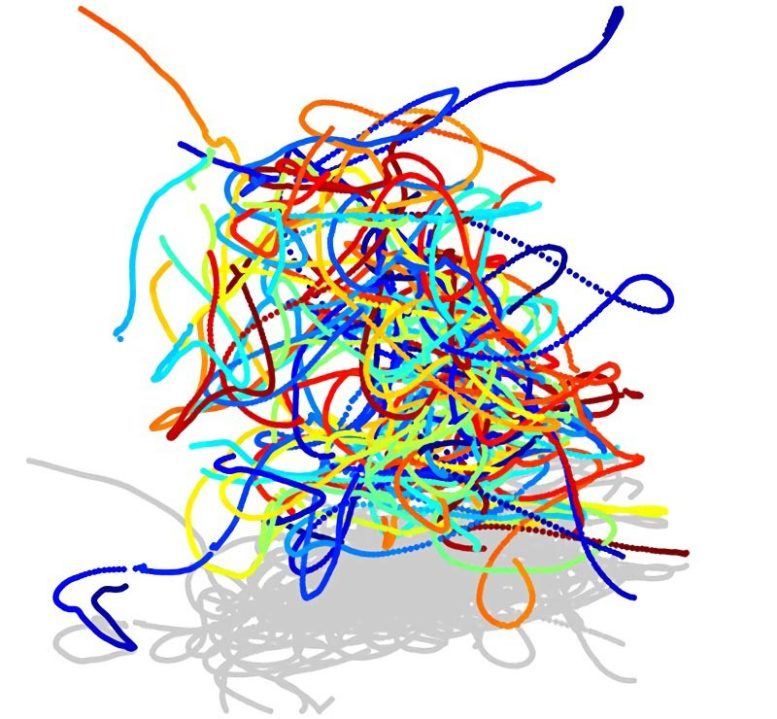
New research from scientists at the Yale School of Engineering & Applied Science may lead to a better understanding of how local, spontaneous interaction among living things leads to the organization of collective animal motion.
The adulthood of a midge fly is decidedly brief — about three days. But a new study of its mating swarm may yield lasting benefits for analyses of bird flocks, fish schools, human crowds, and other forms of collective animal motion.
“This is a field where there’s been almost no quantitative data,” said Nicholas T. Ouellette of the Yale School of Engineering & Applied Science, principal investigator of the research, published on January 15 in the journal Scientific Reports. “What we’ve been able to do is put this in the laboratory, and that lets us take as much data as we want.”
The experiment — the first large-scale quantitative description of an insect swarm — is part of a larger effort to understand how local, spontaneous interaction among living things leads to the organization of complex, dynamic, but coherent systems.
Most previous work on swarms has focused on descriptions of group behavior, such as the size of the swarm and how long it lasts. The methods employed in the new study allow for quantitative measurements of individual participating insects, allowing researchers to ask more detailed questions about swarm behavior.
Using synchronized high-speed cameras and other tools developed for turbulent flow studies, Ouellette and co-author Douglas H. Kelley, now a postdoctoral researcher at MIT, measured the three-dimensional positions, velocities, and accelerations of swarms’ individual members over time, as well as those of the swarms.
This allowed the scientists to document the behavior of individual midges in relation to each other and to the swarm as a whole. It also allowed the researchers to make some comparisons with the behavior of flocking birds and fish schools.
They found that:
- midge swarm size can vary, but the shape is generally similar: somewhat egg-shaped, symmetric about a vertical axis, a little taller than wide, a little thicker at bottom than at top;
- individual midges have little tendency to align with their neighbors, in contrast to flocking birds and schooling fish;
- individuals tend to fly faster horizontally than vertically; and
- on average, all midges demonstrate a tendency toward the center of the swarm.
Researchers also found that there appear to be subgroups within the larger swarm.
“It suggests a degree of modularity — that the swarm is not just built of individuals moving randomly relative to each other, but that you have some sub-flocks organizing in a hierarchical way,” said Ouellette.
Finally, researchers found that something appears to attract the midges, wherever they are in the swarm, to the throng.
“There’s something binding them to the swarm” that is not an external force, said Ouellette, assistant professor of mechanical engineering. “It’s got to be coming from the interactions.”
He continued: “Collective motion is so common in biology — cells do it, fish do it, birds do it, people do it. This suggests that it’s a really useful solution to a lot of different issues that organisms face, especially as all of these different organisms move collectively for different reasons — mating, predator avoidance, movement efficiency, and so on. Also, from an engineering standpoint, spontaneous collective activity seems like it should be a really good design principle. If nature keeps re-inventing it, it must be a good idea.”
The researchers used Chironomus riparius midges. They obtained data on 10 swarming events, containing as few as 10 and as many as 100 flies.
Reference: “Emergent dynamics of laboratory insect swarms” by Douglas H. Kelley and Nicholas T. Ouellette, 15 January 2013, Scientific Reports.
DOI: 10.1038/srep01073
The Army Research Office provided support for the project.
Never miss a breakthrough: Join the SciTechDaily newsletter.
Follow us on Google and Google News.
1 Comment
I casually studied insect swarms here in Christchuch, New Zealand. I’m not sure what species, but they were smaller than a midge, but not as ‘fat’ as a fruit fly.
I noticed that they tended to organize in columns, with quite a bit of up-down traffic. I assumed they were swarming to to pair up for mates, and wondered what ‘algorithm’ they were operating on. The impression I got was that they organised in columns, rather than a ball, to maximise the chances of meeting as many possible potential mates.
A column, compared to a ball, has the advantage of stretching out the central meeting area over a long axis, thus giving more space for a greater number of interations, and therefore, more mates to meet.