
Close Menu
    Facebook X (Twitter) Instagram
    SciTechDaily
    • Biology
    • Chemistry
    • Earth
    • Health
    • Physics
    • Science
    • Space
    • Technology
    Facebook X (Twitter) Pinterest YouTube RSS
    SciTechDaily
    Home»Physics»Switching Behaviors Show How Lifeless Particles Can Become ‘Life-Like’
    Physics

    Switching Behaviors Show How Lifeless Particles Can Become ‘Life-Like’

    By Carol Clark, Emory UniversityNovember 3, 2017No Comments4 Mins Read
    Facebook Twitter Pinterest Telegram LinkedIn WhatsApp Email Reddit
    Share
    Facebook Twitter LinkedIn Pinterest Telegram Email Reddit

    Physicists at Emory University have shown how a system of lifeless particles can become “life-like” by collectively switching back and forth between crystalline and fluid states — even when the environment remains stable. This is the first experimental realization of such dynamics.

    “We’ve discovered perhaps the simplest physical system that can consistently keep changing behavior over time in a fixed environment,” says Justin Burton, Emory assistant professor of physics. “In fact, the system is so simple we never expected to see such a complex property emerge from it.”

    Many living systems — from fireflies to neurons — switch behaviors collectively, firing on and then shutting off. The current paper, however, involved a non-living system: Plastic particles, tiny as dust specks, that have no “on” or “off” switches.

    “The individual particles cannot change between crystalline and fluid states,” Burton says. “The switching emerges when there are collections of these particles — in fact, as few as 40. Our findings suggest that the ability for a system to switch behaviors over any time scale is more universal than previously thought.”

    The Burton lab studies the tiny, plastic particles as a model for more complex systems. They can mimic the properties of real phenomena, such as the melting of a solid, and reveal how a system changes when it is driven by forces.
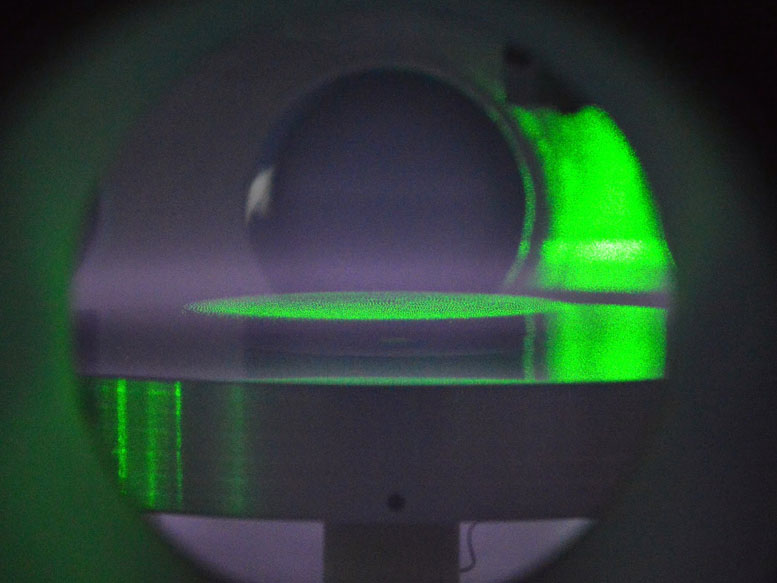
    How Lifeless Particles Can Become 'Life-Like'
    Emory graduate student Guga Gogia slowly “salted” micron-sized particles into a vacuum chamber filled with plasma, creating a single layer of particles levitating above a charged electrode. He kept a low gas pressure, so the particles could move freely.

    The particles are suspended in a vacuum chamber filled with a plasma — ionized argon gas. By altering the gas pressure inside the chamber, the lab members can study how the particles behave as they move between an excited, free-flowing state into a jammed, stable position.

    The current discovery occurred after Emory graduate student Guram “Guga” Gogia tapped a shaker and slowly “salted” the particles into the vacuum chamber filled with the plasma, creating a single layer of particles levitating above a charged electrode. “I was just curious how the particles would behave over time if I set the parameters of the chamber at a low gas pressure, enabling them to move freely,” Gogia says. “After a few minutes I could see with my naked eye that they were acting strangely.”

    From anywhere between tens of seconds to minutes, the particles would switch from moving in lockstep, or a rigid structure, to being in a melted gas-like state. It was surprising because the particles were not just melting and recrystallizing but going back and forth between the two states.

    “Imagine if you left a tray of ice out on your counter at room temperature,” Gogia says. “You wouldn’t be surprised if it melted. But if you kept the ice on the counter, you would be shocked if it kept turning back to ice and melting again.”

    Gogia conducted experiments to confirm and quantify the phenomenon. The findings could serve as a simple model for the study of emerging properties in non-equilibrium systems.

    “Switching is a ubiquitous part of our physical world,” Burton says. “Nothing stays in a steady state for long — from the Earth’s climate to the neurons in a human brain. Understanding how systems switch is a fundamental question in physics. Our model strips away the complexity of this behavior, providing the minimum ingredients necessary. That provides a base, a starting point, to help understand more complex systems.”

    Reference: “Emergent Bistability and Switching in a Nonequilibrium Crystal” Guram Gogia and Justin C. Burton, 26 October 2017, Physical Review Letters.
    DOI: 10.1103/PhysRevLett.119.178004

    Never miss a breakthrough: Join the SciTechDaily newsletter.
    Follow us on Google and Google News.

    Emory University Particle Physics
    Share. Facebook Twitter Pinterest LinkedIn Email Reddit

    Related Articles

    AI Reveals Unexpected New Physics in the Fourth State of Matter

    Fluid Mechanics Discovery Inspired by Street Performers Making Gigantic Soap Bubbles

    More Data of Elusive Higgs Boson from Defunct US Tevatron Collider

    Dynamics of a System of Ultracold Potassium Atoms

    Evidence of Elusive Majorana Fermions Raises Possibilities for Quantum Computing

    Possible Mistakes Found in Faster Than Light Neutrino Measurement

    Quantum Entanglement of 8 Photons Successfully Accomplished by Physicists

    Higgs Boson Signals Gain Strength at Large Hadron Collider

    Quantum Physicists Take a Step Forward in Understanding Quantum Inseparability

    Leave A Reply Cancel Reply

    • Facebook
    • Twitter
    • Pinterest
    • YouTube

    Don't Miss a Discovery

    Subscribe for the Latest in Science & Tech!

    Trending News

    First-of-Its-Kind Discovery: Homer’s Iliad Found Embedded in a 1,600-Year-Old Egyptian Mummy

    Beyond Inflammation: Scientists Uncover New Cause of Persistent Rheumatoid Arthritis

    A Simple Molecule Could Unlock Safer, Easier Weight Loss

    Scientists Just Built a Quantum Battery That Charges Almost Instantly

    Researchers Unveil Groundbreaking Sustainable Solution to Vitamin B12 Deficiency

    Millions of People Have Osteopenia Without Realizing It – Here’s What You Need To Know

    Researchers Discover Boosting a Single Protein Helps the Brain Fight Alzheimer’s

    World-First Study Reveals Human Hearts Can Regenerate After a Heart Attack

    Follow SciTechDaily
    • Facebook
    • Twitter
    • YouTube
    • Pinterest
    • Newsletter
    • RSS
    SciTech News
    • Biology News
    • Chemistry News
    • Earth News
    • Health News
    • Physics News
    • Science News
    • Space News
    • Technology News
    Recent Posts
    • Scientists Flip Immune System “Switch,” Uncover Surprising Path To Stop Gut Inflammation
    • Magnesium Magic: New Drug Melts Fat Even on a High-Fat, High-Sugar Diet
    • Weight-Loss Drugs Like Ozempic May Come With an Unexpected Cost
    • After Decades, MIT Researchers Capture the First 3D Atomic View of a Mysterious Material
    • Your Favorite Fishing Spot Is Turning Brown – and the Fish Are Changing
    Copyright © 1998 - 2026 SciTechDaily. All Rights Reserved.
    • Science News
    • About
    • Contact
    • Editorial Board
    • Privacy Policy
    • Terms of Use

    Type above and press Enter to search. Press Esc to cancel.