
Close Menu
    Facebook X (Twitter) Instagram
    SciTechDaily
    • Biology
    • Chemistry
    • Earth
    • Health
    • Physics
    • Science
    • Space
    • Technology
    Facebook X (Twitter) Pinterest YouTube RSS
    SciTechDaily
    Home»Technology»System to Minimize Injury and Damage When Self-Driving Vehicles Crash
    Technology

    System to Minimize Injury and Damage When Self-Driving Vehicles Crash

    By University of WaterlooOctober 9, 2019No Comments3 Mins Read
    Facebook Twitter Pinterest Telegram LinkedIn WhatsApp Email Reddit
    Share
    Facebook Twitter LinkedIn Pinterest Telegram Email Reddit

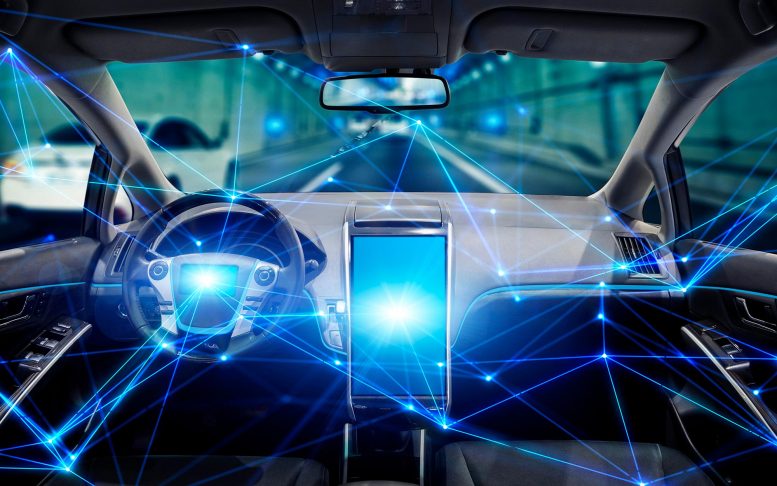
    Self Driving Vehicle Illustration

    Engineers have created decision-making and motion-planning systems to prevent casualties and property damage when self-driving cars are involved in unavoidable collisions.

    After determining that a collision of some sort is unavoidable, the system analyzes all possible courses of action and selects the one with the least severe consequences.

    “What can we do in order to minimize the consequences?” said Amir Khajepour, a professor of mechanical and mechatronics engineering at the University of Waterloo. “That is our focus.”

    Avoiding collisions with people is the first guideline for autonomous vehicle (AV) crash-mitigation technology.

    After that, it considers variables such as relative speeds, crash angles, variations in mass and vehicle type to decide the optimal action, such as braking or steering in a certain direction.

    “We consider the whole traffic environment perceived by the autonomous vehicle, including all the other vehicles and obstacles around it,” said Dongpu Cao, also a mechanical and mechatronics engineering professor at Waterloo.

    Khajepour, director of the Mechatronic Vehicle Systems Lab, said the system is needed because the popular idea that AVs of the future will completely eliminate crashes is a myth.

    Although safety should improve dramatically, he said, there are just too many uncertainties for self-driving vehicles to handle them all without some mishaps.

    “There are hundreds, thousands, of variables we have no control over,” he said. “We are driving and all of a sudden there is black ice, for instance, or a boulder rolls down a mountain onto the road.”

    When an accident is unavoidable, AVs can reduce damage because they always know what is going on around them thanks to sensors, cameras, and other sources, and they frequently make tens, if not hundreds, of decision every second based on that knowledge.

    The new technology bases its decisions on predefined mathematical calculations that take into account the seriousness of collision injuries and damage in order to determine how an AV should react in emergency scenarios.

    Extremely difficult ethical issues, such as whether an AV should prioritize the safety of its own occupants or balance the interests of all accident victims equally, were not taken into consideration by researchers.

    But when carmakers and regulators eventually hammer out the ethical rules for self-driving vehicles, Khajepour said, the system framework is designed to integrate them.

    ###

    In addition to Khajepour and Cao, director of the Waterloo Cognitive Autonomous Driving Lab (CogDrive), the researchers included postdoctoral fellows Hong Wang and Yanjun Huang, and Ph.D. students Yadollah Rasekhipour and Yubiao Zhang.

    Reference: “Crash Mitigation in Motion Planning for Autonomous Vehicles” by Hong Wang, Yanjun Huang, Amir Khajepour, Yubiao Zhang, Yadollah Rasekhipour and Dongpu Cao, September 2019, IEEE Transactions on Intelligent Transportation Systems.
    DOI: 10.1109/TITS.2018.2873921

    Never miss a breakthrough: Join the SciTechDaily newsletter.
    Follow us on Google and Google News.

    Autonomous Vehicles University of Waterloo
    Share. Facebook Twitter Pinterest LinkedIn Email Reddit

    Related Articles

    Eyeing the Future: How NASA’s Human Pilots Shape Autonomous Air Taxis

    Scientists Reveal That Self-Driving Cars Can Make Traffic Slower

    MIT AI Model Speeds Up High-Resolution Computer Vision for Autonomous Vehicles

    Laser Precision Qubit Control: Leap in Reliable Quantum Information Processing

    Tailored to Heal: Programmable 3D Printed Dressing Improves Burn and Cancer Treatments

    Can’t Find Your Phone? Scientists Have Created a Robot To Help

    Researchers Develop a Device That Can Use WiFi To See Through Walls

    On the Road to Cleaner, Greener, and Faster Driving – With Some Help From AI

    Charting a Safe Course for an Autonomous Robot Through a Highly Uncertain Environment

    Leave A Reply Cancel Reply

    • Facebook
    • Twitter
    • Pinterest
    • YouTube

    Don't Miss a Discovery

    Subscribe for the Latest in Science & Tech!

    Trending News

    New Pill Lowers Stubborn Blood Pressure and Protects the Kidneys

    Humans May Have Hidden Regenerative Powers, New Study Suggests

    Scientists Just Solved the Mystery of Why Crabs Walk Sideways

    Doctors Are Surprised by What This Vaccine Is Doing to the Heart

    This Popular Supplement May Boost Your Brain, Not Just Your Muscles

    Scientists Say This Simple Supplement May Actually Reverse Heart Disease

    Warming Oceans Could Trigger a Dangerous Methane Surge

    This Simple Movement Could Be Secretly Cleaning Your Brain

    Follow SciTechDaily
    • Facebook
    • Twitter
    • YouTube
    • Pinterest
    • Newsletter
    • RSS
    SciTech News
    • Biology News
    • Chemistry News
    • Earth News
    • Health News
    • Physics News
    • Science News
    • Space News
    • Technology News
    Recent Posts
    • New MRI Breakthrough Captures Stunningly Clear Images of the Eye and Brain
    • Scientists Warn Sitting Too Much Can Harm Your Body in Surprising Ways
    • Your Blood Pressure Reading Could Be Wrong Because of One Simple Mistake
    • Scientists Discover Cheap Material That Kills Deadly Superbugs
    • This Magnetic Field Trick Creates Entirely New Forms of Matter
    Copyright © 1998 - 2026 SciTechDaily. All Rights Reserved.
    • Science News
    • About
    • Contact
    • Editorial Board
    • Privacy Policy
    • Terms of Use

    Type above and press Enter to search. Press Esc to cancel.