
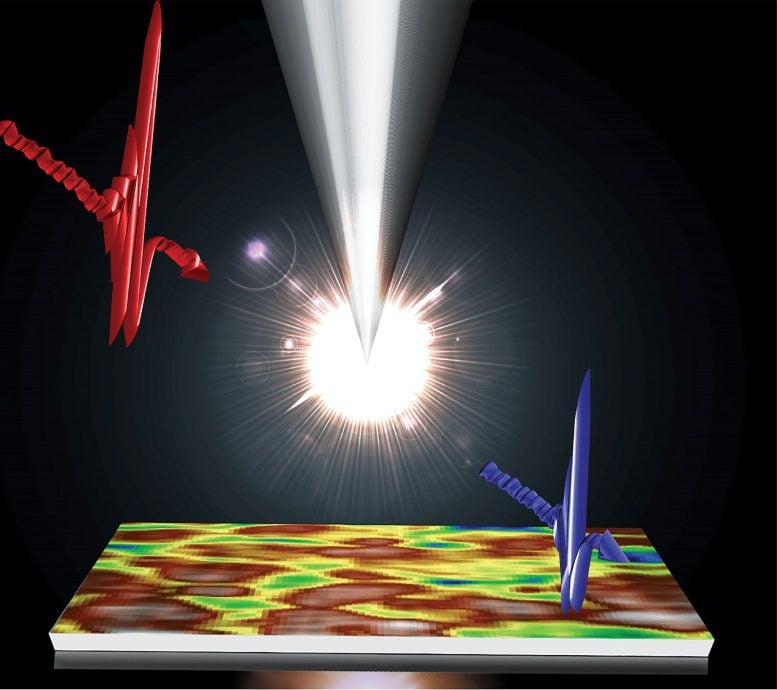
Scientists utilized the terahertz SNOM microscope to detect flaws in quantum computing circuits, specifically in the nano Josephson Junction. Addressing these defects is essential for optimizing quantum computing’s faster processing capabilities.
Researchers used a new tool to help improve a key component in commercially produced quantum computing circuits. The team of scientists from the U.S. Department of Energy’s (DOE) Ames National Laboratory in partnership with the Superconducting Quantum Materials and Systems Center (SQMS), a DOE National Quantum Information Science Research Center led by Fermilab, used the terahertz SNOM microscope, originally developed at Ames Lab, to investigate the interface and connectivity of a nano Josephson Junction (JJ).
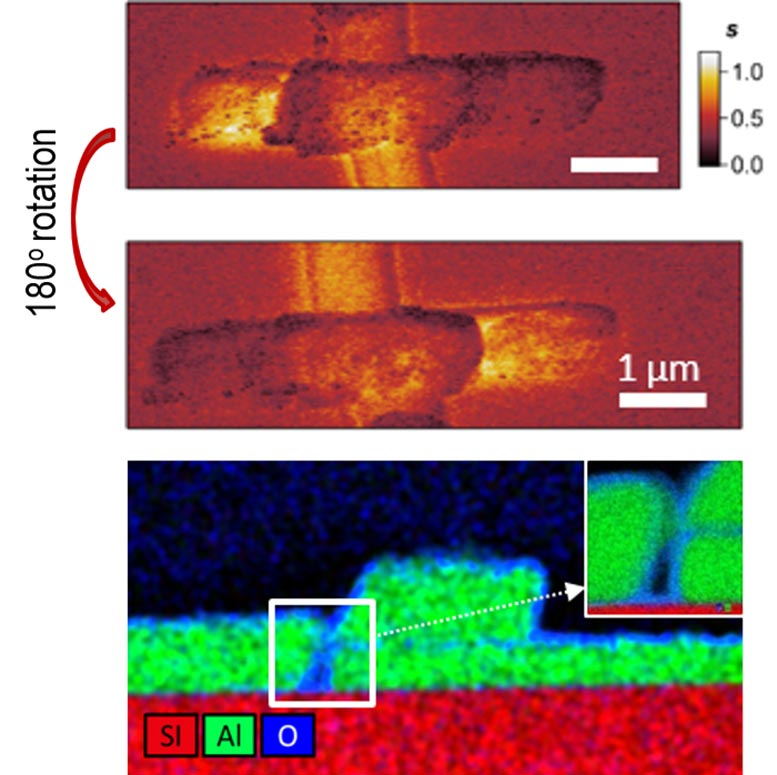
The JJ, a key component in superconducting quantum computers, was fabricated by Rigetti Computing, an SQMS partner. The JJ effectively generates a two-level system at very low cryogenic temperature that produces a quantum bit. The images they obtained with the terahertz microscope revealed a defective boundary in the nano junction that causes a disruption in the conductivity and serves as a challenge to produce long coherence times needed for the quantum computation.
Understanding Qubits
Quantum computers consist of quantum bits or qubits. Qubits function similarly to the bits in a digital computer. Bits are the smallest unit of data that a computer can process and store. Bits are binary, which means there are only two possible states in which they can exist, either a 0 or a 1. Qubits, however, exist as both 0 and 1 simultaneously in their quantum state, which is what allows quantum computers to process more information faster than the computers commonly used today.
Better qubits in a quantum computer lie in understanding the function of a nano Josephson Junction (JJ), the component the team examined. Jigang Wang, a scientist from Ames Lab and leader of the research team, explained that this JJ facilitates the supercurrent flow through the circuit at cryogenic temperature, which makes it possible for qubits to exist in their quantum state. It is important that this flow remain uniform and non-dissipative to keep the system coherent.
Challenges and Breakthroughs
“The complex structural components in the quantum circuits often lead to local electrical field concentration, which causes scattering and energy dissipation and ultimately decoherence,” Wang explained. “So the question for the current quantum computing business is how to mitigate the decoherence.”
Wang and his team used a terahertz scanning near-field optical microscope (SNOM) previously developed at Ames Lab to take images of the JJ under electromagnetic field coupling. This microscope uses a special tip that enhances the microscope’s resolution to the nanoscale, with nearly no touching or in any way affecting the junction component. Using this microscope, the team recorded images of the JJ. If the junction component is fabricated properly, the resulting images will show a consistent electrical field across the component. However, what the team found was a disconnection between two parts of the junction (see image above).
Wang explained that this finding was important for two reasons. First, it identified an issue with the JJ fabrication, which Rigetti can now resolve thus improving their quantum circuit quality. Secondly, it proves that the terahertz microscope developed at Ames Lab is a useful tool for high throughput screening of quantum circuit components.
“This research demonstrates that this terahertz SNOM is an ideal tool that we can use to visualize the heterogeneous electrical field distribution,” said Wang. “And this enables a non-destructive and contactless identification of the effective boundaries in this nano junction. It’s extremely precise at the nanometer scale.”
Microscope Capabilities and Future Goals
Quantum circuits normally operate at these extremely low, cryogenic temperatures. Wang’s team previously demonstrated that the terahertz SNOM microscope can function at extremely low temperatures, “So the ultimate goal of this research is to continue to push this extreme cryogenic terahertz SNOM machine to be able to reach that ultra-low temperature to be able to follow the supercurrent tunneling in real time and in real space of a functioning qubit,” he said.
Wang emphasized that the advancements in this project would not have been possible if Ames Lab were not a member of the SQMS community. “It has been really a privilege to work with them and to contribute as a community to push things forward. It took a village to really solve this type of very complex technological and scientific problem. And it has been really, really important to have this versatile team,” Wang said. “I’m also very happy that as part of Ames Lab we are contributing to the SQMS center and national quantum initiative in an important way.”
Reference: “Visualizing heterogeneous dipole fields by terahertz light coupling in individual nano-junctions” by Richard H. J. Kim, Joong M. Park, Samuel Haeuser, Chuankun Huang, Di Cheng, Thomas Koschny, Jinsu Oh, Cameron Kopas, Hilal Cansizoglu, Kameshwar Yadavalli, Josh Mutus, Lin Zhou, Liang Luo, Matthew J. Kramer & Jigang Wang, 22 June 2023, Communications Physics.
DOI: 10.1038/s42005-023-01259-0
Never miss a breakthrough: Join the SciTechDaily newsletter.
Follow us on Google and Google News.