
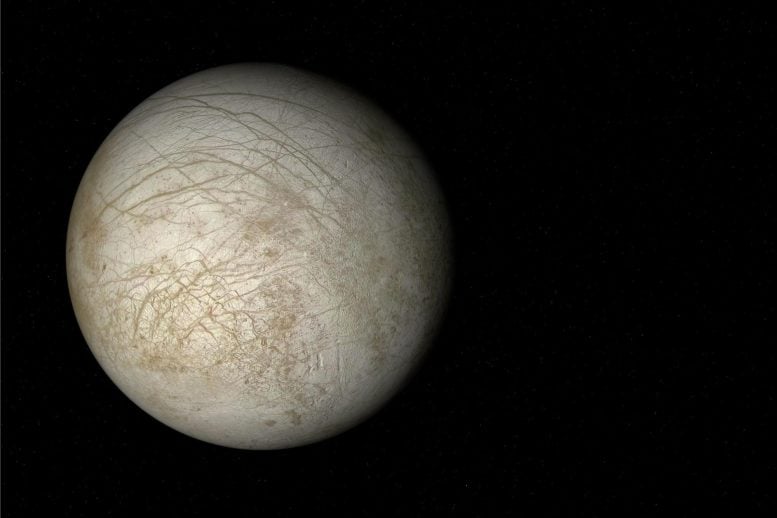
New research from Arizona State University challenges previous assumptions about Europa’s internal structure and habitability. Scientists suggest that Europa’s ocean may have formed from hydrated rocks rather than melting ice and that its metallic core may have formed much later—if at all. The study indicates limited seafloor volcanism, which may impact the moon’s potential to support life.
Within the vast expanse of Jupiter’s moons, Europa stands out as a captivating subject for researchers due to compelling indications of essential elements like nutrients, water, and energy sources.
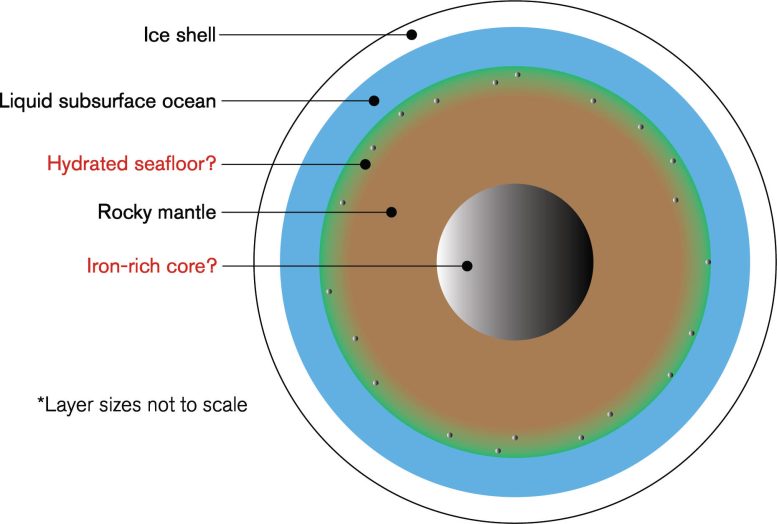
These factors collectively suggest a possible haven for extraterrestrial life forms. Notably, Europa’s composition is thought to consist of four distinct layers, from its outermost surface to its core: a layer of ice, a saline ocean, a rocky mantle, and a metallic core.
Like Earth, Europa’s ocean touches the rocky seafloor, which may allow for rock-water chemistry favorable for life. Some scientists also believe that the seafloor may host volcanoes, which can provide more energy and nutrients for a potential biosphere.
ASU scientists Kevin Trinh, Carver Bierson, and Joe O’Rourke of the School of Earth and Space Exploration investigated the consequences of Europa forming with low initial temperatures, using computer code that Trinh wrote. Their findings have been recently published in Science Advances.
Hydrated Rocks May Be a Key Ingredient
Europa may have a metamorphic origin for the ocean. While some scientists speculated this, Trinh and his team show that if Europa indeed formed from hydrated rocks (i.e., rocks have hydrogen and oxygen), then enough of Europa’s interior should get hot enough to release water directly from the hydrated rocks to form the ocean and ice shell.
“The origin of Europa’s ocean is important because the moon’s potential to support life ultimately depends on the chemical ingredients and physical conditions during the ocean formation process,” said Kevin Trinh, a graduate associate at ASU’s School Of Earth and Space Exploration.
Metallic Core Formation Requires High Temperatures
Many scientists studying this icy moon assumed that Europa formed with a metallic core during or shortly after accretion. This ASU study contradicts that prediction, instead arguing that Europa may not have started forming its metallic core until billions of years after accretion (if it happened at all).
“For most worlds in the solar system, we tend to think of their internal structure as being set shortly after they finish forming. This work is very exciting because it reframes Europa as a world whose interior has been slowly evolving over its whole lifetime. This opens doors for future research to understand how these changes might be observed in the Europa we see today,” said Carver Bierson, a postdoctoral research scholar at ASU’s School Of Earth and Space Exploration.
The existence of a metallic core is deeply tied to Europa’s internal heat, which may also be used to drive seafloor volcanism and contribute to a habitable seafloor environment. However, it is unclear whether Europa generated enough heat to form such a core. Trinh’s code calculates how heat is generated and distributed throughout a moon, which uses the same governing equations that many geodynamicists used for decades. The team’s novel result, however, comes from challenging the assumptions common to Europa modeling: A small moon like Europa could form as a cold mixture of ice, rock, and metal.
However, all of these processes require a hot interior. A small moon like Europa (~1% of Earth’s mass) may not have enough energy to trigger or sustain Earth-like processes—metallic core formation, seafloor volcanism, and ongoing rock-water geochemistry—which implies that Europa’s habitable potential is uncertain. The exact time at which Europa formed determines how much heat is available from the radioactive decay of a short-lived isotope of aluminum. Tidal heating (from gravitational interactions with Jupiter and other moons) also governs how quickly Europa’s interior separates into distinct layers.
Europa’s Seafloor May Be Cool, Hydrated, and Experience Limited (if Any) Seafloor Volcanism
This study implies that there may be limited hydrothermal activity and seafloor volcanism at Europa, which may hinder habitability. However, confident predictions require more data.
“Europa is not just a wet, baby Earth. It is its own special world, full of mysteries to unravel,” said Joseph O’Rourke, Assistant Professor at ASU’s School of Earth and Space Exploration.
In October 2024, NASA plans to launch a spacecraft called Europa Clipper, which should arrive at Europa in April 2030. With the recent work by Trinh, Bierson, and O’Rourke, scientists will be better equipped to interpret incoming data from Europa Clipper, whose main objective is to evaluate Jupiter’s icy moon Europa for the potential conditions to host life.
Reference: “Slow evolution of Europa’s interior: metamorphic ocean origin, delayed metallic core formation, and limited seafloor volcanism” by Kevin T. Trinh, Carver J. Bierson and Joseph G. O’Rourke, 16 June 2023, Science Advances.
DOI: 10.1126/sciadv.adf3955
Never miss a breakthrough: Join the SciTechDaily newsletter.
Follow us on Google and Google News.