

Close Menu
    Facebook X (Twitter) Instagram
    SciTechDaily
    • Biology
    • Chemistry
    • Earth
    • Health
    • Physics
    • Science
    • Space
    • Technology
    Facebook X (Twitter) Pinterest YouTube RSS
    SciTechDaily
    Home»Technology»Terahertz Waves Supercharged: A Breakthrough With Magnetic Materials
    Technology

    Terahertz Waves Supercharged: A Breakthrough With Magnetic Materials

    By Advanced Institute for Materials Research (AIMR), Tohoku UniversityJune 23, 2024No Comments3 Mins Read
    Facebook Twitter Pinterest Telegram LinkedIn WhatsApp Email Reddit
    Share
    Facebook Twitter LinkedIn Pinterest Telegram Email Reddit
    Terahertz Waves Magnetic Material Art Concept
    A new magnetic material discovered at Tohoku University can generate terahertz waves with significantly greater intensity, offering a potential leap in various technologies, from medical imaging to security. Credit: SciTechDaily.com

    Positioned between microwaves and infrared light, terahertz waves are key to pioneering advancements in imaging and diagnostic technologies. A recent discovery at Tohoku University of a material that can emit these waves more intensely promises to catalyze significant breakthroughs across a spectrum of industries.

    Terahertz waves are being intensely studied by researchers around the world seeking to understand the “terahertz gap.” Terahertz waves have a specific frequency that put them somewhere between microwaves and infrared light. This range is referred to as a “gap” because much remains unknown about these waves. In fact, it was only relatively recently that researchers were able to develop the technology to generate them. Researchers at Tohoku University have brought us closer to understanding these waves and filling in this gap of knowledge.

    Breakthrough in Terahertz Wave Generation

    Researchers at the Advanced Institute for Materials Research (WPI-AIMR) and Graduate School of Engineering have discovered a new magnetic material that generates terahertz waves at an intensity about four times higher than that of typical magnetic materials.

    Taking advantage of the features unique to terahertz waves, this technology is expected to be used in a variety of industrial fields, including imaging, medical diagnostics, security inspection, and biotechnology. Assistant Professor Ruma Mandal (WPI-AIMR) explains, “Terahertz waves have low photon energies and unlike X-rays, they don’t emit ionizing radiation. So, if they are used for patient imaging or microscopes, they may be less damaging to tissues or samples.”
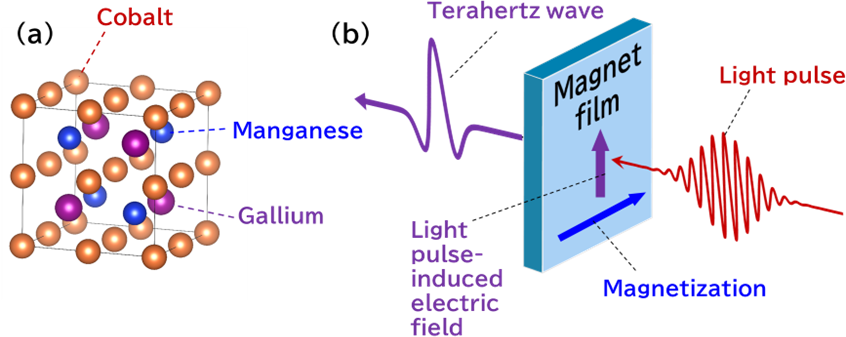
    Generation of Intense Terahertz Waves With a Magnetic Material
    (a) Weyl magnet: schematic diagram of a crystal of cobalt-manganese-gallium Heusler alloy (Co2MnGa). (b) Light-induced terahertz waves. Credit: Shigemi Mizukami

    Enhancing Terahertz Emission With Weyl Magnets

    With these applications in mind, a team of researchers at Tohoku University aimed to develop an efficient, compact, sturdy, and cost-effective terahertz wave emitter. Weyl magnets — a type of topological material — have been shown to generate a huge anomalous Hall effect that make them suitable for generating terahertz waves. In this study, single-crystal thin-film samples of a Weyl magnet made from a cobalt-manganese-gallium Heusler alloy were prepared and studied under various conditions.
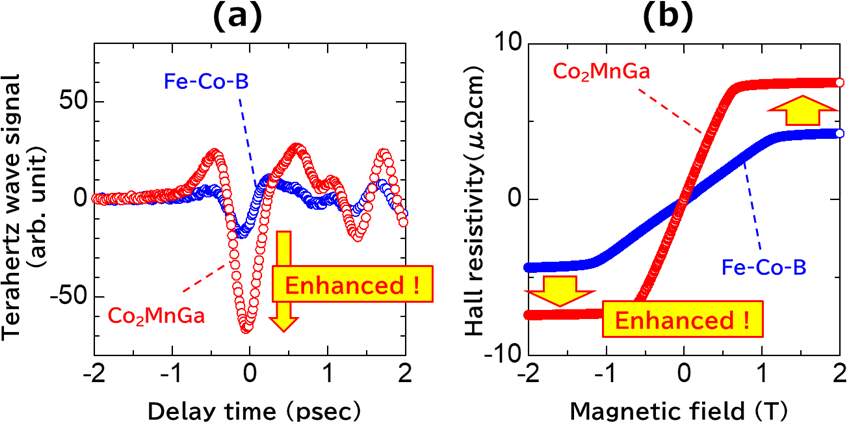
    Photo-Induced Terahertz Waves Generated From the Weyl Magnet
    (a) Photo-induced terahertz waves generated from the Weyl magnet: cobalt-manganese-gallium Heusler alloy (Co2MnGa) thin film observed in this study. (b) Anomalous Hall effect observed in the corresponding thin film sample. Credit: Shigemi Mizukami

    The Future of Terahertz Wave Research

    It was found that the giant anomalous Hall effect originating from the topological electronic structure unique to Weyl magnets enhanced the photo-induced terahertz waves. This achievement will deepen our understanding of the interplay of light and spin in Weyl magnets.

    “Although the intensity of the terahertz waves generated is still lower than that of spin-excitation terahertz emitters developed to date,” says Professor Shigemi Mizukami, “the structure is simpler and expensive heavy metals such as platinum are no longer required.”

    Mandal and their colleagues were able to experimentally demonstrate the ability of this magnetic material to produce terahertz waves, so that it can be used in spintronic devices and other important applications. Such a discovery in a newly emerging field could shape the future of next-generation technologies.

    This work was published in NPG Asia Materials on June 7, 2024.

    Reference: “Topologically influenced terahertz emission in Co2 MnGa with a large anomalous Hall effect” by Ruma Mandal, Ren Momma, Kazuaki Ishibashi, Satoshi Iihama, Kazuya Suzuki and Shigemi Mizukami, 7 June 2024, NPG Asia Materials.
    DOI: 10.1038/s41427-024-00545-9

    Never miss a breakthrough: Join the SciTechDaily newsletter.
    Follow us on Google and Google News.

    Magnets Materials Science Tohoku University
    Share. Facebook Twitter Pinterest LinkedIn Email Reddit

    Related Articles

    Just Hype? New Study Challenges Core Assumptions About Solid-State Lithium Metal Batteries

    Memory Breakthrough: Helical Magnets Pave the Way for Next-Gen Storage

    Laser-Powered Leap: Next-Generation Magnetic Devices That Control Light

    The Next-Generation of Memory Technology – New Material Shows Promise

    Powering the Future: Innovative Device Harvests Vibrational Energy

    Light-Speed Advances: Graphene Nanoprocessing With a Femtosecond Laser

    Surprising New Material Invented That Can Absorb and Release Massive Amounts of Energy

    SnS Crystals Open Pathway for Improved Next Generation Solar Cells

    Super Magnets Produced Successfully With Laser-Based 3D Printer

    Leave A Reply Cancel Reply

    • Facebook
    • Twitter
    • Pinterest
    • YouTube

    Don't Miss a Discovery

    Subscribe for the Latest in Science & Tech!

    Trending News

    Breakthrough Bowel Cancer Trial Leaves Patients Cancer-Free for Nearly 3 Years

    Natural Compound Shows Powerful Potential Against Rheumatoid Arthritis

    100,000-Year-Old Neanderthal Fossils in Poland Reveal Unexpected Genetic Connections

    Simple “Gut Reset” May Prevent Weight Gain After Ozempic or Wegovy

    2.8 Days to Disaster: Scientists Warn Low Earth Orbit Could Suddenly Collapse

    Common Food Compound Shows Surprising Power Against Superbugs

    5 Simple Ways To Remember More and Forget Less

    The Atomic Gap That Could Cost the Semiconductor Industry Billions

    Follow SciTechDaily
    • Facebook
    • Twitter
    • YouTube
    • Pinterest
    • Newsletter
    • RSS
    SciTech News
    • Biology News
    • Chemistry News
    • Earth News
    • Health News
    • Physics News
    • Science News
    • Space News
    • Technology News
    Recent Posts
    • Scientists Print Artificial Neurons That Can Talk to the Brain
    • Bowel and Ovarian Cancers Are Dramatically Rising in Young Adults and Scientists Aren’t Sure Why
    • Alzheimer’s May Begin Decades Earlier Than You Think, New Mayo Clinic Study Finds
    • The Hidden Risk of Taking Breaks From Weight-Loss Drugs Like Ozempic
    • Total Solar Eclipse Made Cities Go Eerily Quiet Beneath the Surface
    Copyright © 1998 - 2026 SciTechDaily. All Rights Reserved.
    • Science News
    • About
    • Contact
    • Editorial Board
    • Privacy Policy
    • Terms of Use

    Type above and press Enter to search. Press Esc to cancel.