
Close Menu
    Facebook X (Twitter) Instagram
    SciTechDaily
    • Biology
    • Chemistry
    • Earth
    • Health
    • Physics
    • Science
    • Space
    • Technology
    Facebook X (Twitter) Pinterest YouTube RSS
    SciTechDaily
    Home»Space»Terrestrial Life Unlikely to Contaminate Mars According to Habitability Climate Model
    Space

    Terrestrial Life Unlikely to Contaminate Mars According to Habitability Climate Model

    By Southwest Research InstituteMay 12, 2020No Comments4 Mins Read
    Facebook Twitter Pinterest Telegram LinkedIn WhatsApp Email Reddit
    Share
    Facebook Twitter LinkedIn Pinterest Telegram Email Reddit
    Mars Brine
    An SwRI scientist modeled the climate of Mars to understand if hydrated salts or brines on the surface of the Red Planet could harbor life. The results suggest that hydrated salts and brines on Mars are not supportive of life. For example, if the dark streaks shown here are formed by the flow of briny water, then that briny water would be too cold to support life. Credit: NASA/JPL-Caltech/University of Arizona

    Southwest Research Institute scientist modeled Mars climate to understand habitability.

    A Southwest Research Institute scientist modeled the atmosphere of Mars to help determine that salty pockets of water present on the Red Planet are likely not habitable by life as we know it on Earth. A team that also included scientists from Universities Space Research Association (USRA) and the University of Arkansas helped allay planetary protection concerns about contaminating potential Martian ecosystems. These results were published this month in Nature Astronomy.

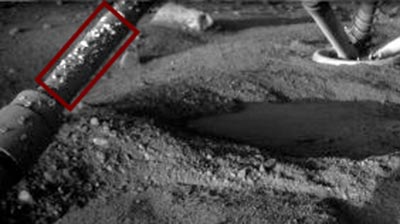
    Due to Mars’ low temperatures and extremely dry conditions, a droplet of liquid water on its surface would instantly freeze, boil or evaporate, unless the droplet had dissolved salts in it. This brine would have a lower freezing temperature and would evaporate more slowly than pure liquid water. Salts are found across Mars, so brines could form there.
    Mars Brine Droplets
    Because saltwater is liquid at lower temperatures than pure water, an SwRI scientist modeled the climate of Mars to understand if pockets of brine on its surface could harbor life. NASA has found evidence of brine on the Red Planet, including these droplets on the strut of the Phoenix lander, which may have formed in the warmed spacecraft environment. Credit: NASA/JPL-Caltech/University of Arizona/Max Planck Institute

    “Our team looked at specific regions on Mars — areas where liquid water temperature and accessibility limits could possibly allow known terrestrial organisms to replicate — to understand if they could be habitable,” said SwRI’s Dr. Alejandro Soto, a senior research scientist and co-author of the study. “We used Martian climate information from both atmospheric models and spacecraft measurements. We developed a model to predict where, when, and for how long brines are stable on the surface and shallow subsurface of Mars.”

    Mars’ hyper-arid conditions require lower temperatures to reach high relative humidities and tolerable water activities, which are measures of how easily the water content may be utilized for hydration. The maximum brine temperature expected is -55 F (-48 C) — at the boundary of the theoretical low temperature limit for life.

    “Even extreme life on Earth has its limits, and we found that brine formation from some salts can lead to liquid water over 40% of the Martian surface but only seasonally, during 2% of the Martian year,” Soto continued. “This would preclude life as we know it.”

    While pure liquid water is unstable on the Martian surface, models showed that stable brines can form and persist from the equator to high latitudes on the surface of Mars for a few percent of the year for up to six consecutive hours, a broader range than previously thought. However, the temperatures are well below the lowest temperatures to support life.

    “These new results reduce some of the risks of exploring the Red Planet while also contributing to future work on the potential for habitable conditions on Mars,” Soto said.

    Reference: “Distribution and habitability of (meta)stable brines on present-day Mars” by Edgard G. Rivera-Valentín, Vincent F. Chevrier, Alejandro Soto and Germán Martínez, 11 May 2020, Nature Astronomy.
    DOI: 10.1038/s41550-020-1080-9

    Soto collaborated with co-authors from the Lunar and Planetary Institute (USRA) and the Arkansas Center for Space and Planetary Sciences at the University of Arkansas on the paper “Distribution and Habitability of (Meta)stable Brines on Present-Day Mars,” published in May in Nature Astronomy. The SwRI portion of this research was funded by NASA under the Habitable Worlds program through a grant led by USRA.

    Never miss a breakthrough: Join the SciTechDaily newsletter.
    Follow us on Google and Google News.

    Astronomy Climate Science Mars Planets Southwest Research Institute
    Share. Facebook Twitter Pinterest LinkedIn Email Reddit

    Related Articles

    Mars’ Muddy Mystery: Did the Red Planet Once Have Seasonal Weather?

    Mars Is Mighty: First Webb Space Telescope Images of Red Planet

    Rolling Stones on Mars: More Than Meets the Eye

    Earth and Mars Were Formed From Collisions of Large Bodies Made of Inner Solar System Material

    State-of-the-Art Climate Model Shows That Venus Could Never Have Had Oceans

    NASA’s InSight Mission Reveals the Detailed Internal Structure of Mars

    Solving a Martian Climate Puzzle: Icy Clouds Could Have Kept Early Mars Warm Enough for Rivers and Lakes

    Incredibly Powerful 900+ Mph Winds in Jupiter’s Atmosphere Measured for the First Time

    New Timeline for Mars Terrains: NASA’s Perseverance Rover Predicted to Encounter More Ancient Surfaces

    Leave A Reply Cancel Reply

    • Facebook
    • Twitter
    • Pinterest
    • YouTube

    Don't Miss a Discovery

    Subscribe for the Latest in Science & Tech!

    Trending News

    The Universe Is Expanding Too Fast and Scientists Can’t Explain Why

    “Like Liquid Metal”: Scientists Create Strange Shape-Shifting Material

    Early Warning Signals of Esophageal Cancer May Be Hiding in Plain Sight

    Common Blood Pressure Drug Shows Surprising Power Against Deadly Antibiotic-Resistant Superbug

    Scientists Uncover Dangerous Connection Between Serotonin and Heart Valve Disease

    Scientists Discover a “Protector” Protein That Could Help Reverse Hair Loss

    Bone-Strengthening Discovery Could Reverse Osteoporosis

    Scientists Uncover Hidden Trigger Behind Stem Cell Aging

    Follow SciTechDaily
    • Facebook
    • Twitter
    • YouTube
    • Pinterest
    • Newsletter
    • RSS
    SciTech News
    • Biology News
    • Chemistry News
    • Earth News
    • Health News
    • Physics News
    • Science News
    • Space News
    • Technology News
    Recent Posts
    • A Common Diabetes Drug May Hold the Key to Stopping HIV From Coming Back
    • Ancient “Syphilis-Like” Disease in Vietnam Challenges Key Scientific Assumptions
    • Drinking Alcohol To Cope in Your 20s Could Damage Your Brain for Life
    • Scientists Crack Alfalfa’s Chromosome Mystery After Decades of Debate
    • Ancient Ant-Plant Alliance Collapses As Predatory Wasps Move In
    Copyright © 1998 - 2026 SciTechDaily. All Rights Reserved.
    • Science News
    • About
    • Contact
    • Editorial Board
    • Privacy Policy
    • Terms of Use

    Type above and press Enter to search. Press Esc to cancel.