
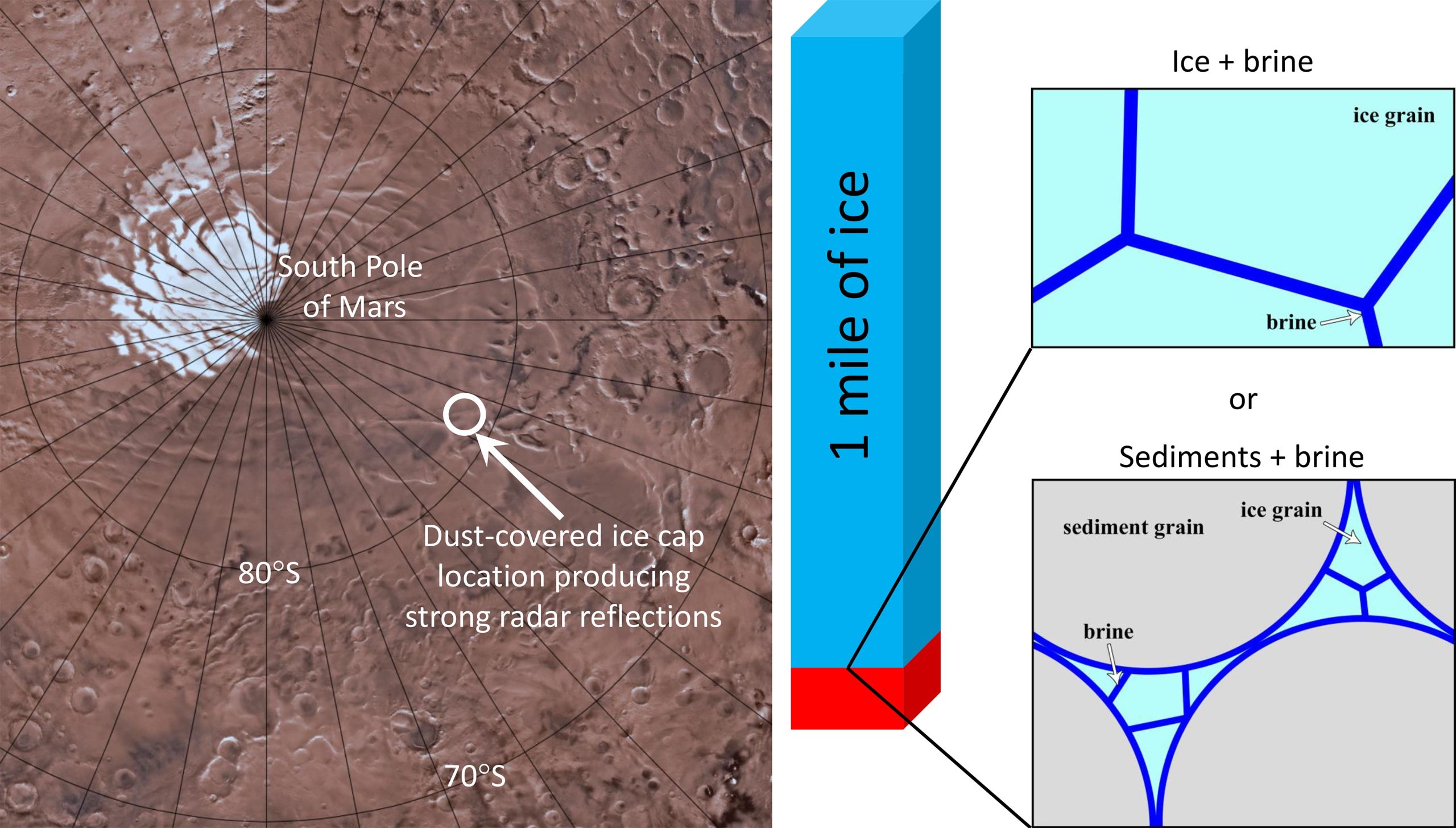
Research indicates that salty water exists beneath Mars’ ice cap, supporting potential habitats for life in extreme cold, akin to subglacial lakes on Earth.
A Southwest Research Institute scientist measured the properties of ice-brine mixtures as cold as -145 degrees Fahrenheit (-98 degrees Celsius) to help confirm that salty water likely exists between grains of ice or sediment under the ice cap at Mars’ south pole. Laboratory measurements conducted by SwRI geophysicist Dr. David Stillman support oddly bright reflections detected by the MARSIS subsurface sounding radar aboard ESA’s Mars Express orbiter.
Radar Detection of Martian Ice Cap Anomalies
With a 130-foot (40-meter) antenna, MARSIS flies over the planet, bouncing radio waves over a selected area and then receiving and analyzing the echoes or reflections. Any near-surface liquid water should send a strong bright signal, whereas the radar signal for ice and rock would be much smaller.
Because conventional models assume the Mars south polar cap experiences temperatures much lower than the melting point of water, many scientists have questioned the presence of liquid water. Clay, hydrated salts, and saline ices have been proposed as potential explanations for the source of the bright basal reflections. The Italian-led team investigating the proposed phenomena used previously published data, simulations, and new laboratory measurements.
“Lakes of liquid water actually exist beneath glaciers in Arctic and Antarctic regions, so we have Earth analogs for finding liquid water below ice,” said Stillman, a specialist in detecting water in any format — liquid, ice or absorbed — on planetary bodies and co-author of a paper describing these findings. “The exotic salts that we know exist on Mars have amazing ‘antifreeze’ properties allowing brines to remain liquid down to -103 degrees Fahrenheit (-75 degrees Celsius). We studied these salts in our lab to understand how they would respond to radar.”
Implications for Extraterrestrial Life
Stillman has over a decade of experience measuring the properties of materials at cold temperatures to detect and characterize subsurface ice, unfrozen water, and the potential for life throughout the solar system. For this project, Stillman measured the properties of perchlorate brines in an SwRI environmental chamber that produces near-liquid-nitrogen temperatures at Mars-like pressures.
“My Italian colleagues reached out to see if my laboratory experiment data would support the presence of liquid water beneath the Martian ice cap,” Stillman said. “The research showed that we don’t have to have lakes of perchlorate and chloride brines, but that these brines could exist between the grains of ice or sediments and are enough to exhibit a strong dielectric response. This is similar to how seawater saturates grains of sand at the shoreline or how flavoring permeates a slushie, but at -103 degrees Fahrenheit below a mile of ice near the South Pole of Mars.”
The search for water in the cosmos is rooted in searching for potential habitability, because all known life requires water.
“In this case ‘following the water’ has led us to a place so cold that life as we know it couldn’t flourish,” Stillman said. “But it’s still interesting, and who knows what evolutionary paths extraterrestrial life may have taken?”
Reference: “Assessing the role of clay and salts on the origin of MARSIS basal bright reflections” by Elisabetta Mattei, Elena Pettinelli, Sebastian Emanuel Lauro, David E. Stillman, Barbara Cosciotti, Lucia Marinangeli, Anna Chiara Tangari, Francesco Soldovieri, Roberto Orosei and Graziella Caprarelli, 19 January 2022, Earth and Planetary Science Letters.
DOI: 10.1016/j.epsl.2022.117370
The lead authors for an Earth and Planetary Sciences Letters paper describing this research are from Roma Tre University in Rome, Italy.
Never miss a breakthrough: Join the SciTechDaily newsletter.
Follow us on Google and Google News.
5 Comments
Life on Mars is IMPOSSIBLE. Colonizing the planet is not realistic. “Extraterrestrial life” man shut the f*** up & sit down.
Extraterrestrial life is not impossible. There is a very low chance there isnt any type of extraterrestrial life, whether that be intelligent, animals, or microscopic.
Very informative, well done
Mars is so Earth like in the photos we get but I doubt anything lives there. I can see why people talk of life there and Sci Fi colony dreams but I drew up a proposal you are welcome to improve on and it requires ice water from the Martian poles. see the Deep Space Food One Million Dollar Challenge.
re ” The Astroman Duckweed Cultivation with Thermionic Electron Generator and Thorium Reactor ”
Dux Astroman Robot
https://youtu.be/2DqOQryFiu8
Wherein we claim: ” The system will use a Nuclear Thorium Reactor for energy production or Helium 3 plasma if on the Moon for heat and gas collection, solar and wind energy systems and a robotic device to cultivate food in the enclosed duckweed aquarium from water collected from the moon or planet to be colonized..”
re : An Thermionic electron electric generator uses radioactive cobalt 60 magnets that emit high energy Beta Particles ( electricity ) will it work or will it be too hot to function or can it be cooled in a sub zero temperature gas chamber ?
Note: if anyone would like to improve this system please feel free to do so
https://www.deepspacefoodchallenge.org/eligibility
clickbait. no water found. just another theory