
Close Menu
    Facebook X (Twitter) Instagram
    SciTechDaily
    • Biology
    • Chemistry
    • Earth
    • Health
    • Physics
    • Science
    • Space
    • Technology
    Facebook X (Twitter) Pinterest YouTube RSS
    SciTechDaily
    Home»Physics»Tetra-Neutron Experiment: Understanding of Nuclear Forces Might Have To Be Significantly Changed
    Physics

    Tetra-Neutron Experiment: Understanding of Nuclear Forces Might Have To Be Significantly Changed

    By Technical University of Munich (TUM)December 12, 20214 Comments5 Mins Read
    Facebook Twitter Pinterest Telegram LinkedIn WhatsApp Email Reddit
    Share
    Facebook Twitter LinkedIn Pinterest Telegram Email Reddit
    Abstract Atomic Physics Concept
    Experiments by physicists at the Technical University of Munich indicate the potential existence of a particle comprising four bound neutrons.

    The tetra-neutron – experiment finds evidence for a long-sought particle comprising four neutrons.

    While all atomic nuclei except hydrogen are composed of protons and neutrons, physicists have been searching for a particle consisting of two, three, or four neutrons for over half a century. Experiments by a team of physicists of the Technical University of Munich (TUM) at the accelerator laboratory on the Garching research campus now indicate that a particle comprising four bound neutrons may well exist.

    While nuclear physicists agree that there are no systems in the universe made of only protons, they have been searching for particles comprising two, three, or four neutrons for more than 50 years.
    Tetra-Neutron Impression
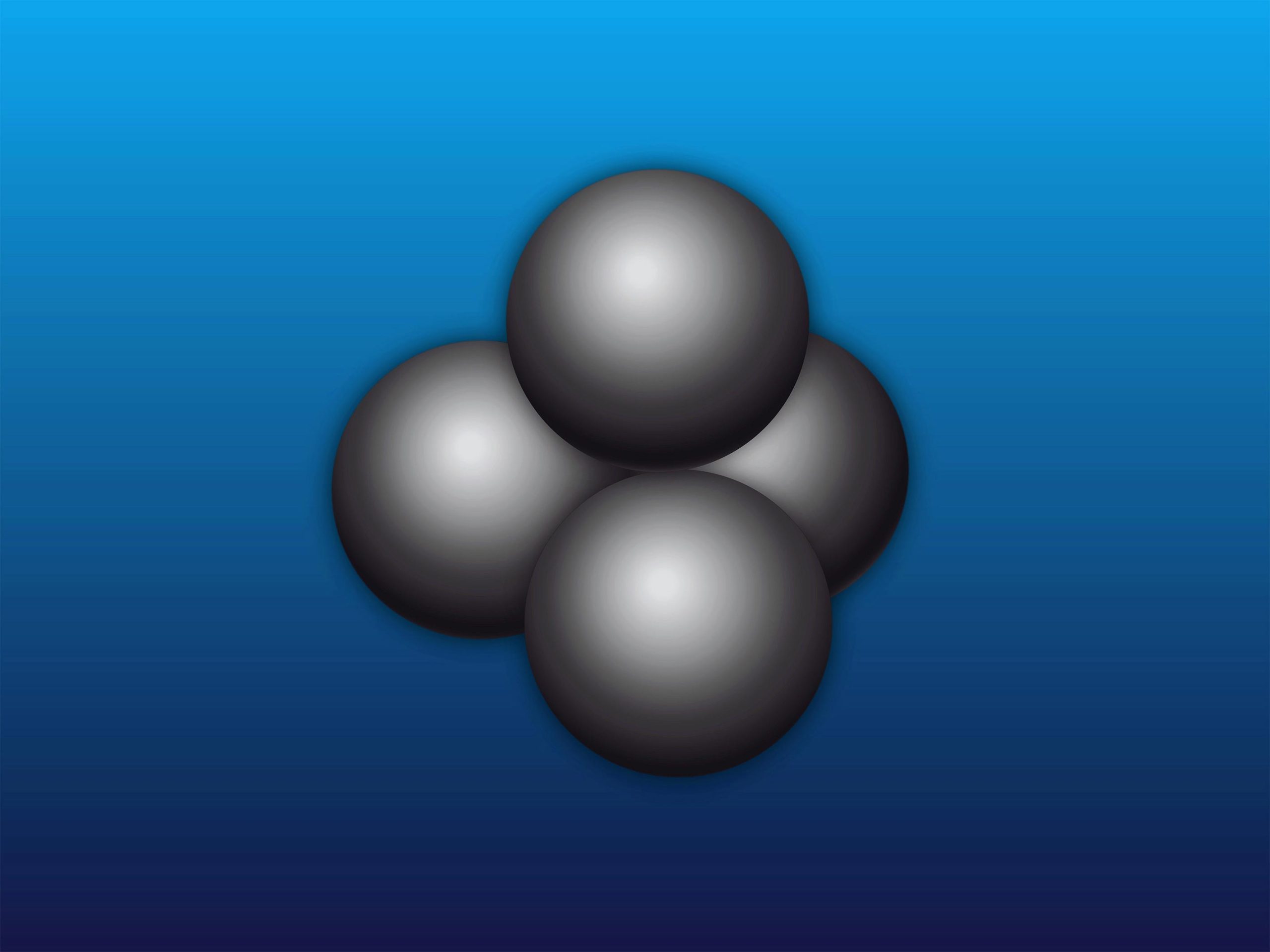
    In the tandem Van de Graaff accelerator of the Maier-Leibnitz laboratory on the Garching research campus a team of physicists of the Technical University of Munich (TUM) bombarded a lithium-7 target with lithium-7 atomic nuclei which were accelerated to 12 percent of the speed of light. All measurement results indicate that their experiments produced carbon-10 and the sought-after tetra-neutron. Credit: Sonja Battenberg / TUM

    Should such a particle exist, parts of the theory of the strong interaction would need to be rethought. In addition, studying these particles in more detail could help us better understand the properties of neutron stars.

    “The strong interaction is literally the force that holds the world together at its core. Atoms heavier than hydrogen would be unthinkable without it,” says Dr. Thomas Faestermann, who directed the experiments.

    Everything now points to the fact that precisely these kinds of particles were created in one of the last experiments carried out at the now decommissioned tandem Van de Graaff particle accelerator on the Garching research campus.

    Tetra-Neutron Nuclear Reaction
    In the tandem Van de Graaff accelerator of the Maier-Leibnitz laboratory on the Garching research campus a team of physicists of the Technical University of Munich (TUM) bombarded a lithium-7 target with lithium-7 atomic nuclei, accelerated to 12 percent of the speed of light. All measurement results indicate that their experiments produced carbon-10 and the sought-after tetra-neutron. Credit: Thomas Faestermann / TUM

    The Long Search for the Tetra-Neutron

    As early as 20 years ago, a French research group published measurements that they interpreted as the signature of the sought-after tetra-neutron. However, later work by other groups showed that the methodology used could not prove the existence of a tetra-neutron.

    In 2016, a group in Japan attempted to produce tetra-neutrons from helium-4 by bombarding it with a beam of radioactive helium-8 particles. This reaction should produce beryllium-8. In fact, they were able to detect four such atoms. From their measurement results, the researchers concluded that the tetra-neutron was unbound and quickly decayed back into four neutrons.
    Thomas Faestermann
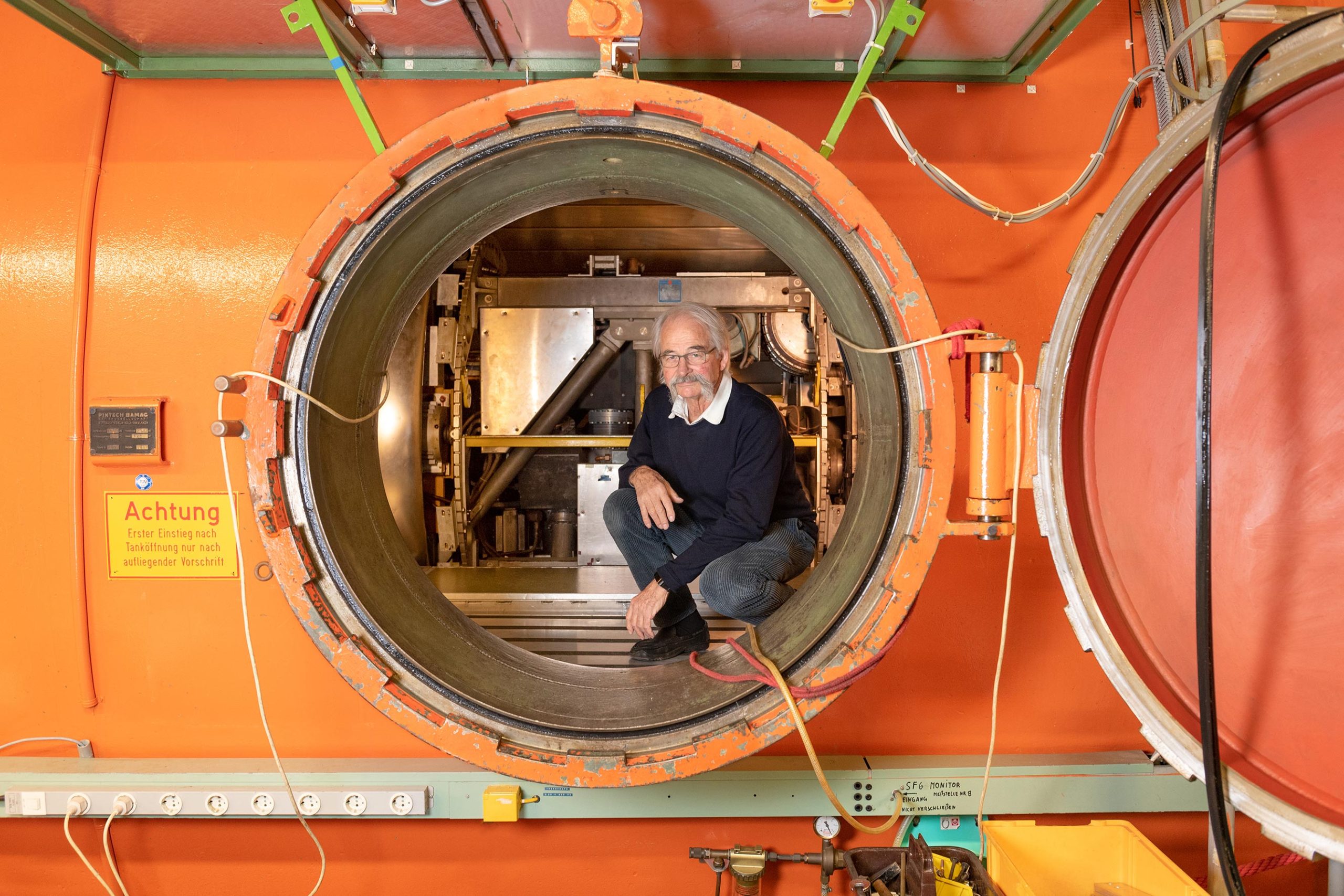
    Dr. Thomas Faestermann in the access hatch of the tandem Van de Graaff accelerator on the Garching research campus. Here, more than ten million volts accelerated lithium ions to about 12 percent the speed of light. Faestermann and his team bombarded a lithium-7 target with these lithium-ions. All measurement results indicate that their experiments produced carbon-10 and the sought-after tetra-neutron. Credit: Uli Benz / TUM

    In their experiments, Faestermann and his team bombarded a lithium-7 target with lithium-7 particles accelerated to about 12 percent of the speed of light. In addition to the tetra-neutron, this should produce carbon-10. And indeed, the physicists succeeded in detecting this species. A repetition confirmed the result.

    Circumstantial Evidence

    The team’s measurement results matched the signature that would be expected from carbon-10 in its first excited state and a tetra-neutron bound by 0.42 megaelectronvolts (MeV). According to the measurements, the tetra-neutron would be roughly as stable as the neutron itself. It would then decay by beta-decay with a half-life of 450 seconds. “For us, this is the only physically plausible explanation of the measured values in all respects,” explains Dr. Thomas Faestermann.
    Roman Gernhäuser
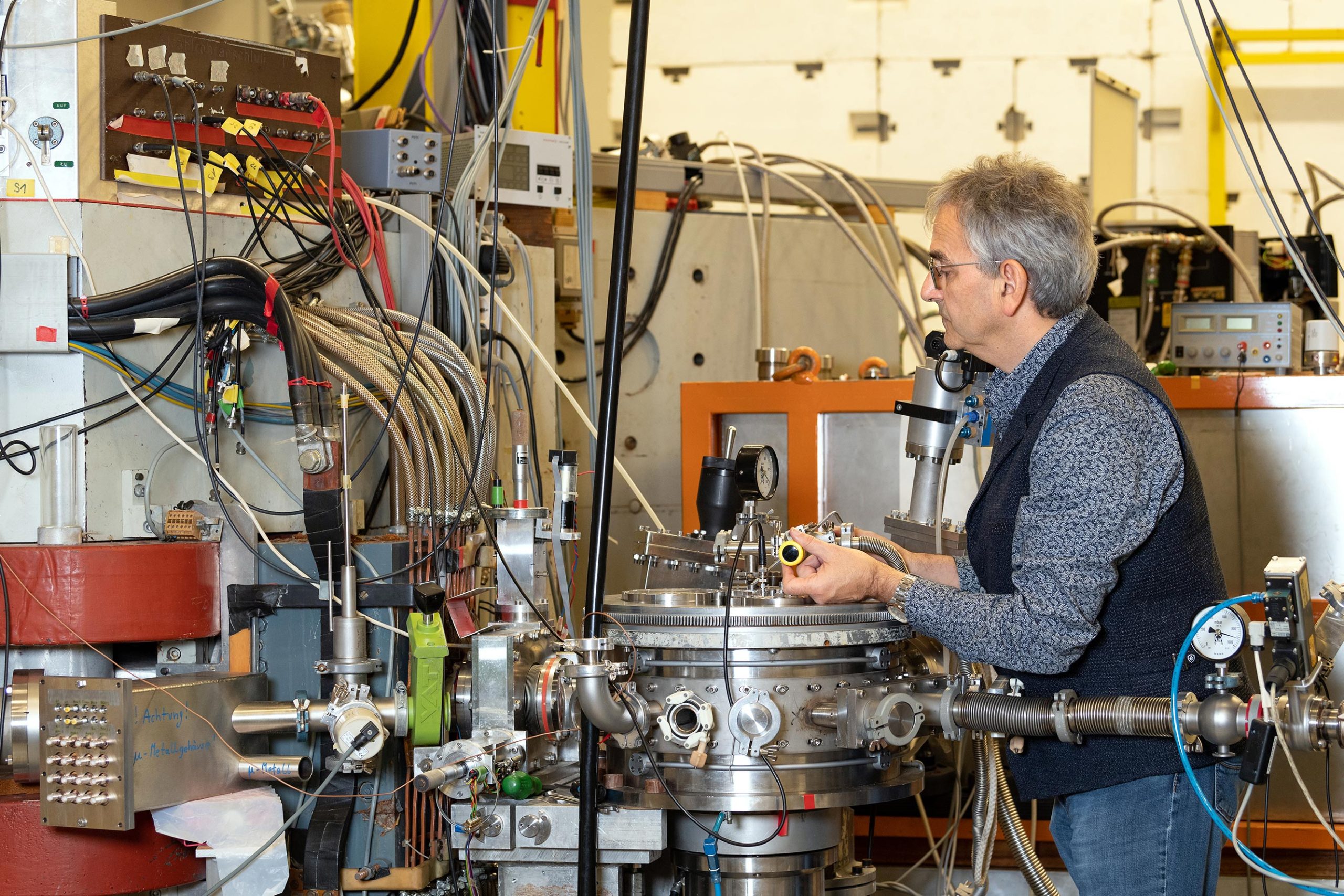
    Dr. Roman Gernhäuser, researcher at the Departmernt of Physics of the Technical University of Munich (TUM), at the target chamber of the tandem Van de Graaff accelerator on the Garching research campus, where lithium ions, accelerated to about 12 percent of the speed of light, hit the lithium-7 target. All measurement results indicate that their experiments produced carbon-10 and the sought-after tetra-neutron. Credit: Uli Benz / TUM

    With their measurements, the team achieves a certainty of well over 99.7 percent, or 3 sigma. But in physics, the existence a particle is only considered conclusively proven once a certainty of 5 sigma is achieved. Thus, the researchers are now eagerly awaiting independent confirmation.

    Reference: “Indications for a bound tetraneutron” by Thomas Faestermann, Andreas Bergmaier, Roman Gernhäuser, Dominik Koll and Mahmoud Mahgoub, 26 November 2021, Physics Letters B.
    DOI: 10.1016/j.physletb.2021.136799

    The Maier-Leibnitz Laboratory, with its tandem Van de Graaf accelerator, was operated jointly by the Technical University of Munich and the Ludwig Maximillian University of Munich. The facility was shut down for structural reasons in early 2020. All five authors of the publication are graduates or employees of the Technical University of Munich.

    Never miss a breakthrough: Join the SciTechDaily newsletter.
    Follow us on Google and Google News.

    Astrophysics Atomic Physics Neutrons Particle Physics Popular Technical University of Munich
    Share. Facebook Twitter Pinterest LinkedIn Email Reddit

    Related Articles

    A Crunching Multiverse To Solve Two Fundamental Physics Puzzles at Once

    Unexpected Substructures in the Fundamental Components of All Matter

    Gravity Might Play a Bigger Role in the Formation of Elementary Particles Than Scientists Thought

    Breakthrough in Nuclear Physics: Strong Interaction Between Stable and Unstable Particles

    Tracking Down the Mystery of the Origin of Matter: Complex Experiment Runs for 2 Years in Search for “New Physics”

    Radar and Ice Could Help Detect Mysterious Subatomic Particles That Pass Right Through Matter

    An Exotic Analysis Technique Places Another Piece in the Dark Matter Puzzle

    Matter Without Antimatter? Closing In on Elusive Particles.

    Black Holes Have Properties That Resemble the Dynamics of Solids and Liquids

    4 Comments

    1. xABBAAA on December 12, 2021 8:28 am

      … “Changed” and even that is changed…

      Reply
    2. Alexiev on December 12, 2021 10:28 am

      Another one for the Department of Redundancy Department. Maybe Neutron Flux has induced a Causal Loop in Neutron Flux…

      Reply
    3. Gordon Stull on December 15, 2021 6:46 pm

      Ever since the Baryon asymmetry problem, conventional wisdoms say, that an orbiting-particle system cannot be any smaller than a atom… I beg to differ!All matter no matter how small or how large is made up of orbiting particle systems… no exception to the rule!

      Reply
    4. xABBAAA on December 21, 2021 7:37 am

      … I guess, now only listening to Rising Appalachia – Harmonize, could potentially balance all of those thingies that jump from all of those equations. And how could those equations be considered correct, after all… all this time…

      Reply
    Leave A Reply Cancel Reply

    • Facebook
    • Twitter
    • Pinterest
    • YouTube

    Don't Miss a Discovery

    Subscribe for the Latest in Science & Tech!

    Trending News

    Scientists Discover How Coffee Impacts Memory, Mood, and Gut Health

    Why Did the Neanderthals Disappear? Scientists Reveal Humans Had a Hidden Advantage

    Physicists Propose Strange Experiment Where Time Goes Quantum

    Magnesium Magic: New Drug Melts Fat Even on a High-Fat, High-Sugar Diet

    Weight-Loss Drugs Like Ozempic May Come With an Unexpected Cost

    Mezcal “Worm” in a Bottle Mystery: DNA Testing Reveals a Surprise

    New Research Reveals That Your Morning Coffee Activates an Ancient Longevity Switch

    This Is What Makes You Irresistible to Mosquitoes

    Follow SciTechDaily
    • Facebook
    • Twitter
    • YouTube
    • Pinterest
    • Newsletter
    • RSS
    SciTech News
    • Biology News
    • Chemistry News
    • Earth News
    • Health News
    • Physics News
    • Science News
    • Space News
    • Technology News
    Recent Posts
    • NASA Fires Up Record-Breaking Plasma Thruster for Future Mars Missions
    • This Popular Supplement May Boost Your Brain, Not Just Your Muscles
    • What Happened in Childhood Could Be Causing Your Gut Issues Today
    • Scientists Say This Simple Supplement May Actually Reverse Heart Disease
    • Scientists Just Captured Killer T Cells in Action Inside Tumors
    Copyright © 1998 - 2026 SciTechDaily. All Rights Reserved.
    • Science News
    • About
    • Contact
    • Editorial Board
    • Privacy Policy
    • Terms of Use

    Type above and press Enter to search. Press Esc to cancel.