
Close Menu
    Facebook X (Twitter) Instagram
    SciTechDaily
    • Biology
    • Chemistry
    • Earth
    • Health
    • Physics
    • Science
    • Space
    • Technology
    Facebook X (Twitter) Pinterest YouTube RSS
    SciTechDaily
    Home»Space»The Auriga Project Helps Uncover the History of the Galaxy
    Space

    The Auriga Project Helps Uncover the History of the Galaxy

    By Royal Astronomical SocietyMay 24, 2017No Comments4 Mins Read
    Facebook Twitter Pinterest Telegram LinkedIn WhatsApp Email Reddit
    Share
    Facebook Twitter LinkedIn Pinterest Telegram Email Reddit
    Biggest Ever Simulations Help Uncover the History of the Galaxy
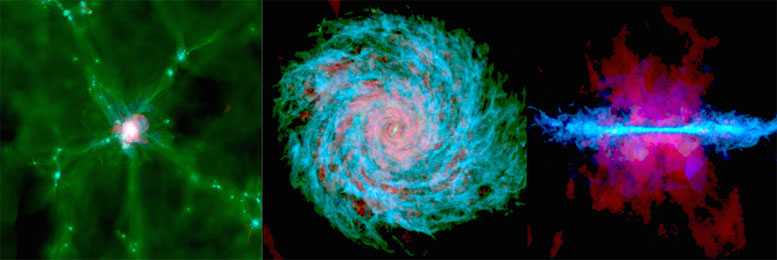
    A composite of images from the simulation. (Left) Projected gas density of the galaxy environment about 10 billion years ago. Depicted are filamentary gas structures that feed the main galaxy at the center. (Middle) Bird’s eye view of the gas disc in the present day. The fine detailed spiral pattern is clearly visible. (Right) Side-on view of the same gas disc in the present day. Cold gas is shown as blue, warm gas as green and hot gas as red. Credit: Robert J. J. Grand, Facundo A. Gomez, Federico Marinacci, Ruediger Pakmor, Volker Springel, David J. R. Campbell, Carlos S. Frenk, Adrian Jenkins and Simon D. M. White.

    Using the Hornet and SuperMUC supercomputers in Germany and a state-of-the-art code, a team of scientists has helped uncover the history of the galaxy.

    Thousands of processors, terabytes of data, and months of computing time have helped a group of researchers in Germany create some of the largest and highest resolution simulations ever made of galaxies like our Milky Way.

    Led by Dr. Robert Grand of the Heidelberger Institut fuer Theoretische Studien, the work of the Auriga Project appears in the journal Monthly Notices of the Royal Astronomical Society.

    Astronomers study our own and other galaxies with telescopes and simulations, in an effort to piece together their structure and history.

    Spiral galaxies like the Milky Way are thought to contain several hundred thousand million stars, as well as copious amounts of gas and dust.

    The spiral shape is commonplace, with a massive black hole at the center, surrounded by a bulge of old stars, and arms winding outwards where relatively young stars like the Sun are found.
    However understanding how systems like our galaxy came into being continues to remain a key question in the history of the cosmos.

    The enormous range of scales (stars, the building blocks of galaxies, are each about one trillion times smaller in mass than the galaxy they make up), as well as the complex physics involved, presents a formidable challenge for any computer model.

    Using the Hornet and SuperMUC supercomputers in Germany and a state-of-the-art code, the team ran 30 simulations at high resolution, and 6 at very high resolution, for several months.
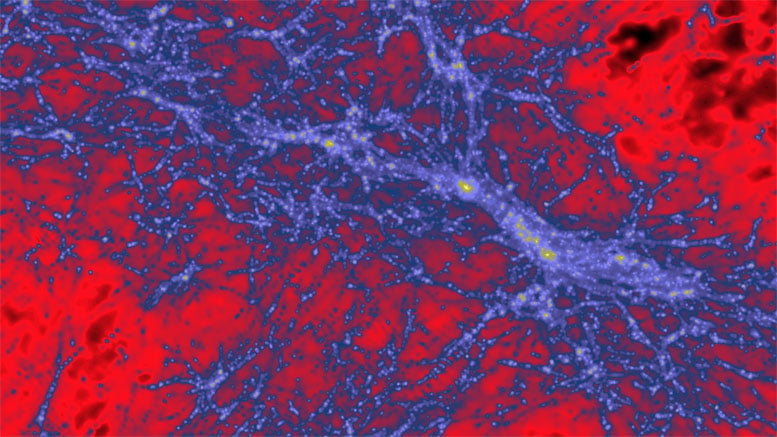
    Dark Matter Density 500 Million Years After the Big Bang
    The dark matter density 500 million years after the Big Bang, centered on what would become the Milky Way. Red, blue and yellow colors indicate low, intermediate and high density regions. Credit: Robert J. J. Grand, Facundo A. Gomez, Federico Marinacci, Ruediger Pakmor, Volker Springel, David J. R. Campbell, Carlos S. Frenk, Adrian Jenkins and Simon D. M. White.

    The code includes one of the most comprehensive physics models to date. It includes phenomena such as gravity, star formation, hydrodynamics of gas, supernova explosions, and for the first time the magnetic fields that permeate the interstellar medium (the gas and dust between the stars).

    Black holes also grew in the simulation, feeding on the gas around them, and releasing energy into the wider galaxy.

    Dr. Grand and his team were delighted by the results of the simulation. “The outcome of the Auriga Project is that astronomers will now be able to use our work to access a wealth of information, such as the properties of the satellite galaxies and the very old stars found in the halo that surrounds the galaxy.”

    The team also see the effect of those smaller galaxies, in some cases spiraling into the larger galaxy early in its history, in a process that could have created large spiral discs.
    Dr. Grand adds: “For a spiral galaxy to grow in size, it needs a substantial supply of fresh star-forming gas around its edges – smaller gas-rich galaxies that spiral gently into ours can provide exactly that.”

    The scientists will now combine the results of the Auriga Project work with data in surveys from observatories like the Gaia mission, to better understand how mergers and collisions shaped galaxies like our own.

    Reference: “The Auriga Project: the properties and formation mechanisms of disc galaxies across cosmic time” by Robert J. J. Grand, Facundo A. Gómez, Federico Marinacci, Rüdiger Pakmor, Volker Springel, David J. R. Campbell, Carlos S. Frenk, Adrian Jenkins and Simon D. M. White, 12 January 2017, MNRAS.
    DOI: 10.1093/mnras/stx071

    Never miss a breakthrough: Join the SciTechDaily newsletter.
    Follow us on Google and Google News.

    Astronomy Astrophysics Cosmology Galaxy Evolution Royal Astronomical Society
    Share. Facebook Twitter Pinterest LinkedIn Email Reddit

    Related Articles

    Astronomers Measure How A Galaxy’s Spin Affects Its Shape

    Interactions between Cold Dark Matter and Radiation Leads to a Dramatic Reduction in Satellite Galaxies

    Dark Energy Survey Reveals a Rare Superluminous Supernova

    New Research Shows Early Galaxies Grew Massive Through Collisions

    Simulations Shed Light on the Formation of Stars in the Earliest Galaxies

    Uniform Heavy Element Distribution Points to Early Cosmic ‘Seeding’

    Study Suggest Spiral Galaxies Are Larger Than Previously Thought

    New Planck Data Challenges Our Understanding of the Universe

    New Model May Rule Out the Presence of Dark Matter

    Leave A Reply Cancel Reply

    • Facebook
    • Twitter
    • Pinterest
    • YouTube

    Don't Miss a Discovery

    Subscribe for the Latest in Science & Tech!

    Trending News

    Popular Sugar-Free Sweetener Linked to Liver Disease, Study Warns

    What Is Hantavirus? The Deadly Disease Raising Alarm Worldwide

    Scientists Just Discovered How the Universe Builds Monster Black Holes

    Scientists Unveil New Treatment Strategy That Could Outsmart Cancer

    A Simple Vitamin May Hold the Key to Treating Rare Genetic Diseases

    Scientists Think the Real Fountain of Youth May Be Hiding in Your Gut

    Ravens Don’t Follow Wolves, They Predict Them

    This Common Knee Surgery May Be Doing More Harm Than Good

    Follow SciTechDaily
    • Facebook
    • Twitter
    • YouTube
    • Pinterest
    • Newsletter
    • RSS
    SciTech News
    • Biology News
    • Chemistry News
    • Earth News
    • Health News
    • Physics News
    • Science News
    • Space News
    • Technology News
    Recent Posts
    • Why Are So Many New Fathers Dying? Scientists Say the U.S. Has a Dangerous Blind Spot
    • Scientists Identify Simple Supplement That Greatly Reduces Alzheimer’s Damage
    • You May Have a Dangerous Type of Cholesterol Even if Your Tests Look Normal
    • Study Reveals Dangerous Flaw in AI Symptom Checkers
    • New MRI Breakthrough Captures Stunningly Clear Images of the Eye and Brain
    Copyright © 1998 - 2026 SciTechDaily. All Rights Reserved.
    • Science News
    • About
    • Contact
    • Editorial Board
    • Privacy Policy
    • Terms of Use

    Type above and press Enter to search. Press Esc to cancel.