
Close Menu
    Facebook X (Twitter) Instagram
    SciTechDaily
    • Biology
    • Chemistry
    • Earth
    • Health
    • Physics
    • Science
    • Space
    • Technology
    Facebook X (Twitter) Pinterest YouTube RSS
    SciTechDaily
    Home»Space»Astronomers Measure How A Galaxy’s Spin Affects Its Shape
    Space

    Astronomers Measure How A Galaxy’s Spin Affects Its Shape

    By Royal Astronomical SocietySeptember 12, 2017No Comments3 Mins Read
    Facebook Twitter Pinterest Telegram LinkedIn WhatsApp Email Reddit
    Share
    Facebook Twitter LinkedIn Pinterest Telegram Email Reddit
    Rotation Speed Helps Reveal Galaxy Shapes
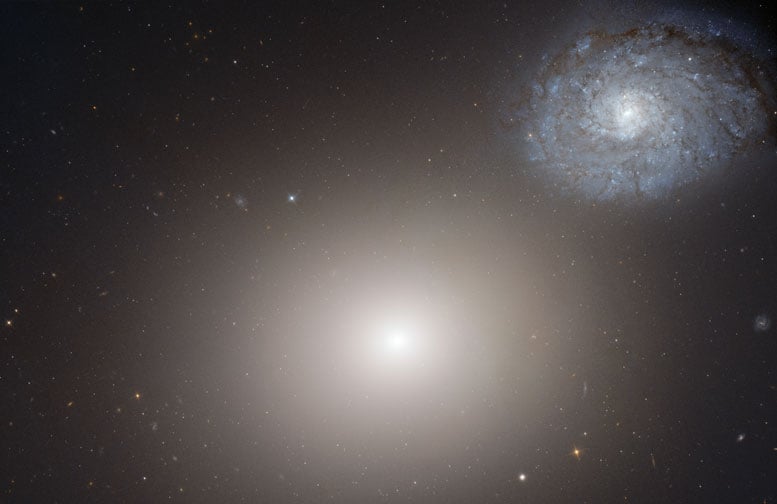
    The giant elliptical galaxy M60 and smaller spiral galaxy, NGC 4647, located in the constellation Virgo. From our vantage point both galaxies look round but they have intrinsically different shapes. Credit: NASA, ESA, and the Hubble Heritage (STScI/AURA)–ESA/Hubble Collaboration

    In a newly published study, a team of astronomers measures how a galaxy’s spin affects its shape.

    It sounds simple, but measuring a galaxy’s true 3D shape is a tricky problem that astronomers first tried to solve 90 years ago. However, for the first time astronomers have measured how a galaxy’s spin affects its shape, in new research published in the journal Monthly Notices of the Royal Astronomical Society.

    “This is the first time we’ve been able to reliably measure how a galaxy’s shape depends on any of its other properties – in this case, its rotation speed,” said research team leader Dr. Caroline Foster of the University of Sydney.

    Galaxies can be shaped like a pancake, a sea urchin or a football, or anything in between. Faster-spinning galaxies are flatter than their slower-spinning siblings, the team found.

    “And among spiral galaxies, which have discs of stars, the faster-spinning ones have more circular discs,” said team member Prof Scott Croom of the University of Sydney.

    The team made its findings with SAMI (the Sydney-AAO Multi-object Integral field unit), an instrument jointly developed by The University of Sydney and the Australian Astronomical Observatory with funding from CAASTRO, the ARC Center of Excellence for All-sky Astrophysics.

    SAMI gives detailed information about the movement of gas and stars inside galaxies. It can examine 13 galaxies at a time and so collect data on huge numbers of them.

    Dr. Foster’s team used a sample of 845 galaxies, over three times more than the biggest previous study. This large number was the key to solving the shape problem.

    Because a galaxy’s shape is the result of past events such as merging with other galaxies, knowing its shape also tells us about the galaxy’s history.

    Reference: “The SAMI Galaxy Survey: the intrinsic shape of kinematically selected galaxies” by C. Foster, J. van de Sande, F. D’Eugenio, L. Cortese, R. M. McDermid, J. Bland-Hawthorn, S. Brough, J. Bryant, S. M. Croom, M. Goodwin, I. S. Konstantopoulos, J. Lawrence, Á. R. López-Sánchez, A. M. Medling, M. S. Owers, S. N. Richards, N. Scott, D. S. Taranu, C. Tonini and T. Zafar, 8 September 2017, Monthly Notices of the Royal Astronomical Society.
    DOI: 10.1093/mnras/stx1869

    Never miss a breakthrough: Join the SciTechDaily newsletter.
    Follow us on Google and Google News.

    Astronomy Astrophysics Cosmology Galaxy Evolution Royal Astronomical Society
    Share. Facebook Twitter Pinterest LinkedIn Email Reddit

    Related Articles

    The Auriga Project Helps Uncover the History of the Galaxy

    Interactions between Cold Dark Matter and Radiation Leads to a Dramatic Reduction in Satellite Galaxies

    Dark Energy Survey Reveals a Rare Superluminous Supernova

    New Research Shows Early Galaxies Grew Massive Through Collisions

    Simulations Shed Light on the Formation of Stars in the Earliest Galaxies

    Uniform Heavy Element Distribution Points to Early Cosmic ‘Seeding’

    Study Suggest Spiral Galaxies Are Larger Than Previously Thought

    New Planck Data Challenges Our Understanding of the Universe

    New Model May Rule Out the Presence of Dark Matter

    Leave A Reply Cancel Reply

    • Facebook
    • Twitter
    • Pinterest
    • YouTube

    Don't Miss a Discovery

    Subscribe for the Latest in Science & Tech!

    Trending News

    Could Low Vitamin D Be Making Your Pain Worse?

    Scientists Discover Once-Weekly Workout That Melts Belly Fat Surprisingly Effectively

    Scientists Just Tested a Thruster Powerful Enough for Human Missions to Mars

    Doctors Say Your Ice Pack Might Be Making Injuries Worse

    Scientists Discover 43-Foot Sea Reptile Twice the Size of a Great White Shark

    Bees and Birds Are Drinking Alcohol From Flowers

    Scientists Discover How Obesity May Trigger Alzheimer’s Disease

    Scientists Confirm Alcohol Causes Widespread Health Damage

    Follow SciTechDaily
    • Facebook
    • Twitter
    • YouTube
    • Pinterest
    • Newsletter
    • RSS
    SciTech News
    • Biology News
    • Chemistry News
    • Earth News
    • Health News
    • Physics News
    • Science News
    • Space News
    • Technology News
    Recent Posts
    • Simple Family Routines May Be the Secret to a Smoother Start at School
    • Brain Study Overturns Long-Held Beliefs About How Humans Learn Speech
    • Ancient Goose Fossil Challenges Long-Held Theories About New Zealand Birds
    • A Tiny Bright-Blue Octopus Found in the Galápagos Is Completely New to Science
    • Scientists Stop Pancreatic Cancer Before It Starts in Landmark Preclinical Study
    Copyright © 1998 - 2026 SciTechDaily. All Rights Reserved.
    • Science News
    • About
    • Contact
    • Editorial Board
    • Privacy Policy
    • Terms of Use

    Type above and press Enter to search. Press Esc to cancel.